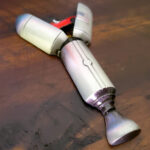
An event challenge coin marks something that happened rather than a unit, a company or a rank. When the event has no emblem of its own, and most do not, the design is built from the object at the centre of it, the moment it happened, or the single image everyone already carries in their head.
What Do You Put on a Coin When There Is No Logo?
Most coins start with something. A unit crest, a company logo, a badge, a lodge number, a branch tradition that says roughly what the coin should look like before anyone draws a line.
An event usually has none of that. A first, a milestone, a one-off launch, a project team assembled for eighteen months, an anniversary of something nobody expected to repeat. There is no insignia, no precedent and no previous coin to build on, and the instinct is to reach for the organisation’s logo and put it in the middle. That is almost always the weakest available answer, because the logo describes who was there rather than what happened.
Four approaches work better.
Use the object. If there is a piece of hardware, a vehicle, a building or a tool at the centre of the event, that is your design. It is specific, it is instantly recognisable to everyone who was involved, and it needs no explanation. A rocket, a fire engine, a bridge, a ship, a printing press.
Use the moment. Not the object at rest but the object doing the thing. This is the strongest option when it is available, and it is covered in the next section.
Use the image everyone already has. Every memorable event produces one picture that everybody who followed it holds in their memory. For this mission it was a red car floating against black space. If that image exists, use it and do not improve on it, because its power is that it is already familiar.
Resist adding an emblem for the sake of it. Coins usually have a crest, so there is pressure to add one. A coin about an event does not need a badge in the corner to be legitimate, and an invented emblem for a one-off occasion tends to look like a placeholder. Blank metal around a strong central image is a finished design.
For the wider category, see our commemorative challenge coins and event challenge coins.
Designing a Moment Rather Than a Thing
There is a real difference between a coin shaped like a rocket and a coin shaped like a rocket at one particular second.
This coin is the second kind. It is not a Falcon Heavy. It is a Falcon Heavy with the fairing open and the payload leaving, which is an event frozen in metal rather than an object reproduced in it. The whole mission is in the shape.
That is a harder design problem than it looks, and it has two requirements.
The shape has to read as mid-action rather than broken. An open fairing, a raised barrier, a cut ribbon and a lowered ramp all carry the same risk: at coin scale, a thing in a non-resting position can simply look damaged. The way through it is usually to keep the two halves visually connected and symmetrical, so the eye reads the gap as deliberate. A shape that is open on one side and closed on the other reads as an accident.
The viewer has to recognise the instant without being told. A coin has no caption, so the moment has to be one that people already picture. If the audience has to be talked through what they are looking at, the design has failed even if the engineering is beautiful.
Where else this works: a ship at the moment of launch, the first shovel going into ground, a ribbon mid-cut, landing gear touching down, a bell being struck. Where it does not work: anything whose significance is administrative rather than visual. A contract award has no moment, and a coin that tries to invent one will look strange.
Rocket shapes in general are covered on our page about aerospace and rocket coin design, and mission-specific pieces on our page about mission commemorative coins.
When One Colour Is Enough
The finish on this coin is brushed silver throughout, with a single bright red on the car. That is the entire palette.
It works because of what colour does on a coin. Enamel separates elements and tells the eye where to look, which means every colour you add competes with every other one for that job. A coin with six colours has no focal point, because everything is shouting at once. A coin with one colour has exactly one, and the eye goes straight to it before it registers anything else.
Here the red car is the story. Everything else, the rocket, the fairing, the structure, is context, and context belongs in bare metal. Brushed silver also does something enamel cannot. It holds the light differently as the coin turns, so a monochrome field stays interesting in the hand rather than going flat.
The practical version of this principle applies to almost any design. Decide what a person should see first, colour that, and leave the rest in metal. If two things are competing to be seen first, the design is not finished yet. The same approach on a very different kind of coin is covered on our page about using colour sparingly on a coin.
About This Car in Space Coin
SpaceX is an American spacecraft manufacturer and launch provider headquartered in Hawthorne, California. Its Falcon Heavy test flight carried an unusual payload: a cherry-red Tesla Roadster owned by Elon Musk, with a spacesuit-clad mannequin named Starman in the driver’s seat.
SpaceX ordered a coin to commemorate the launch, and asked for the shape to do the work. The coin is cut to the outline of the Falcon Heavy with the fairing open, at the moment the payload is released. The rocket is finished in brushed silver and the car is picked out in bright red. There is no border, no legend ring and no company mark competing with the shape.
What makes it effective is that the design carries no text load at all. The event is legible from the silhouette alone, which is the ideal outcome for an event coin and is only possible when the moment is famous enough to be recognised cold. Most projects cannot do this, which is why most event coins carry a date or a name somewhere on them. This one did not need to.
It is also a useful example of a custom shape earning its cost. Custom shaping is worth paying for when the outline carries meaning a round coin could not. Here it carries the entire concept. On a design where the shape is decorative rather than meaningful, the money is usually better spent on size or plating.
Can We Use a Company Logo on a Coin?
Most companies can, but the authorisation has to come from the company, not from us. Logos, wordmarks, product names and brand imagery are controlled by the organisations that own them, and internal teams are not always the ones who can approve their use.
The practical version is straightforward. Clear the artwork through whoever owns the brand before you order, and send us artwork your organisation is authorised to supply. We produce from what the customer provides and we do not grant permission on anyone’s behalf. If you are unsure who signs off, your marketing or legal team is usually the right place to ask.
Design a Coin for Your Event
You do not need an emblem and you do not need artwork. For a one-off event most customers have neither, which is exactly the situation this page is about. Tell us what happened, send a photograph of the object or the moment if one exists, and a designer will draw something at no cost with unlimited revisions. Nothing goes into production until you approve a digital proof.
The minimum order is 50 coins. Standard production runs about 45 to 50 days after final artwork approval, rush production is available on many projects, and shipping within the continental United States is included. Embleholics is veteran-owned, SDVOSB and registered in SAM.gov. If the coin is for a dated event, say the date at first contact.
Frequently Asked Questions
What is an event challenge coin?
An event challenge coin is a custom coin made to mark a specific occasion rather than a unit, rank or organisation. Launches, openings, anniversaries, conventions, milestones and one-off projects are all common subjects, and the design is usually built around the event itself rather than around a crest.
Can you make a coin if we have no logo or emblem?
Yes. Most event coins are made for occasions that have no insignia of their own. The design can be built from the object at the centre of the event, the moment it happened, or the image people most associate with it. Professional artwork is included at no cost with unlimited revisions.
What goes on a coin commemorating a one-off event?
A one-off event coin usually carries the object or moment at the centre of the event, a date, and a short line naming the occasion. An organisation’s logo is optional and often unnecessary, because a strong central image identifies the event more clearly than a crest does.
Can a coin be shaped like a specific object?
Yes. Custom shapes are cut to an outline you provide or that is drawn during design, and a shape is worth the cost when the outline itself carries meaning. Rockets, vehicles, buildings, tools, badges and state outlines are all common custom shapes.
Can a coin show something in motion?
Yes, and a coin showing an object mid-action is often stronger than one showing it at rest. The two requirements are that the shape reads as deliberate rather than broken, usually through symmetry, and that the moment is familiar enough for viewers to recognise it without a caption.
How much colour does a coin need?
Often just one. Colour tells the eye where to look, so each additional colour competes for that job and a heavily coloured coin ends up with no focal point. Choosing the single element that carries the story and colouring only that, against bare or brushed metal, is usually the stronger design.
Can we use a company logo on a challenge coin?
Company logos and brand imagery are controlled by the companies that own them, so permission has to come from the company rather than from a manufacturer. Clear the artwork internally before ordering and send us artwork your organisation is authorised to supply.
What is the minimum order for event coins?
The minimum order for custom challenge coins is 50 coins. For an event, that figure usually covers the team involved plus a reserve for guests and later requests, and larger quantities reduce the cost per coin.
More Space Force Projects