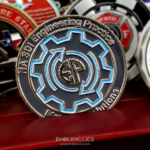
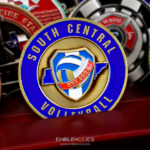
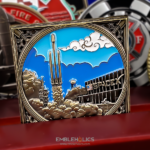
Simple, contemporary and elegant, with both faces carrying the organization’s logos. The interest comes from the finish rather than the artwork: glossy solid paint on some surfaces, and a brushed effect on the patterned areas to add depth. This Texas fabrication team coin was made for Fabrication X Texas Support at McGregor, the on-site manufacturing and metal shop behind rocket engine testing.
Mixing Gloss and Brushed on One Coin
Two finishes on a single face is the most economical way to add depth to a design that has no sculpting in it.
They catch light differently. Gloss reflects in one direction and brushed metal scatters. Side by side, the two surfaces separate as clearly as two colors would, and the separation changes as the coin is turned.
It creates layers without relief. A flat design can feel like a sticker on metal. Varying the surface treatment gives the eye something to read as foreground and background, which is depth without any change in height.
Patterned areas benefit most. A brushed texture over a pattern makes the pattern read as a material rather than as a graphic, which is the difference between a logo printed on metal and a logo that looks like it belongs there.
And it costs less than sculpting. Finish variation is a plating and surfacing decision rather than a die decision, so it is a cheaper route to visual interest than 3D relief.
The requirement is a clear boundary. Two finishes meeting on a vague line looks like an error rather than a choice, so the artwork has to specify exactly where each treatment starts and stops.
See antique vs polished finishes and plating and finish options.
Coins for Fabrication and Manufacturing Teams
A metal shop is an unusually fitting coin client, and the reasons are more than thematic.
They understand what they are holding. A fabrication team knows machining, tolerances, surface finish and tooling. They are the one audience that will examine a coin as a manufactured object, which raises the bar and also means good work is actually noticed.
The work is behind the scenes. A support shop builds the fixtures, stands and hardware that let the visible work happen. The output is somebody else’s test, somebody else’s launch, and recognition for that has to be generated internally.
The team is the right size. A site support shop is a defined group, usually comfortably inside a 50 piece order, where a company-wide coin would be a far larger undertaking.
And a coin is the same kind of object they produce. Cut metal, finished to a spec, made to last. There is a closer relationship between the gift and the work here than in almost any other industry.
See also corporate challenge coins.
On-Site Support at an Engine Test Facility
The McGregor site in Texas is where rocket engines are tested, and an on-site fabrication and metal shop exists because test programs cannot wait for parts. For engines tested there, see our SpaceX SN1100 and SpaceX Merlin Engine Coin.
That is the thing worth saying about this kind of team. A test campaign generates unplanned requirements constantly: a bracket that does not exist, a fixture that needs modifying, a stand that has to be rebuilt between runs. An external vendor works in weeks and an on-site shop works in hours, and that difference is the entire reason the shop is there.
It also means the work is almost entirely one-off. A production line makes the same thing repeatedly and gets better at it. A support shop makes something different every day, to a drawing that may have been sketched that morning, and has to get it right the first time because there is no second part.
A coin suits that pattern. There is no product launch to celebrate and no shipment to mark, just a continuous run of problems solved, which is exactly the situation where an organization needs an object to hand over rather than a milestone.
Keeping a Corporate Coin Simple
The brief here was simple, contemporary and elegant, and that combination has specific requirements when the content is company logos.
Resist filling the space. A corporate coin tends to accumulate: a logo, a tagline, a site name, a year, a safety slogan. Each addition is defensible and the total is a cluttered face. Decide what the coin is for and leave the rest off.
Logos need room, not size. A mark surrounded by clear space reads better than a larger one crowded to the rim. Negative space is the main thing separating an elegant coin from a busy one.
Let the finish carry the interest. When artwork is restrained, surface treatment is where the character comes from. That is what this coin does, and it is the reliable approach for any design whose content is a logo and little else.
And avoid dating it unnecessarily. A team coin with no year on it stays issuable to new hires indefinitely, which is usually what a support organization actually wants.
Order a Team or Corporate Coin
Professional artwork is free with unlimited revisions, and nothing goes into production until you approve a digital proof. The challenge coin minimum is 50 pieces, standard production runs about 45 to 50 days after final artwork approval, rush production is available on many projects, and shipping within the continental United States is included. Embleholics is veteran-owned, SDVOSB and registered in SAM.gov.
Two suggestions for a team coin. Specify exactly where each finish starts and stops in the artwork, because two surface treatments meeting on an imprecise line reads as a defect rather than a decision. And leave the year off unless the coin marks a specific event, so new members can receive the same piece years later. Request a free quote to begin.
Coin Back
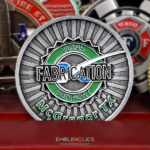
Coin Front

Frequently Asked Questions
Can a coin use two different finishes?
Yes. Glossy and brushed surfaces catch light differently, so they separate as clearly as two colors while the coin stays metallic. The boundary between them has to be specified precisely in the artwork.
How does finish variation create depth without sculpting?
By giving the eye something to read as foreground and background. A flat design can look like a sticker on metal, while varied surface treatment layers it without any change in height.
Is a mixed finish cheaper than 3D relief?
Usually. Finish variation is a plating and surfacing decision rather than a die decision, so it adds visual interest at lower cost than sculpted relief.
Why do fabrication teams make good coin clients?
Because they understand the object. A machine shop knows tolerances, tooling and surface finish, so they examine a coin as a manufactured item, which means careful work is genuinely noticed.
Why does a support shop need a coin?
Because the output is always somebody else’s success. There is no product launch or shipment to mark, just a continuous run of problems solved, which is exactly when recognition has to be generated internally.
What does an on-site fabrication shop do at a test facility?
It makes the brackets, fixtures and stands a test campaign needs on short notice. An external vendor works in weeks and an on-site shop works in hours, which is why the shop exists.
How do you keep a corporate coin from getting cluttered?
Decide what the coin is for and leave the rest off. Logos, taglines, site names, years and slogans each seem defensible individually and together produce a crowded face.
Should a company team coin carry the year?
Only if it marks a specific event. An undated coin can be given to new members indefinitely, which is usually what a continuing team wants.
More Corporate Projects