An engineering or production milestone coin is a custom challenge coin commissioned by a company or team to mark a manufacturing achievement, such as a build-rate record, a first article or a program completion, and given to the people who did the work.
Why Engineering and Production Teams Commission Challenge Coins
The challenge coin came out of the military, where it has been used for decades to recognize people who did something well. It has moved into industry for a straightforward reason: it solves a problem most corporate recognition does not.
A coin recognizes a team. Employee-of-the-month schemes single one person out of a group of forty who all did the work, and everyone in that group knows it. A coin struck for a program goes to everyone who was on it, the engineers, the line, the quality group, the test team, the people on nights. Nobody has to be chosen over anyone else.
It also survives. Plaques stay on a wall until the office is refitted. Certificates go in a drawer. Coins stay in pockets and on desks, and they turn up years later in the hands of people who left the company and kept theirs.
Cost is the other reason. Against a program budget, coins for an entire production team round to nothing. Very few forms of recognition cost so little and land so well with people who build physical things for a living, because an object with weight, made properly, is a language they already speak.
Manufacturing Milestones Worth Marking with a Coin
If you are justifying an order internally, it helps to name the milestone precisely. The ones that come up most often:
- Build-rate and throughput records. The month the line hit a number it had never hit before.
- First article completion. The first unit off a new line or a new design, usually the hardest one the team will ever build.
- Unit number milestones. The hundredth, the five hundredth, the thousandth.
- Program or contract completion. The end of a multi-year effort, marked before the team disperses onto other work.
- Safety hour records. A year, or five, without a lost-time incident.
- Zero-defect runs. A quality achievement that rarely gets recognized at all, because nothing visibly happened.
- Line or facility launches. A new plant, a new cell, a new capability coming online.
- Plant anniversaries. Twenty-five or fifty years of a site that people’s parents worked at.
- Shift and crew recognition. Coins struck for a specific crew, often with the shift or cell number on the reverse.
Any of these can carry a date, a unit count or a line designation, which is usually what turns a generic coin into one people keep.
Designing a Coin Without Color: Brushed Metal and Relief
A monochrome coin is harder to produce well than a colored one, which is the opposite of what most people assume.
On a colored coin, enamel does a lot of the work. Color separates the elements, hides a shallow cut and draws the eye to the parts of the design that read cleanly. Take the color away and the engraving carries the whole design on its own. Every line depth, every radius and every transition between raised and recessed metal is visible, because there is nothing else to look at.
What replaces color is light. An embossed relief standing above a brushed field catches light on its raised surfaces while the brushed background scatters it. The contrast is real and it shifts as the coin moves in the hand, which is why a good monochrome coin looks better in person than in a photograph.
Bronze, brass, copper, nickel and antique finishes all behave differently under that treatment, and the choice matters more on a coin with no color to fall back on. The plating and finish options on a gold coin cover how each finish reads against relief, and the same logic applies in reverse here.
For an engineering audience, restraint is the argument. A coin with no color and precise relief reads as a machined object rather than a promotional item. It looks like the things the team already makes.
Finished Coin (Front)
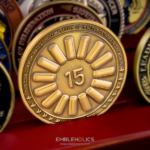
Embossed relief of 15 rocket second stages arranged in a clean, precise circular layout, symbolizing engineering excellence.
Finished Coin (Back)
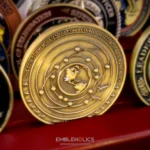
About This SpaceX Second Stages Coin
The brief was for something elegant and modern but clean, with the graphical elements drawn from the hardware itself rather than decorated around it.
The coin is brushed bronze with no color anywhere on either face. The front carries an embossed relief of fifteen rocket second stages arranged in a circular layout. The reverse carries an embossed relief of the earth with engraved lettering. Nothing is enameled, nothing is plated bright, and the entire design lives in the metal.
What it marks is a production milestone: fifteen orbital second stages completed in a single month, in June 2024. That distinction is worth being precise about, because second stages are expendable hardware. One is built and consumed on every flight, so a monthly completion figure is a statement about a factory rather than a launch manifest. Fifteen stages finished in June is a build rate, and the coin was made for the group that hit it.
The design follows from that. A launch coin would probably have carried color and a mission patch. A production coin marking a rate record belongs in brushed metal, because the people receiving it spend their working lives around brushed metal. Building it that way meant every graphical element and every letter had to be drawn and cut correctly, since the accuracy of the lines and the depth of the engraving are the only things carrying the piece.
Embleholics is not an official SpaceX vendor, partner or licensee, and this coin was produced from artwork supplied and approved by the customer. Other approaches to the same kind of work appear on aerospace and mission commemorative coins, the Starbase test campaign coin, engineering practice coins and defense engineering coins.
Can We Use a Company Logo on a Coin?
Company names, logos and marks are protected. Using one on a coin requires authorization from the brand owner, and the customer is responsible for holding those rights.
In practice this is rarely an obstacle. Most corporate coins are commissioned by a team inside the company that owns the mark, and internal approval is a matter of routing artwork through the brand or communications group before production. It is worth doing early rather than at proof stage, because a change after artwork approval can mean new tooling.
We work from artwork the customer is authorized to supply, as set out in sections 15 and 16 of the terms and conditions, and we will raise it if a design appears to include a mark the customer may not control. Competitors tend to avoid this conversation. It is short, it protects both sides, and it is a better position than finding out late. The same applies across corporate challenge coins generally.
Design a Coin for Your Team
Artwork is free and revisions are unlimited. You will see a proof before anything is struck, and nothing enters production until you have approved it. If you are marking a production milestone and are unsure what belongs on the coin, tell us what the team achieved and we will come back with options, because the unit number, the date, the line or cell designation and the shift are all common reverse-side elements.
Orders start at 50 coins, shipping within the continental United States is included, and rush production is available if you are working to a date. A 20 percent deposit starts production and typical production time is around 45 to 50 days, so plan backward from when the team needs coins in hand. Molds and dies are free on qualifying orders and retained for up to five years, so a second run for the next milestone does not start from scratch.
Embleholics is veteran-owned, based in Port Orchard, Washington, and registered in SAM as a Service-Disabled Veteran-Owned Small Business under UEI F3AGRUW5RT53, which matters if the order runs through a government or prime contractor purchasing process. Send your idea, sketch or finished artwork and you will hear back within 24 hours. Contact us now for a free quote.
Frequently Asked Questions
What is an engineering challenge coin?
An engineering challenge coin is a custom coin commissioned by an engineering or manufacturing organization to mark a technical achievement or program milestone. It is given to the team that did the work rather than awarded to an individual.
Why do manufacturing and production teams give challenge coins?
A coin recognizes an entire team rather than singling one person out, costs very little against a program budget, and stays with people long after a certificate or plaque is forgotten. It also suits an audience that works with physical objects.
What milestones are worth marking with a coin?
Build-rate records, first article completion, unit number milestones, program or contract completion, safety hour records, zero-defect runs, new line or facility launches, plant anniversaries, and recognition of a specific shift or crew.
What is a brushed or monochrome challenge coin?
A monochrome coin uses no enamel or paint. The entire design is carried in the metal, with an embossed relief standing above a brushed background so that light rather than color creates the contrast.
What is the difference between embossed and engraved detail on a coin?
Embossed detail is raised above the surface of the coin. Engraved detail is cut into it. Many designs use both, with a raised relief as the main element and engraved lettering around it.
Can a challenge coin be made without any color?
Yes, and it is a common choice for engineering and corporate coins. A coin without color depends entirely on the quality of the relief and the finish, which is why the artwork and die work matter more on a monochrome design.
Do you make coins for a whole production team or shift?
Yes. Team-wide coins are one of the most common corporate orders, and orders start at 50 coins. Designs are often varied slightly by shift or cell, usually on the reverse, so each group has something specific to them.
Can we put our company logo on a challenge coin?
Only with authorization from the brand owner. Most corporate teams clear the design internally through their brand or communications group. We work from artwork the customer is authorized to supply.
More Corporate Projects