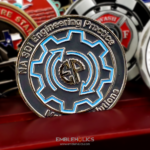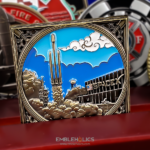
The Super Crusher is a structural test stand at SpaceX’s Starbase site, where full-scale rocket sections are filled with cryogenic propellant and loaded until engineers find their limits. A test team challenge coin marks the end of a campaign like that, given to the people who ran it.
What Is the Super Crusher?
The Super Crusher is a structural test stand at Massey’s, the test site at SpaceX’s Starbase facility in Boca Chica, Texas. Its job is to break things on purpose, or at least to find out exactly how much it takes to break them.
A test article is placed on the stand and a cap is fitted over the top. Straps connect that cap to hydraulic pistons in the base, which pull downward to reproduce the axial loads a stage carries in flight. Rams push upward against the engine mounts at the same time, simulating thrust. The article is filled with cryogenic propellant while all of this happens, because metal behaves differently at those temperatures and testing it warm would prove nothing.
The stand takes its name from its predecessor. The earlier structural fixture at the site was called the Can Crusher, and it worked on the same principle at smaller scale. The Super Crusher handles full-size sections.
The reason the work happens on the ground is simple. Simulation and subscale testing narrow the possibilities but they cannot settle the question. The only way to know a full-scale stage survives launch loads is to load one until it does not, and then look at where it went.
What Is Massey’s Test Site?
Massey Outpost, usually shortened to Massey’s, sits at the southwest end of the Starbase site. It handles cryogenic proof testing for Starship and Super Heavy hardware, structural testing on the stands, and static fire testing.
Keeping it separate from the launch site is deliberate. Cryogenic proofing and structural testing tie up a facility for long periods and carry their own hazards, and running them at the launch pad would mean choosing between testing and flying. A dedicated site lets both continue at once.
The site was formerly a gun shop and range before SpaceX acquired it and rebuilt it as a test facility.
Why Test Teams Commission Challenge Coins
Test campaigns are among the most overlooked pieces of work in engineering, and the reason is structural rather than unfair.
A launch is visible. It has a date, a countdown, an audience and coverage. A test campaign has none of that. It runs for months inside a fence, and the milestone at the end of it is a data package confirming that a structure behaves as predicted. Nobody outside the program sees it happen, and by the time the hardware flies, the test campaign that made the flight possible is several steps back in the story.
That is exactly why a coin lands with this audience. It is often the only tangible thing marking a campaign that consumed a year of people’s working lives, and the team knows precisely what it represents even though nobody else does.
Test campaigns also suit coins structurally. They have a defined beginning and a defined end, which is more than most engineering work offers. There is a clear moment when the thing is finished and the team disperses onto the next article.
The audience runs well beyond space. Ground test teams, structural and cryogenic test crews, engine test groups, environmental and vibration labs, and the facilities teams who keep stands running all work the same way, across aerospace, defense, automotive and heavy industry. Related work sits alongside this in the gallery, including engineering practice coins and defense contractor coins.
What Milestones Do Test Programs Mark?
The occasions are more specific than most people outside testing expect:
- Campaign completion. The end of a defined test series, usually the most common reason a coin is ordered.
- Qualification passed. The article met the requirement and the design is cleared.
- First test on a new stand. The stand itself is a build project, and the first article on it is a milestone for the people who built it.
- A stand entering service. Marked by the facilities and construction teams rather than the test crew.
- Test article retirement. A single article often survives dozens of cycles before it is finished with.
- A record number of cycles. The count itself becomes the milestone.
- End of a long program. Marked before the team is reassigned.
Where the milestone is a factory output figure rather than a test event, production and manufacturing milestone coins are the closer fit. Where it is a flight, aerospace and mission commemorative coins cover that end of the sequence. Build, test, fly, and a different coin at each stage.
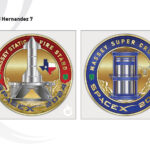
SpaceX Massey Super Crusher Challenge Coin Artwork
About This Super Crusher Coin
The coin commemorates a 2024 cryogenic test campaign at Massey’s, and the brief was for something classic rather than technical.
It is brass-colored metal, with sculpted relief on both faces. The front carries the rocket and the cryogenic test device, with the curved forms machined and then polished so the light runs cleanly across them rather than catching on tool marks. Banner lettering encircles the relief, colored so the text stays readable against the metal.
The interesting decision is the typography. The letterforms are modern, and the frame around them is deliberately antique: banners, patterns and sculptural devices that would not look out of place on a coin struck a century ago. That combination should not work for hardware this new, and the reason it does is that test stands are not glamorous objects. They are heavy industry. A vintage industrial frame suits a steel structure that pulls rockets apart with hydraulic rams better than a clean modern treatment would have.
The design artwork shown alongside the finished coin is what the customer approved before any metal existed. Curved sculptural relief is difficult to judge from a flat proof, which is part of why the artwork stage matters on a design like this one.
Design a Coin for Your Test Program
Artwork is free and revisions are unlimited. You receive a digital proof and production begins only after you approve it, which matters on sculpted relief where the depth and the curve have to be settled before tooling is cut.
Orders start at 50 coins, shipping within the continental United States is included, and most orders are complete in 45 to 50 days after artwork approval. Rush production is available if you are working to a campaign close-out date.
Embleholics is veteran-owned, based in Port Orchard, Washington, and registered in SAM as a Service-Disabled Veteran-Owned Small Business under UEI F3AGRUW5RT53. You can see more corporate challenge coins across the site, or contact us now for a free quote.
Frequently Asked Questions
What is the Super Crusher?
The Super Crusher is a structural test stand at SpaceX’s Massey’s test site at Starbase. It applies flight loads to full-scale rocket sections using hydraulic pistons while the article is filled with cryogenic propellant, to find the structure’s limits on the ground.
What is Massey’s test site?
Massey Outpost, usually called Massey’s, is a test site at the southwest end of SpaceX’s Starbase facility in Boca Chica, Texas. It handles cryogenic proof testing, structural testing and static fire testing away from the launch site.
What is a cryogenic pressure test?
A cryogenic pressure test fills a tank or stage with cryogenic liquid and pressurizes it to verify the structure holds at flight conditions. Metal behaves differently at very low temperatures, so testing at ambient temperature would not prove the design.
What is a static fire test?
A static fire test runs a vehicle’s engines while it is held down on a stand rather than launched. It verifies engine performance, propellant systems and the structure under thrust before the vehicle flies.
What is a test team challenge coin?
A test team challenge coin is a custom coin marking the completion of a test or qualification campaign. It is given to the ground test crew, engineers and facilities staff who ran the campaign, work that rarely gets recognized outside the program.
What milestones do test programs mark with a coin?
Campaign completion, qualification passed, the first test on a new stand, a stand entering service, test article retirement, a record number of cycles, and the end of a long program.
Do you make coins for engineering and test teams?
Yes. Test and qualification teams across aerospace, defense, automotive and heavy industry order coins the same way, and the gallery includes engineering, manufacturing and defense contractor projects alongside this one.
What is the minimum order?
The minimum order on coins is 50. Most orders are complete in 45 to 50 days after artwork approval, and rush production is available if you are working to a campaign close-out date.
More Corporate Projects