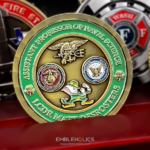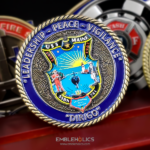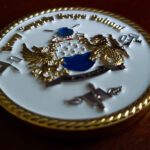
A gold plated challenge coin is struck from a base metal such as brass or zinc alloy, then finished with a thin layer of gold-tone plating. Recessed areas of the design are filled with enamel or paint, while the raised metal is left bare so the plating shows through.
What Is a Gold Plated Challenge Coin?
A challenge coin is struck, not cast. A steel die carrying the design is pressed into a blank of base metal, forcing the metal to take the shape of the die. Brass, zinc alloy and iron are the three base metals used, and the choice depends on the size, shape and level of detail in the artwork. That base metal is what gives a coin its weight and its edge definition.
Plating comes after striking. The struck coin is finished with a thin layer of gold-tone plating covering every exposed surface. It is a surface treatment rather than a material, so the coin underneath is the same brass or alloy it was before.
Which raises the obvious question: is it real gold? No, and no manufacturer in this trade uses solid gold. A solid gold coin at any usable order quantity would cost more than most units spend on an entire event. Plating gives you the color and finish of gold on a coin that can be handed out by the hundred, carried in a pocket for twenty years, and replaced if it is lost.
That is the trade every coin makes, and it is why the decisions worth spending time on are not about the metal underneath. They are about the finish on top and how color sits against it.
Gold, Silver, Nickel and Antique Finishes
Plating is available in gold, silver, nickel and copper, and each of those comes in traditional, matte and antique. Antique brass and black nickel are available as well, and two finishes can be combined on a single coin using dual plating, which is a common way to separate a central emblem from the field around it.
The choice changes how a design reads more than most people expect.
Bright finishes reflect light off the raised relief, so detail reads as shine and contrast. Color sitting next to bright plating looks saturated, because the metal beside it is throwing light back. Bright suits designs with strong shapes and a limited palette.
Antique finishes work the other way. The plating is darkened, then the raised surfaces are polished back, leaving the darker tone sitting in the recesses. Fine detail reads deeper because every line carries a shadow. Antique silver and antique gold are the two most requested finishes for exactly that reason, and they suit dense designs, heraldry, small lettering and anything where the relief is doing the work rather than the color.
Neither is better. A crest with fine engraving usually wants antique. A bold squadron emblem in two colors usually wants bright. The coin on this page is bright gold, and the reason is on the coin itself.
How Color Works on a Coin: Enamel, Paint and Bare Metal
Color sits in the recessed areas of a struck coin. The die creates raised metal and sunken metal, color fills the sunken parts, and the raised parts stay bare showing the plating. That is why the metal lines in a coin design are the design. They are the borders holding every color apart.
There are three ways to fill those recesses, and they look different in the hand. Soft enamel is filled to just below the level of the raised metal, so you can feel the lines when you run a thumb across the face. Hard enamel is filled and then polished completely flat, giving a smooth jewelry-quality surface that stands up to years of handling. Paint sits differently again and suits large flat areas of a single color, which is what this coin uses. Beyond those, UV printing, transparent enamel, epoxy coating and other challenge coin manufacturing options can be combined on one design.
You do not have to fill every recess. Leaving areas bare so the plating shows through as its own color is a design decision rather than an omission, and restraint tends to read as expensive. A coin with one background color against bright plating usually looks more considered than the same coin with six colors competing across its face. The same restraint can run in the opposite direction, which is what the same school’s coin in black does with a dark treatment instead of a light one.
About This Navy Supply Corps School Coin
This coin is gold plated with a white painted background on both faces. Everything else, the reliefs, the inscriptions and the border detail, is etched into the surface rather than raised above it. The design was built digitally and machined from the approved artwork, which is what holds the engraving depth consistent across a flat design where there is nowhere for an error to hide.
The finish is the decision that makes it. Gold on a Supply Corps coin is not a default, it is the Corps’ own color. Supply Corps officers wear a gold oak leaf, and they have worn it in gold since the era when the Pay Corps was renamed the Supply Corps. Before that the insignia was silver. Choosing gold plating for the Supply Corps schoolhouse puts the coin in the same color the wearer already carries on their sleeve, which is a quieter and better argument than adding a second color would have been.
The Navy Supply Corps School in Newport trains newly commissioned Supply Corps officers through the Basic Supply Officer Course, known as BSOC and formerly as BQC. Officers who complete it earn the “Ready for Sea” designation. The school’s other coin covers NSCS in more depth, and the gallery also holds custom Navy Supply Corps coins, a matching NSCS patch, and further examples of custom Navy challenge coins across every command.
Ordering a Second Coin: Reorders and Repeat Designs
NSCS has two coins in this gallery, made differently. That is normal. Commands, schools and units come back for a new class, a change of command, a follow-on event, or a design that worked and deserves a second run.
Reorders are cheaper than first orders here, and the reason is the tooling. Molds and dies are provided free on qualifying orders and retained for up to five years from the date of the last production run, specifically so a reorder can use them. Running the identical coin again means no new artwork fee and no new mold fee while that tooling is still active, with current production pricing applied. Most competitors treat tooling as a line item and charge for it twice.
Changes affect that. Altering the artwork, dimensions, plating, shape, text or construction may require new tooling, so a second coin in a different finish is not automatically a free reorder. It is worth asking before you assume either way. After extended inactivity, molds may be retired, in which case a new mold fee can apply, which is the practical reason not to leave a repeat order for six years. Full detail sits in sections 10 and 11 of the terms and conditions.
If you have ordered before, reference the previous coin when you get in touch. It shortens the process considerably.
Design a Coin in Gold or Any Finish
Artwork is free and revisions are unlimited. Nothing goes into production until you have approved a proof, and if you are undecided between finishes, say so, because seeing the same design in bright gold and antique gold beats guessing from a description.
Orders start at 50 coins, shipping within the continental United States is included, and rush production is available if you are working to a ceremony date. A 20 percent deposit starts production and typical production time is around 45 to 50 days, so plan backward from the date you need coins in hand.
Embleholics is veteran-owned, based in Port Orchard, Washington, and registered in SAM as a Service-Disabled Veteran-Owned Small Business under UEI F3AGRUW5RT53, which matters if you are ordering through a government purchase process. Send your idea, sketch or finished artwork and you will hear back within 24 hours. Request a quote to start.
Frequently Asked Questions
What is a gold plated challenge coin?
A gold plated challenge coin is struck from a base metal such as brass, zinc alloy or iron, then finished with a thin layer of gold-tone plating. The plating covers the exposed metal surfaces and gives the coin its color and finish.
Is a gold challenge coin real gold?
No. The plating is a gold-tone surface finish over a base metal, not solid gold. No manufacturer in this trade uses solid gold, because the cost at any usable order quantity would be prohibitive.
What plating options are available for challenge coins?
Gold, silver, nickel and copper, each available in traditional, matte and antique. Antique brass and black nickel are also available, and two finishes can be combined on one coin using dual plating. Antique silver and antique gold are the most requested.
What is the difference between soft enamel, hard enamel and paint?
Soft enamel is filled to just below the raised metal lines, so the surface has texture you can feel. Hard enamel is polished completely flat for a smooth, highly durable finish. Paint suits large flat areas of a single color, as on this coin.
What does an etched challenge coin look like?
On an etched coin the detail is cut into the surface rather than raised above it. Inscriptions and fine relief sit below the plane of the coin, which gives a flatter, more engraved appearance than a high-relief design.
Does gold plating wear off or tarnish?
Plating is a surface layer, so many years of heavy handling can wear it at the high points. Antique finishes tend to disguise wear better than bright ones, because contrast is already built into the design.
Can you reorder the same coin later?
Yes. Molds and dies are retained for up to five years from the last production order, and rerunning the original design carries no new artwork fee and no new mold fee while tooling remains active. Current production pricing applies.
What is the Navy Supply Corps School?
NSCS in Newport, Rhode Island trains newly commissioned Supply Corps officers through the Basic Supply Officer Course, known as BSOC and formerly as BQC. Officers who complete it earn the “Ready for Sea” designation.
More Navy Projects