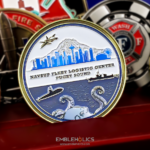
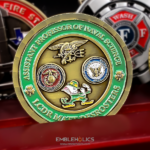
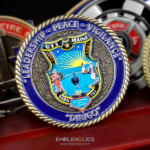
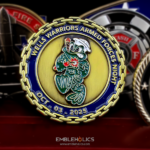
A custom military patch is an embroidered or woven emblem stitched onto fabric backing, made to be worn on a uniform, a flight suit, a ball cap, or a unit jacket. This one was produced for the Navy Supply Corps School, the training command that turns newly commissioned officers into supply officers. The design carries the school’s insignia in gold thread on a navy field, and the piece is finished with a stitched border so the edge will not fray with wear.
Morale patches are not the same as authorized uniform insignia
A morale patch is unit property, not uniform property. Rank insignia, warfare devices, and service tapes are prescribed items: the uniform regulations say exactly what they look like, where they sit, and who may wear them. A morale patch sits outside that system. It is designed by the unit, paid for by the unit, and worn at the discretion of whoever commands the space it is worn in, which in practice means a flight suit, a shop jacket, a cover, or a gear bag rather than a service dress uniform.
That freedom is the whole appeal. Because no regulation dictates the artwork, a unit can put its own nickname, its own mascot, or an inside joke on a patch in a way it could never do with an authorized device. It also means the approval path runs through the command, not through a uniform board. Check with your chain of command before ordering if the patch is meant to be worn on anything issued.
Embroidery has limits that a coin die does not
Thread cannot hold detail the way struck metal can. A die presses metal into relief, so a coin can carry fine line work, tiny lettering, and shallow texture. Embroidery builds the image out of stitches laid side by side, and each stitch has a minimum width. Below a certain size, a line stops reading as a line and turns into a lump of thread.
In practice that changes three things when artwork moves to fabric:
- Small text gets larger or gets cut. Mottos, hull numbers, and date lines often have to be set bigger, shortened, or moved to a less crowded part of the design.
- Thin outlines thicken. A hairline border around a crest becomes a visible stitched rule, which can close up the space inside it.
- Color counts drop. Shading that a coin achieves with polished and sandblasted metal has to be done with distinct thread colors instead, so gradients become flat blocks.
The translation runs more easily in the other direction. A design drawn for embroidery is already simplified, with bold shapes and strong color separation, so it usually strikes well as a coin without much rework. A design drawn for a coin almost always needs redrawing before it can be stitched. If a unit wants both, it costs less effort to start with the patch artwork. This school has both pieces, a patch and a Navy Supply Corps School challenge coin, and the two were drawn as separate artwork rather than one being traced from the other.
Backing decides where the patch can actually go
The backing choice is about whether the patch comes off. Three options cover almost every request:
- Hook-and-loop. The patch attaches to a loop panel and lifts off in a second. This is the standard for flight suits and plate carriers, where patches get swapped by mission, by day, or before a visit from someone senior.
- Iron-on. A heat-activated film on the back bonds to fabric with a household iron. It is quick and cheap, and it holds well on cotton. It is not meant for anything that will be washed hard or worn daily, and most people stitch the edges down anyway once it is positioned.
- Sew-on. A plain fabric back, stitched down through the border. It is the most permanent and the most durable, and it is the only sensible choice for a patch going onto something that will be laundered for years.
Merrowed and die-cut edges
The edge treatment is what keeps the patch from unraveling. A merrowed edge is a thick overlock stitch wrapped around the outside. It is the classic look, it is very tough, and it only works on simple outlines, so circles, ovals, shields, and rectangles. A die-cut edge is heat-sealed and trimmed to shape, which allows irregular outlines with notches, points, and cutouts that a merrowed border could not follow. If your design has an eagle with spread wings or lettering that breaks the outline, it needs a die-cut edge.
Starting a patch order
Send the artwork and tell us where the patch will be worn. Those two pieces of information settle most of the production questions on their own: the wear location drives the backing, the backing and the outline drive the edge, and the finished size drives how much detail can survive the stitching. We will tell you what in the design needs to change before it goes to the embroidery machine rather than after. Patches sit alongside coins, unit coins, and the other custom pieces in our specialty products range, and you can send a design over through our free quote form.
Frequently Asked Questions
What is a custom military patch?
A custom military patch is an embroidered or woven emblem on fabric backing, made to a unit’s own design and worn on uniforms, flight suits, caps, jackets, or gear. Unlike rank insignia or warfare devices, the artwork is created by the unit rather than prescribed by uniform regulations, which is why patches carry nicknames, mascots, and unit humor that official insignia never would.
Can I wear a custom morale patch on my uniform?
That depends on your command, not on the patch. Morale patches are not authorized uniform items, so there is no regulation that grants permission to wear one. Permission comes from the chain of command for the specific garment and setting, which is why morale patches usually appear on flight suits, working gear, ball caps, and unit jackets rather than on service dress uniforms. Ask before you order if the patch is meant for anything issued.
Can you use my challenge coin design for a patch?
Usually not without redrawing it. Embroidery builds an image from stitches that have a minimum width, so fine lettering, hairline outlines, and metal shading that read clearly on a struck coin turn muddy in thread. Expect small text to be enlarged or trimmed, thin lines to thicken, and gradients to become flat color blocks. A patch design converted into a coin, on the other hand, usually transfers with little change.
What backing should I choose for a patch?
Choose hook-and-loop if the patch needs to come off, iron-on if it is going onto something casual and you want it on quickly, and sew-on if it is permanent and will be washed often. Flight suits and plate carriers almost always use hook-and-loop because patches get swapped out regularly. Sew-on is the most durable of the three.
What is the difference between a merrowed edge and a die-cut edge?
A merrowed edge is a thick overlock stitch wrapped around the outside of the patch, and it only follows simple shapes such as circles, ovals, shields, and rectangles. A die-cut edge is heat-sealed and trimmed, so it can follow irregular outlines with points, notches, and cutouts. Designs where the artwork breaks the outline need a die-cut edge.
How small can lettering be on an embroidered patch?
There is no single number, because it depends on the thread, the font, and the finished patch size, but lettering is the first thing to fail when a design is shrunk. If a motto or a long unit title will not hold at the size you want, the usual fixes are to enlarge the patch, shorten the text, or move the wording to a less crowded area. We will flag anything at risk before production starts.
Do you make patches and coins for the same unit?
Yes, and the Navy Supply Corps School is an example: the school has both this patch and a separate challenge coin. The two pieces were drawn as separate artwork rather than one being copied from the other, because what works in thread and what works in struck metal are not the same thing.
More Navy Projects