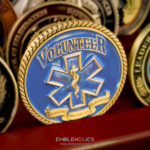
A volunteer fire department has no payroll, which makes a coin one of the few forms of recognition it has available. This one was made for White Pine County Volunteer Fire Rescue in Nevada: a gold coin with the Star of Life on the front and the United States flag with an engraved prayer on the reverse. The choice of the Star of Life rather than a fire service cross is the design decision worth understanding, because a combined fire and rescue organization has two emblems to pick from and they mean different things.
Who Pays for a Volunteer Department’s Coins
This is the first practical question and it shapes everything after it.
A paid department has a budget, a procurement route and someone whose job includes approving things. A volunteer department usually has none of those. Coins get funded by the firefighters’ association, an auxiliary, a fundraiser, a local business or the members themselves, which has three consequences.
- The order is price-sensitive in a way a municipal order is not. It is worth asking what a single color change or a simpler finish saves, because that money came out of a pancake breakfast.
- The coin often has to serve more than one purpose. Recognition for members, a thank-you for donors, something to hand to the county commission, and sometimes something to sell to recover the cost. A design that only works as an internal member coin wastes most of that.
- Decisions are made collectively. There is rarely one approver, so agreeing the design before artwork saves rounds of proofs.
Volunteers also tend to serve their own community for decades, often across generations, which argues for a coin built on the county and the service rather than on a year or a current roster.
Fire and EMS Have Different Emblems
A combined fire and rescue organization runs two missions, and each has its own symbol.
The fire service device is the cross, usually called a Maltese cross and technically a Cross of Saint Florian. It is covered in detail, including how it behaves as a coin outline, on the Boise firefighters coin.
The EMS device is the Star of Life, a blue six-pointed star with a white border and a Rod of Asclepius at its center.
A department that does both has three options, and it is worth choosing deliberately rather than defaulting.
Put one emblem on each face, which is the cleanest solution and the one that respects both missions equally. Choose the one that reflects the larger share of the call volume, which for most rural volunteer departments is medical rather than fire. Or combine them, which almost never works, because both are geometric devices with fixed proportions and overlapping them damages each.
This coin takes the second route, leading with the Star of Life, which for a volunteer organization running EMS across a rural county is the honest reflection of what the members actually spend their time doing.
What the Star of Life’s Six Bars Mean
Each of the six bars stands for a stage of emergency medical response, which is why the star should not be cropped, restyled or reduced to fewer points.
- Detection, the initial recognition of the emergency
- Reporting, the call for help and the dispatch
- Response, the immediate care given by whoever is there first
- On scene care, the treatment given by arriving EMS personnel
- Care in transit, treatment during transport
- Transfer to definitive care, the handover at the hospital
The symbol has a useful history for anyone designing with it. The American Medical Association created it in 1963 as a universal medical identification symbol, in red, and chose not to trademark or copyright it, offering it freely instead. Leo R. Schwartz of the National Highway Traffic Safety Administration later changed the color to blue and attached the six EMS functions to the bars.
That decision not to trademark it is why the Star of Life appears everywhere, and it is a genuinely unusual position in this trade: most emblems on these pages need someone’s permission, and this one does not. Note that some jurisdictions do regulate its use on vehicles and uniforms, so check locally for those applications. On a coin it is not an issue.
The Rod of Asclepius Is Not a Caduceus
The device at the center of the Star of Life is a Rod of Asclepius: a single staff with one snake and no wings. It is not a caduceus, which has two snakes and a pair of wings.
The two get swapped constantly, and an EMS audience notices. Both are legitimate symbols with different lineages, and both appear in this trade. The caduceus is correct in its own places, including on the United States Public Health Service device, which pairs it with a fouled anchor for reasons set out on the Public Health Service coin page. On a Star of Life, one snake and no wings is the right answer.
Engraving a Prayer
The reverse carries a prayer engraved across the field, which is one of the more demanding things to put on a coin and a long tradition in the fire service.
A prayer is like a roster of names in one important respect: it cannot be abridged. You can shorten a motto, cut a tagline or drop a date, but removing a line from a prayer is not an editorial decision anyone wants to be responsible for. So the text length is fixed and everything else bends around it.
Three things follow. The diameter is set by the text rather than the other way around, so expect a prayer coin to be larger than a standard one. The lettering should be engraved rather than raised, because cut letters hold crisper edges at the sizes a long passage forces you into. And the other face has to stay simple, since a coin with a wall of text on one side needs somewhere for the eye to rest. See also a fireman’s prayer challenge coin.
About White Pine County Volunteer Fire Rescue
White Pine County Volunteer Fire Rescue is the network of volunteer fire departments serving communities across White Pine County, Nevada, coordinated under the White Pine County Fire District. Its member departments include Lund, McGill, Ruth, Snake Valley and Steptoe Valley, and its volunteers respond to fires, medical calls, hazardous materials incidents and rescues.
See EMS challenge coins, a volunteer firefighter coin, and more firefighter challenge coins.
Order a Coin for Your Volunteer Department
Send your department or district patch and tell us whether the coin is for members, for donors, or both, since that changes the design. If you want a prayer or any long passage on it, send the exact text, because its length decides the diameter.
Professional artwork is free with unlimited revisions, the minimum order is 50 coins, and nothing goes into production until you approve a digital proof. Standard production runs about 45 to 50 days after final artwork approval, rush production is available on many projects, and shipping within the continental United States is included. Embleholics is veteran-owned, SDVOSB and registered in SAM.gov.
Frequently Asked Questions
What is a volunteer fire department challenge coin?
A volunteer fire department challenge coin is a coin for an unpaid fire or rescue organization, usually funded by the firefighters’ association, an auxiliary, a fundraiser or the members themselves rather than from a municipal budget. Because volunteers are not paid, a coin is one of the few forms of recognition a volunteer department has available.
What is the difference between the Maltese cross and the Star of Life?
The cross, usually called a Maltese cross and technically a Cross of Saint Florian, is the fire service device. The Star of Life, a blue six-pointed star with a Rod of Asclepius at its center, is the EMS device. A combined fire and rescue organization has both missions, so the cleanest approach is one emblem per face rather than trying to combine them.
What do the six bars of the Star of Life mean?
Each bar stands for a stage of emergency medical response: detection, reporting, response, on scene care, care in transit, and transfer to definitive care. Because every bar carries meaning, the symbol should not be cropped, restyled or reduced to fewer points.
Can anyone use the Star of Life?
The American Medical Association created the symbol in 1963 and chose not to trademark or copyright it, offering it freely, which is why it appears so widely. That makes it unusually unrestricted compared with most service emblems. Some jurisdictions do regulate its use on vehicles and uniforms, so check locally for those applications, but on a coin it is not an issue.
Is the symbol in the Star of Life a caduceus?
No. It is a Rod of Asclepius, a single staff with one snake and no wings. A caduceus has two snakes and wings and is a different symbol with a different lineage. The two are frequently confused, and an EMS audience will notice if a coin gets it wrong.
Can a prayer be engraved on a challenge coin?
Yes, and it is a long tradition in the fire service. The constraint is that a prayer cannot be abridged, so the text length is fixed and the coin’s diameter has to be set by it rather than the reverse. Engrave the lettering rather than raising it, since cut letters stay crisper at small sizes, and keep the other face simple so the eye has somewhere to rest.
Should a volunteer department’s coin be designed to sell?
It is worth deciding before artwork. Many volunteer organizations need the coin to recognize members, thank donors, present to local officials and sometimes sell to recover the cost, and a design built only as an internal member coin serves just one of those. A coin built on the department and the community rather than on a year or a roster covers all of them.
What is White Pine County Volunteer Fire Rescue?
It is the network of volunteer fire departments serving communities across White Pine County, Nevada, coordinated under the White Pine County Fire District. Member departments include Lund, McGill, Ruth, Snake Valley and Steptoe Valley, and volunteers respond to fires, medical calls, hazardous materials incidents and rescues.
More Firefighters Projects