A fire department challenge coin usually carries three things: one emblem, one identifier and one line of text. The emblem is most often the Maltese or Florian cross. The identifier is the station, the department or the academy class. Decide who the coin is for first, because that choice settles most of the design.
Fire Department Challenge Coins at a Glance
Every fire department coin falls into one of six types. Each type has its own audience and its own short list of details.
| Coin type | Who it’s for | What usually goes on it |
|---|---|---|
| Station coin | One firehouse | Station number, apparatus, station nickname |
| Department coin | Every station | Patch, department name, founding year |
| Academy class coin | A graduating class | Class number, year, academy name |
| Union local coin | Members of a local | Local number, affiliation |
| Retirement coin | One firefighter | Name, years of service, final rank |
| Memorial coin | A fallen firefighter | Name, badge or unit number, dates |
Start With Who the Coin Is For
Every coin answers one question before any other: who will carry it? A station coin belongs to one house, so crews expect their own number and apparatus on it. A department coin speaks for every station at once, so it leans on the patch and the department name. A class coin is about graduation day, and the class number matters more than anything else.
Most departments end up ordering firefighter challenge coins for more than one of these over the years. Promotions, retirements, anniversaries and academy graduations are the occasions departments mark with coins most often, so it pays to settle the emblem and lettering once and reuse them.
The Emblem: Maltese Cross or Florian Cross

Most fire coins are built around a cross, and two versions dominate. They look similar at a glance but come from different traditions.
The Maltese cross has four V-shaped arms that end in eight sharp points. It comes from the Knights Hospitaller, the medieval order that cared for pilgrims, and it was the fire service’s main symbol for generations.
The Florian cross has four rounded lobes and a softer outline. Firefighters connect it with St. Florian, their patron saint, and it has become steadily more common on North American badges. Both sit alongside the helmets, axes, ladders and speaking trumpets that make up the fire service’s visual language.
The design point most departments miss is that the cross doesn’t have to sit inside a round coin. It can be the coin. One department ordered a coin cut entirely in the shape of a Maltese cross, so it’s recognisable before anyone reads a word. Custom-shaped challenge coins need their own cutting die and cost a little more than round ones, but for a fire department no shape is more natural.
Station, Apparatus and Department Details
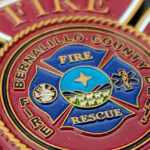
After the emblem comes identity. The usual candidates are the station number, the engine, ladder, truck or rescue numbers, the department name and city, the founding year, the department patch and a short motto.
You won’t fit all of them. A standard 2-inch coin has about the area of a small patch, and raised metal needs larger letters than embroidery does. Short names and numbers survive the move to metal. Small patch lettering and long mottos usually don’t.
Most departments solve this by splitting the work across both faces: the emblem and department name on the front, and the station, apparatus or class details on the back.
Rank and Role
Bugles are the fire service’s marks of rank. They come from the speaking trumpets officers used to shout orders on the fireground before radios. On many departments the count rises with rank, from one bugle for a lieutenant and two for a captain up to five for the fire chief. Schemes vary, and some departments use stars instead, so check yours before it goes on a coin.
Rank matters most on two kinds of coin. A chief’s coin is carried by the chief and handed out in person, usually for something specific. A promotion or retirement coin marks one person’s rank at one point in a career. The crew coin, which goes to everyone on the roster, usually leaves rank off so the whole station can carry the same design.
Memorial Coins
A memorial coin needs a name, a badge or unit number, dates and one short line. Nothing more is required, and restraint is what makes these coins work.
Finishes tend to be quiet: antique metal, little colour and plenty of open space. Some departments add a photograph. Hanover Fire EMS chose a rectangular memorial coin with a printed portrait on one face and an illustration of a firefighter at work on the other.
Let the department and the family approve the wording before anything is made. Every order includes a digital proof before production, and changes are free until it’s approved.
Four Fire Department Coins and What They Chose
Four departments, four different answers to the same question. Each one solved the space problem on a 2-inch coin in its own way.
Firehouse Leadership Coin
This command coin is built around the Red, Green and Blue leadership model: red for the directive commander at a working fire, green for the collaborative leader at the station, blue for the analytical problem-solver after the fire is out. Three colours carry a whole training philosophy, so the coin needs very little text. Command coins are handed out rather than traded, so the reverse is often left free for a name.
Fire Station 43 Coin
Fire Station 43 skipped the round coin entirely and went with a coin cut in the outline of a pre-siren station bell. It doubles as a bottle opener, too. A shape with history behind it does more work than any logo.
Sanford Fire 150th Anniversary Coin
Sanford Fire used the same bell idea for a milestone: a 150th anniversary coin handed to every crew at the department’s anniversary ceremony in 2023. Two dates mark the span of its history.
IAFF Challenge Coin
The Clearwater Paper Fire Department, an IAFF member department, wanted something classic. Its IAFF challenge coin uses copper base metal brushed for a burnt look and just two paint colours. A restrained palette reads as heritage.
Across the fire department coins we’ve produced, one pattern holds: the best ones commit to a single strong idea.
What to Leave Off
The fastest way to improve a coin design is to remove things. These five cause most of the problems we see in first drafts.
- Long mottos. Anything over six or seven words belongs on the back or nowhere.
- Full patch detail. Keep the outline and the main device; drop the fine lettering.
- Photographs, except on memorial coins.
- More than two fonts.
- Every name on the roster. Put names on the back only for retirement and memorial coins.
How to Order a Fire Department Coin
Embleholics is a veteran-owned custom challenge coin maker that works with career, volunteer and industrial fire departments across the US. Every order includes free professional artwork, unlimited revisions and a digital proof you approve before production starts. Most orders are complete 45–50 days after artwork approval, rush production is available, and shipping is free within the continental US. The 50-coin minimum suits small volunteer companies as well as large career departments.
To get an accurate quote, send:
- Your patch, logo or a rough sketch (a phone photo is fine)
- The quantity and the date you need the coins
- Any text, such as station number, motto or names
- Ideas for shape, colours or special features like a bottle opener
The same process works for police, EMS and other first responder coins, so departments with joint fire-EMS or public safety roles can keep one supplier. Start your free design today.
Frequently Asked Questions
What should be on a fire department challenge coin?
Most carry one emblem, usually the Maltese or Florian cross, plus one identifier such as the station number, department name or academy class. A short motto or dates can go on the back. Decide who the coin is for first, and leave off anything that won’t read at 2 inches.
How much do fire department challenge coins cost?
Embleholics’ published prices for a standard 2-inch coin run from $10.90 each at 50 coins to $5.70 each at 500 or more. Size, colour count, 3D detail, custom shapes and extras such as bottle openers change the final price. Artwork and continental US shipping are included.
Can a challenge coin be shaped like a Maltese cross?
Yes. The cross can be the coin’s outline instead of artwork on a round coin. A custom shape needs its own cutting die, so it costs a little more, but it makes the coin recognisable at a glance.
What is the difference between the Maltese cross and the Florian cross?
The Maltese cross has four V-shaped arms ending in eight sharp points and comes from the Knights Hospitaller. The Florian cross has four rounded lobes and is associated with St. Florian, the patron saint of firefighters. Both appear on fire service coins and badges.
Can we put our station number and apparatus on the coin?
Yes, and most station coins do. Numbers and short names reproduce well in raised metal. If you want the station number, apparatus and department name together, split them across the two faces so the lettering stays large enough to read.
What goes on a firefighter memorial coin?
A name, badge or unit number, dates of service and one short line. Some departments add a photograph. Keep the design quiet, and have the department and family approve the wording before production begins.
How long do custom fire department coins take?
Most orders are complete 45–50 days after the artwork is approved, and rush production is available for tight deadlines. For a retirement, anniversary or graduation, start the design at least two months ahead.
Recent Posts