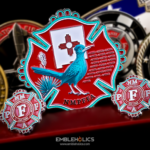
You’ll find the Florian Cross on fire apparatus, station walls, helmets, patches, and challenge coins across the country. But what does it actually mean? Where did it come from? The answer takes us back more than 1,700 years to a Roman official who became a symbols of courage and sacrifice: St. Florian.
Who Is St. Florian?
St. Florian is widely recognized as the patron saint of firefighters.
Our understanding of St. Florian comes primarily from the Passio Floriani, a Latin account of his martyrdom written several centuries after his death. Florian lived during the reign of the Roman emperors Diocletian and Maximian, a period marked by intense persecution of Christians.
Florian served as a high-ranking Roman administrative official in the province of Noricum, located in present-day Austria. When forty Christians were arrested and imprisoned for refusing to renounce their faith, Florian chose to stand with them rather than remain silent.
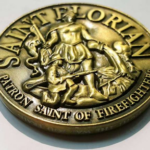
As the story tells it, Florian traveled from Cetium (modern St. Pölten) to Lauriacum (modern Lorch) knowing that doing so would likely cost him his life. When brought before the governor Aquilinus, he was ordered to sacrifice to the Roman gods. Florian refused.
Despite torture and repeated demands to abandon his beliefs, Florian remained steadfast. He famously declared that while the governor had power over his body, only God had power over his soul.
On May 4, 304 AD, Florian was sentenced to death. A stone was tied around his neck, and he was thrown from a bridge into the Enns River. According to the account, he met his fate with remarkable courage and conviction.

Stemonitis (2006). CC BY-SA 2.5
Over the centuries, stories emerged describing Florian extinguishing a devastating fire with only a bucket of water. Whether historical or symbolic, these legends helped establish his connection with firefighters and those who protect communities from disaster.
St. Florian is one of the most recognized patron saints in the fire service.
Understanding the Florian Cross
One of the most common misconceptions in the fire service is that the Florian Cross originated with St. Florian himself.
The rounded, four-lobed emblem commonly called the Florian Cross developed independently of the saint. Its origins are generally traced to medieval heraldry and decorative cross forms used throughout Europe. The design consists of four outward-curving arms that create eight rounded points around a central circle.

Over time, firefighters began adopting the symbol because it offered a distinctive emblem that could easily display department names, apparatus numbers, mottos, and insignia. Since St. Florian was already the recognized patron saint of firefighters,the cross naturally became associated with him.
Today, many firefighters simply refer to the emblem as the Florian Cross because of that long-standing association. While the saint and the cross do not share the same historical origin, together they have become one of the most recognizable symbols in the fire service.
Meanings Firefighters Have Attributed to the Florian Cross
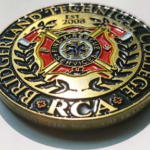
Now that you know the history behind the Florian Cross, what does this symbol mean?
The Florian Cross has accumulated meaning through generations of firefighters. For many, it represents the values that define the profession itself.
-
- Protection: St. Florian became known as a protector, and firefighters continue that mission every day by placing themselves between danger and the communities they serve.
- Courage: Florian’s story is one of extraordinary courage. He chose to stand by his convictions despite knowing the consequences. Firefighters carry that same spirit every time they respond to uncertain and dangerous situations.
- Loyalty: The fire service is built on trust and brotherhood. The Florian Cross represents the trust and brotherhood on which the fire service is built.
- Honesty: Florian never concealed what he believed. His willingness to speak truthfully remains an important value associated with the symbol.
- Sympathy: Firefighters enter people’s lives during some of their most difficult moments. Compassion and empathy are as important as technical skill.
- Dexterity: The Florian Cross symbolizes the physical skill, discipline, and ability to perform under pressure needed.
Ultimately, the meaning of the Florian Cross comes from the people who wear it, and the values and traditions they choose to embody.
The Maltese Cross and the Florian Cross

The Florian Cross is often confused with another iconic fire service symbol: the Maltese Cross.
The Maltese Cross has a different origin. It is traditionally associated with the Knights Hospitaller, a medieval military and religious order that provided care and protection to pilgrims during the Crusades. Over time, stories emerged describing the knights’ bravery while battling fires and protecting others from danger.
Because of these traditions, many early fire organizations adopted the Maltese Cross as a symbol of courage and service.

Ralph Hammann (2018). CC BY-SA
Visually, the two emblems are quite different. The Maltese Cross features four V-shaped arms that create eight sharp points. The Florian Cross uses four rounded lobes that create a softer, circular appearance.
For many years, the Maltese Cross was the more commonly used firefighting symbol. Today, however, the Florian Cross has become increasingly prominent, particularly in North America, due to its strong connection with St. Florian and modern fire service identity.
Carrying the Tradition Forward
The Florian Cross can be found on countless items throughout the fire service: patches, pins, memorials, plaques, and firefighter challenge coins. For collectors and departments alike, first responder challenge coins have become one of the most meaningful ways to preserve fire service traditions. Like the symbol itself, these coins tell a story. They connect today’s firefighters with generations who came before them and serve as lasting reminders of the values that define the profession.
Recent Posts