Police departments use challenge coins to recognise officers, mark retirements, honour the fallen, give specialty units an identity, graduate training classes and connect with the community. Most coin programmes are run by the chief’s office or a unit commander. They’re funded from the department budget, a union or Fraternal Order of Police lodge, or a police foundation.
Police Challenge Coin Ideas at a Glance
Most department coin programmes come down to six uses. Each one has its own presenter and its own design conventions.
| Use | Who presents it | Typical design |
|---|---|---|
| Recognition | The chief or a unit commander | Department badge, “For Excellence” or similar line |
| Retirement | The department or the retiree | Name, badge number, years of service |
| Memorial | The department | Name, badge number, end-of-watch date |
| Specialty unit | The unit | Unit device on the front, department on the back |
| Academy class | The academy | Class number and year |
| Community outreach | Community relations officers | Badge, flag, department name; no dates |
Recognition Coins
The most familiar police coin is the chief’s coin. The chief carries a few and presents one in a handshake for something specific: a good arrest, a rescue, a long night handled well. It costs the department a few dollars and means far more to the officer than a certificate, because a coin gets carried, shown and kept.
The same idea works further down the chain. Unit commanders and sergeants often carry their own coins to recognise their people on the spot instead of waiting for an annual awards night. The more specific the reason, the more the coin is worth to the person who receives it. That’s why recognition is usually the first programme departments build when they start ordering police challenge coins.
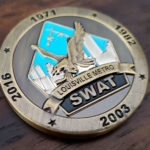
Louisville SWAT Challenge Coin
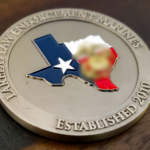
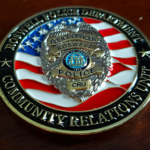
Roswell Community Coin
Retirement and Memorial Coins
A retirement coin is about one officer: name, badge number and years of service, often with the department badge on the front. Many departments order a small run for each retirement, enough for the officer to hand out to the people who mattered in their career.
A memorial coin honours an officer who died in the line of duty. It usually carries the name, badge number, end-of-watch date and a short line. These coins work best when they’re quiet: antique metal, little colour and plenty of space. Let the department and the family approve every word. Every Embleholics order includes a digital proof, so the wording can be checked before anything is made.
Specialty Unit Coins
Specialty units build their identity through coins more than almost anyone else in policing. Each unit has its own culture, training and call sign, and a coin is how it marks who’s in. K9, SWAT, honor guard, narcotics and traffic units mostly follow the same pattern: the unit’s own device on the front and the department’s identity on the back. Two examples show how far that pattern can stretch.
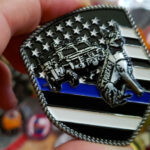
Seattle Police K9 Coin
Seattle’s K9 Unit covers patrol, narcotics, explosives and electronic storage detection dogs, and it wanted one emblem for all of them. The result is a shield-shaped K9 coin engraved on both sides in the department’s black, blue and white.
Louisville Metro SWAT Coin
The Louisville Metro Police Department was formed by merger in 2003, and its SWAT team wanted a coin that felt modern while honouring that history. The SWAT coin puts the team insignia on one side and the contemporary department graphic on the other, on brushed brass with only three paint colours.
Academy and Training Coins
Graduation is a natural coin moment. A class coin carries the class number and year, and recruits keep it for the rest of their careers. Command-level training produces coins too, often for officers who already carry several.
Southern Police Institute Coin
Command officers in the Southern Police Institute’s Session 91 course received a coin with sculpted institute and session logos on the front and a machined border of tiny rectangles around the back rim.
Community Outreach Coins
Some coins are never meant for officers. Outreach coins go to residents, volunteers and citizen academy graduates, and most of those people have never held a challenge coin. That means the design has to explain itself.
Roswell Police Community Relations Coin
Roswell’s Community Relations Unit hands out a community outreach coin with the badge over an American flag and border text naming the department and unit. The badge says who, the flag says whose, and the border text says what. It leaves off dates and names, so the department can reorder the same coin all year without new setup.
Designing Around the Badge
Most departments start from their badge or shoulder patch. That works well, with one adjustment: a badge built for a uniform carries more fine detail than 2 inches of metal can hold, so the outline and main device stay and the smallest lettering goes.
A department badge or agency seal is protected, and authorisation to use it comes from the department itself. Many states also have laws on badge use, so get written permission to use the police badge before you order. Once that’s settled, historic badges and lodge emblems make some of the strongest coins.
NYPD Badge-Style Coin
This badge-style coin recreates an old-school NYPD badge in a copper finish on the front. On the back is a 3D eagle in antique brass, with added texture for authenticity.
WSFOP Coin
The Washington State Lodge of the Fraternal Order of Police chose a star-shaped coin with points that run past the edge on both sides. Strong blue and yellow pick out the FOP emblem.
Who Pays and Who Signs Off
This is the part most first-time buyers don’t know, and it varies by city. Three questions settle it.
Who pays. Common sources include the department’s operating budget, the officers’ union or FOP lodge, a police foundation or support group, and sometimes the officers themselves, who chip in for a unit coin. Recognition coins are often funded differently from unit coins, so check which applies before you start.
Who signs off. The chief’s office usually approves the design. If the badge or city seal appears, the city or department may need to authorise it as well. Build that approval into the timeline.
How the invoice gets paid. Embleholics accepts government purchase cards and purchase orders on Net-30 terms from law enforcement agencies, with formal written quotes and W-9 forms for your purchasing office. Payment can follow the stage your city’s process requires, so a coin order fits a normal municipal purchasing cycle.
How to Order Your Department’s Coin
Embleholics is a veteran-owned custom challenge coin maker that works with city police, sheriff’s offices, state agencies and FOP lodges. Every order includes free professional artwork, unlimited revisions and a digital proof you approve before production. Most orders are complete 45–50 days after artwork approval, and rush production is available. The minimum is 50 coins, and shipping is free within the continental US.
To get an accurate quote, send:
- The badge, patch or a rough sketch
- The quantity and the date you need the coins
- The text: unit name, motto, names or badge numbers
- How you’ll pay: card, PO or Net-30
The tradition behind the coins runs deep, and the symbolism on police coins is worth knowing before you design one. Departments that also run fire or EMS can order first responder coins through the same process, and our past police coin projects show the range. Start your department’s free design today.
Frequently Asked Questions
What are police challenge coins used for?
Departments use them to recognise officers, mark retirements and promotions, honour fallen officers, identify specialty units such as K9 and SWAT, graduate academy classes and thank members of the community. The chief’s coin, presented by hand for something specific, is the best-known use.
How much do police challenge coins cost?
Embleholics’ published prices for a standard 2-inch coin run from $10.90 each at 50 coins to $5.70 each at 500 or more. Custom shapes, 3D detail and extra colours change the final price. Artwork, revisions and continental US shipping are included.
Who presents a police chief’s coin?
The chief, in person. The chief carries a small number and hands one over in a handshake to recognise a specific act. Some departments also give unit commanders their own coins so recognition can happen on the spot.
Can a police K9 unit have its own challenge coin?
Yes. K9 coins are among the most popular unit coins. They usually carry the unit’s emblem or a dog’s head on one side and the department’s identity on the other, and some are cut in a shield or badge shape.
Do we need permission to put our badge on a coin?
Yes. A department badge or agency seal is protected, and authorisation comes from the department itself. Many states also have statutes on badge use. Get written approval from the chief’s office before ordering.
Can a city pay for coins with a purchase order?
Yes. Embleholics accepts purchase orders with Net-30 terms from law enforcement agencies and government buyers, as well as government purchase cards. Formal quotes and W-9 forms are available for your purchasing office.
What goes on a police retirement coin?
The officer’s name, badge number and years of service, usually with the department badge or patch on the front. Some add the officer’s final unit or rank. Retiring officers often hand them to colleagues, so a small run is common.
Recent Posts