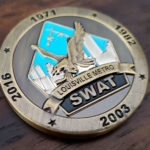
The brief for this SWAT challenge coin was modern but still honoring the unit’s history, and there is a specific reason that was harder than it sounds. Louisville’s SWAT team is older than the police department it belongs to. The team was formed in 1971 under the Jefferson County Police Department; the Louisville Metro Police Department did not exist until 2003. A coin for a unit in that position has two identities to carry, and this one solves it by giving each of them a face.
The Unit Is Older Than the Department
On 6 January 2003 the Jefferson County Police Department and the Louisville Division of Police merged to become the Louisville Metro Police Department, as part of the creation of Louisville’s consolidated city-county government. New department, new badge, new patrol car livery, and officers choosing between proposed designs for cars and uniform patches.
The SWAT team came through that as an existing unit with thirty-two years behind it. That is a common situation and almost nobody designs for it properly.
It happens every time a department is consolidated, a fire district is regionalized, a city and county service is combined, or a unit is moved from one agency to another. The organization on the letterhead is new. The unit inside it is not, and the people in it served under the predecessor. A coin that only reflects the current department quietly erases the part of the history that most of the unit actually lived.
Two Sides for Two Eras
There are two ways to put two identities on one coin, and only one of them works.
Blending them does not. Merging two badges or two sets of artwork into a single new device produces a third thing with no history at all. Everyone who served under either predecessor sees their identity diluted rather than honored, and the result usually satisfies nobody. It is the design equivalent of a compromise nobody asked for.
Separating them does. Give each identity a complete face. That is what this coin does: the Louisville Metro PD SWAT insignia on one side, and a more contemporary graphic on the other. Each side is a whole statement rather than half of one, and the viewer gets both in sequence instead of a muddle at once.
This is the strongest argument there is for using both faces deliberately rather than treating the reverse as leftover space. A two-sided object is uniquely suited to carrying two things that should not be mixed, and a merged agency is the clearest case of that in the whole category.
One practical note. Decide which face is the front, and let the current official insignia have it. The heritage side is the one people will turn the coin over for.
Three Colors Is a Specification, Not a Preference
This coin uses a brushed brass base and exactly three colors across both faces, and stating the number was the right way to brief it.
Most color instructions are vague, as in keep it clean or do not overdo it, which leaves the decision with whoever draws the artwork. A number is a specification. It can be checked, and it forces the choices to be made consciously.
Three is a useful ceiling on a metal base for two reasons.
It gives you exactly enough hierarchy. A dominant color, a secondary and an accent. That is sufficient to direct the eye and establish what matters, and with the metal acting as a fourth value, the coin still reads as metal rather than as a printed badge.
Every extra color is a boundary and a cost. Each additional color adds another edge where paint can bleed into its neighbor and another step in production. Color count is a risk and a price number as much as an aesthetic one, which is why a specified maximum is worth setting at the brief rather than discovering at the proof.
The brushed finish on the brass is doing quiet work alongside it, scattering light so the three colors read as the only bright things on the coin. If you are weighing finishes, see antique versus polished challenge coin finish.
Getting a Police Unit Coin Approved
Two approvals are worth settling before artwork rather than after, and both are routine when handled early.
The badge and insignia. A department badge and official insignia belong to the department, and reproducing them on merchandise is governed by its own policy. If you are ordering as a unit, a shift or a group of officers rather than through the department, confirm what is approved. There is more on this in permission to use a police badge on a coin.
The imagery. A police department’s items are public-facing in a way a military unit’s are not, and departments differ on what they are comfortable appearing on something that may be photographed and shared. Agencies vary widely here, so it is a question for your command rather than for a manufacturer, and asking it first avoids a design you like being turned down late.
We produce from the artwork a customer supplies and rely on the customer to hold the right to supply it. We do not grant permission on anyone’s behalf.
Order a Coin for Your Unit
Send your unit insignia and tell us whether the coin needs to carry a predecessor identity as well as the current one, because that decides how the two faces are divided. If you want a color limit, state the number.
Professional artwork is free with unlimited revisions, the minimum order is 50 coins, and nothing goes into production until you approve a digital proof. Standard production runs about 45 to 50 days after final artwork approval, rush production is available on many projects, and shipping within the continental United States is included. Embleholics is veteran-owned, SDVOSB and registered in SAM.gov. See how police departments use challenge coins, an emergency service unit coin, or more police challenge coins.
Frequently Asked Questions
What is a SWAT challenge coin?
A SWAT challenge coin is a coin made for a police tactical unit, usually carrying the unit’s insignia and the department’s identity. They are commonly ordered by the unit itself rather than by the department centrally, and the design is normally kept to the badge, the unit name and the agency, with the department approving the imagery.
When was the Louisville Metro Police Department formed?
The Louisville Metro Police Department began operations on 6 January 2003, when the Jefferson County Police Department and the Louisville Division of Police merged as part of the creation of Louisville’s consolidated city-county government. A new badge and new patrol car design came with it, chosen by officers from several proposals.
When was Louisville’s SWAT team formed?
Jefferson County’s Special Weapons and Tactics team was formed in 1971, more than three decades before the merged Louisville Metro Police Department existed. The unit’s heritage therefore predates the department it now belongs to, which is why a coin for it has two identities to carry.
How do you design a coin for a department formed by a merger?
Give each identity its own face rather than combining them. The current official insignia takes the front, and the heritage identity takes the reverse, so each is a complete statement. Merged and consolidated agencies are the clearest case for using both sides of a coin deliberately instead of treating the reverse as leftover space.
Should two legacy badges be blended into one device?
No. Merging two badges produces a third device with no history of its own, and everyone who served under either predecessor sees their identity diluted rather than honored. Keeping them separate, on separate faces, lets both be correct.
How many colors should a challenge coin use?
On a metal base, three across the coin is a workable ceiling: a dominant, a secondary and an accent, with the metal acting as a fourth value. Beyond that the coin starts to read as a printed badge rather than a struck one, and each extra color adds another boundary where paint can bleed and another production step. Specify the number at the brief rather than leaving it to the artwork stage.
Why use a brushed finish rather than polished on a coin with painted color?
A brushed surface scatters light rather than reflecting it, so the painted areas become the only bright elements on the coin and the color reads more strongly. A polished base competes with the paint for attention and shows handling marks more readily.
Who approves a police department coin?
The department, not the unit placing the order. Badges and official insignia are departmental property and their use on merchandise is governed by department policy, and departments also differ on what imagery they will approve on a public-facing item. Settle both before the artwork stage rather than after a proof.
More Law Enforcement Challenge Coins Projects