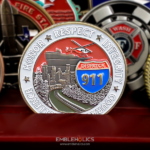
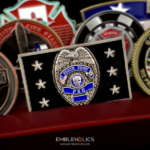
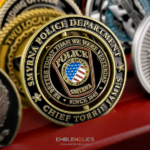
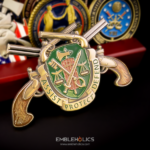
This coin is cut to a shield rather than struck as a disc, with the graphics engraved on both faces and the unit’s colors of black, blue and white. It was made for the Seattle Police Department’s K9 Unit.
Why the Shield Is the Natural Law Enforcement Shape
Of all the custom outlines available, the shield is the one that does the most work for the least effort in a police context.
The shape already means something. A shield reads as law enforcement before anyone looks at the detail, because that is the form a badge takes. No other outline carries that association, which means the shape is doing a job that would otherwise cost you lettering.
It is sturdier than most custom shapes. A shield has no narrow points, no thin projections and no sharp internal angles. It is a broad form with gentle curves, which makes it one of the few custom outlines with no real fragility concern. Compare that to a star, where every tip is a bend waiting to happen.
And it fills differently from a circle. A shield is wider at the top and tapers to a point at the bottom, which gives a layout a natural reading order: heading across the top, main device in the middle, a word or a date in the taper. A circle gives no such structure, so every element has to be positioned from scratch.
The one thing to plan for is the same as with any custom outline: standard capsules, sleeves and display racks are made for round coins, so packaging has to be specified separately. See custom shaped challenge coins.
Engraved on Both Faces
Both sides of this coin are engraved rather than sculpted in relief, which is a deliberate choice rather than a cheaper one.
Recessed line work reads as a drawing, and a drawing is the right register for a badge-style piece. Sculpted relief reads as an object, which suits a figure or an animal but can make a heraldic design look like a casting rather than an emblem.
Engraving also holds fine detail better on a shape with a tapering lower half. As a shield narrows toward the point, any element placed there gets less room, and recessed line work stays crisp in a confined space where raised relief would start to crowd.
The practical note on engraved designs is contrast. Bare engraving relies on shadow, which is subtle. Filling the recesses with color, as this coin does with the unit’s black, blue and white, is what makes the line work read clearly at arm’s length. See engraving and finish options.
Coins for a K9 Unit
A canine unit is a small, distinct team inside a larger department, and that is exactly the shape of organization a coin suits.
It is a unit within a unit. A department coin represents the whole agency. A K9 coin represents a handful of handlers who train together, deploy together and share a specialty nobody else in the department has. That is where a coin carries meaning.
The dogs are part of the team. A K9 coin is one of the few that honors working animals alongside the people, which gives the piece a subject that is genuinely its own rather than a variation on the department’s badge.
And handlers meet other handlers. K9 teams train with units from other agencies, attend certifications and competitions, and work mutual aid. Those are exactly the occasions where coins get exchanged.
At Seattle, the K9 Unit covers several kinds of work: patrol and generalist dogs, narcotics detection, bomb detection, and electronic storage detection. Breeds used in police work, German shepherds among them, have an estimated 220 million olfactory sensory cells, against roughly five million in a human nose, which is the basic reason the dogs do what no equipment can.
See also another police K9 coin, a military police K9 coin and more police challenge coins.
Using Department Colors
This unit asked for its own colors, black, blue and white, and there is a reason that instruction is worth giving explicitly.
A designer left to choose will produce something that looks good. A designer given the department’s colors will produce something that looks like it belongs to the department, which is not the same thing. For a unit inside a larger agency, matching the parent organization’s palette is what ties the piece to the badge on the uniform.
Black, blue and white is also a practically sound combination. The black gives a forgiving dark fill where small imperfections disappear, the white provides maximum contrast against it, and the blue carries the identity. Three colors is also comfortably within the range where the enamel count does not drive the cost up.
Order a Coin for Your Unit
Professional artwork is free with unlimited revisions, and nothing goes into production until you approve a digital proof. The challenge coin minimum is 50 pieces, standard production runs about 45 to 50 days after final artwork approval, rush production is available on many projects, and shipping within the continental United States is included. Embleholics is veteran-owned, SDVOSB and registered in SAM.gov.
Two things that help. Send your department’s color references rather than describing the shades, since enamel colors are matched from a standard range and a described color is a guess. And if the coin reproduces a department badge or seal, the authorization and the approved artwork both come from the agency; we produce from what the customer supplies. Request a free quote to begin.
Finished Coin (Front)

Finished Coin (Back)

Frequently Asked Questions
What is a shield shaped challenge coin?
It is a coin cut to a shield outline rather than struck as a disc. The shape reads as law enforcement on its own, because that is the form a badge takes, so it identifies the piece before any detail is read.
Is a shield a sturdy shape for a coin?
Yes, one of the sturdiest custom outlines available. It has no narrow points, thin projections or sharp internal angles, which is where other shapes fail. A star, by contrast, has a potential bend point at every tip.
How does a shield shape change the layout?
It gives you a built-in reading order. A shield is wide at the top and tapers to a point, so a heading sits naturally across the top, the main device in the middle, and a word or date in the taper. A circle offers no such structure.
Should a badge style coin be engraved or sculpted?
Engraved, usually. Recessed line work reads as a drawing, which is the right register for a heraldic or badge style design. Sculpted relief reads as a solid object, which suits a figure or animal but can make an emblem look like a casting.
Why fill engraved lines with color?
Because bare engraving relies on shadow alone, which is subtle at arm’s length. A color fill in the recesses is what makes the line work read clearly, and it lets you use the department’s colors at the same time.
Why order a coin for a K9 unit specifically?
Because a canine unit is a small, distinct team inside a larger department, with its own training, its own specialty and its own handlers. That is where a coin carries meaning, in a way a general department coin cannot.
Should we specify our department colors?
Yes, and send the color references rather than describing the shades. Enamel colors are matched from a standard range, so a named reference is exact where a description is a guess. Matching the parent agency’s palette is what ties a unit coin to the badge on the uniform.
Will a shield shaped coin fit standard packaging?
No. Capsules, sleeves and display racks are made for round coins, so any custom outline needs its packaging specified separately. Raise it at the quote stage rather than after the coins are struck.
More Police Projects