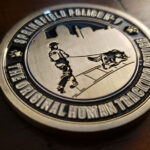
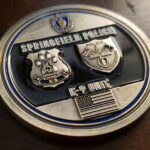
The department asked for something minimal: few patterns, few elements. The front carries an engraved picture of a K-9 unit, the reverse carries sculpted emblems and insignias, and the coin is almost entirely black, with color only on the rims and the insignias.
Engraving a Real Animal
A stylized mascot and a portrait of an actual dog are two completely different jobs, and the portrait is the harder one.
A mascot can be simplified; a likeness cannot. A cartoon bulldog works because nobody is checking it against a specific animal. A portrait has to look like that dog, which means the proportions of the head and the set of the ears all have to be right, and there is no room to exaggerate them for legibility.
Fur is the problem. A dog’s coat is thousands of fine lines, and fine lines are exactly what disappears at coin size. Attempting the texture produces a gray haze. The working approach is to render fur as a small number of directional strokes at the edges of the form and leave the interior smooth, letting the eye fill in the rest.
Shadow does the modeling. On this coin the black is used for the shadows in the image, which is why the portrait reads. A face built from outline alone looks flat; a face built from a few well placed dark areas reads as a head with depth, even with no texture at all.
And a photograph is a starting point, not artwork. A photo has to be converted into line and shadow before it can be engraved, and that conversion is a drawing decision. A clear, well lit photograph taken from the side or three quarters on gives a far better result than a casual phone picture.
See engraving and finish options.
Almost Entirely Black
Black for the shadows and the backgrounds, with small areas of color on the rims and insignias only. That is an unusual proportion and a sound one.
Black is the most forgiving fill on a coin. Variations in depth, minor contamination and small unevenness all vanish against it, where they would be glaring on a pale color. A coin that is mostly black is a coin with very little that can go visibly wrong.
It also gives a portrait the contrast it needs. An engraved image depends entirely on the difference between the dark recesses and the bright metal between them. Any mid tone in there weakens that contrast, which is why a monochrome treatment reads better on a portrait than a colored one would.
And the small color areas work because they are small. Color on the rim and the insignia, and nowhere else, means those elements are the only things on the coin competing with the portrait, and they are placed where they frame it rather than interrupt it.
The instruction worth taking from this is that a minimal brief does not mean a cheap coin. It means deciding what the coin is about, in this case the dog, and refusing to let anything else take attention from it.
Engraved Front, Sculpted Back
The two faces use different techniques, and that pairing is more deliberate than it looks.
Engraving reads as a drawing, which is right for a portrait. Sculpting reads as an object, which is right for emblems and insignias, because a device in relief catches light and looks like a badge rather than a picture of one.
Using both on one coin gives each face its own character without needing different colors or shapes to distinguish them. A viewer turning the coin over registers immediately that they are looking at something different, which is a better outcome than two faces that look like variations of each other.
See also a shield shaped police K9 coin and a military police K9 coin.
Coins for K-9 Units
The Springfield unit has a longer origin story than most. In 1976 Sergeant Alan Carlson watched police dogs at work, concluded they were a useful tool for law enforcement, studied the idea and wrote a proposal for the department. The proposal was submitted for years without success. In 1981 a new City Manager put the report in front of the City Council, and the K-9 unit was formed.
Today the department’s K-9 trainer tests each dog at the vendor’s kennel before accepting it, checking whether the animal has the instincts and drives required for police service dog training and for the department’s own standards.
That is a good illustration of why these units order coins. A K-9 unit is a small team inside a department with its own history, its own selection standards and its own specialty, and it includes working animals who cannot receive any other form of recognition. See more police challenge coins.
Order a Coin With Your Dog on It
Professional artwork is free with unlimited revisions, and nothing goes into production until you approve a digital proof. The challenge coin minimum is 50 pieces, standard production runs about 45 to 50 days after final artwork approval, rush production is available on many projects, and shipping within the continental United States is included. Embleholics is veteran-owned, SDVOSB and registered in SAM.gov.
Two things that make a portrait coin work. Send the best photograph you have, taken in good light from the side or three quarters on, rather than a casual snapshot, because the engraving is drawn from it. And look at the proof at coin size rather than enlarged on a screen, since a likeness that reads at full screen can lose itself at an inch and a half. Request a free quote to begin.
Finished Coin (Front)
Finished Coin (Back)
Frequently Asked Questions
What is a police dog challenge coin?
It is a coin made for a law enforcement K-9 unit, often carrying a portrait of a working dog alongside the department’s emblems. The format recognizes both the handlers and the animals, which no other award does.
Can a real dog be engraved on a challenge coin?
Yes, though a likeness is harder than a stylized mascot. The proportions of the head and the set of the ears have to be right, and there is no room to exaggerate them for legibility the way a cartoon allows.
How is fur handled at coin size?
Not as texture. A coat is thousands of fine lines and those disappear when reduced, leaving a gray haze. The working method is a few directional strokes at the edges of the form with the interior left smooth, letting the eye fill in the rest.
What photograph should we send?
A clear, well lit shot from the side or three quarters on. The engraving is drawn from your photo, and that conversion into line and shadow is a drawing decision, so a good source makes a far better result than a casual phone picture.
Why is the coin almost entirely black?
Because an engraved portrait depends on contrast between dark recesses and bright metal, and any mid tone weakens it. Black is also the most forgiving fill on a coin, so variations that would show against a pale color disappear.
Does a minimal design mean a cheaper coin?
No. A minimal brief means deciding what the coin is about and refusing to let anything else take attention from it. The restraint is a design decision, and a plain coin depends more on precise execution, not less.
Can one coin be engraved on one side and sculpted on the other?
Yes, and it is a good pairing. Engraving reads as a drawing, which suits a portrait, while sculpting reads as an object, which suits emblems. Each face gets its own character without needing different colors or shapes.
Why do K-9 units order their own coins?
Because a canine unit is a small team inside a larger department with its own selection standards, its own history and a specialty nobody else has. It also includes working animals, who have no other way of being recognized.
More Police Projects