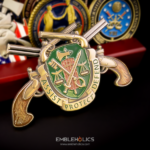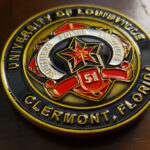
A command development course produces something a department rarely does: a cohort. Officers from agencies across the country spend weeks together, graduate as a numbered session, and keep in touch for the rest of their careers. This coin was made for a Command Officers Development Course run by the Southern Police Institute, carrying the SPI logo and the Session 91 logo across both faces, with the inscriptions engraved and the rim machined into a pattern of fine rectangles.
The session number is the whole point
A leadership course coin is a cohort coin, and the cohort is identified by its session. Graduates do not say they attended SPI; they say which session they were in, and when two of them meet years later that is the first thing they establish.
So the session number is not a detail to tuck into a rim. It should be as prominent as the institution’s own mark, and on a well-designed course coin the two share the billing, as they do here with one logo on each face.
This creates the standard training-coin problem and its standard solution. A course that runs repeatedly needs a coin for every cohort, but a session number struck into a die means a new die each time. Three approaches work:
- A new die per session. Most expensive per cohort, and the cohorts usually prefer it, because the session’s own logo can change each year. Common where each session designs its own.
- A fixed institutional die with the session engraved afterwards. One tooling cost, then a per-coin engraving charge. The session number is smaller and less integrated, but the economics are much better over several years.
- A two-part design. A fixed face carrying the institution and a variable face carrying the session, so only one side of the tooling changes. This is the compromise most institutions land on once they have run a few sessions.
Decide this at the institution level rather than per session, or each cohort reinvents it and nobody gets the benefit of the repeat volume.
Who orders a course coin, and for whom
Course coins have an unusually clean headcount and an unusually messy one at the same time. The class roster is exact. Everything around it is not.
- The class. Known precisely, which is rare.
- Faculty and course staff. Easily forgotten and badly received when missed.
- Guest instructors and speakers. A command course brings in a lot of these, and a coin is the normal thank-you.
- Sponsoring agencies. Officers often want one to take back to the chief who sent them.
- The host agency. Courses are frequently delivered at a host department’s facility rather than on campus, and the hosts should get coins.
A class of thirty can easily need fifty or sixty coins, and because the session number makes the batch unrepeatable, running short is permanent. This is a case for ordering generously.
Engraving and a machined rim
A course coin for command officers should sit closer to a diploma than to a souvenir, and this one does. Engraved inscriptions rather than enamel lettering, a logo given room, and no decorative clutter.
The rim is where the craft is. A pattern of fine machined rectangles around the edge is a detail nobody notices from a distance and everybody notices in the hand. Rim patterning is one of the most cost-effective ways to make a restrained coin feel finished: it lives entirely in the die, so it is paid for once and reproduced across the run for nothing, and it gives the eye a boundary that stops a plain design looking unfinished.
It also suits an academic context. A machined geometric rim reads as precise and institutional, where a rope border would read as traditional and military. For a university-affiliated programme, the former is the better note.
About the Southern Police Institute
The Southern Police Institute has been running since 1951 and sits within the Department of Criminal Justice in the College of Arts and Sciences at the University of Louisville. It provides professional development to law enforcement practitioners, drawing officers from agencies across the United States, and its programmes include the Administrative Officers Course and the Command Officers Development Course.
Courses are often delivered away from campus, hosted by agencies around the country, which is why a given session may be associated with a city far from Louisville. Worth knowing when a coin’s inscription needs to say where a session was held as well as which session it was.
Ordering a course or academy coin
Tell us whether this is one session or the start of a series. That is the question that decides whether you want a single die, a fixed die with engraving, or a two-part design, and getting it right at the institution level saves every subsequent cohort money. Give us the class size plus faculty, guest instructors and host agency, because the roster is only about half the real number. You can see related work including the Sergeants Major Academy coin and more police challenge coins, or send your details through the free quote form.
Frequently Asked Questions
What is a police leadership challenge coin?
It is a coin for a law enforcement command or executive development course rather than for a department. Because these courses draw officers from agencies across the country and graduate them as a numbered session, the coin belongs to a cohort, and the session identity matters as much as the institution’s.
Should the session number go on the coin?
Prominently. Graduates identify themselves by session rather than simply by having attended, so the number should share billing with the institution’s mark rather than being tucked into a rim. On a well-designed course coin the two often take one face each.
How do you handle a coin for a course that runs every year?
Three ways. A new die for each session gives the most freedom and costs the most per cohort. A fixed institutional die with the session number engraved after striking means one tooling cost and a small per-coin charge. A two-part design, with one fixed face and one variable face, changes only half the tooling each time and is where most institutions settle. Decide it institutionally rather than letting each session choose.
How many coins does a course need?
Considerably more than the class roster. Faculty, course staff, guest instructors and speakers, sponsoring agencies and the host agency all need coins, so a class of thirty can need fifty or sixty. Because the session number makes the batch unrepeatable, running short cannot be fixed later.
Should a course coin use enamel or engraving?
Engraving, generally. A command course coin should read closer to a diploma than to a souvenir, which means engraved inscriptions, a logo with room around it and no decorative clutter. It also costs less, since engraving lives in the die rather than being charged per coin by color area.
What does a patterned rim add?
A great deal for very little. A machined pattern around the edge is invisible at a distance and obvious in the hand, it gives a restrained design a boundary so it does not look unfinished, and because it lives in the die it is paid for once and reproduced across the whole run at no extra cost. A geometric rim reads as precise and institutional, where a rope border reads as traditional and military.
What is the Southern Police Institute?
The Southern Police Institute has operated since 1951 as part of the Department of Criminal Justice in the College of Arts and Sciences at the University of Louisville. It delivers professional development to law enforcement practitioners from agencies across the United States, including the Administrative Officers Course and the Command Officers Development Course. Sessions are frequently hosted by agencies away from campus.
More Police Projects