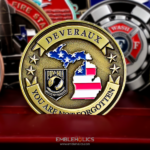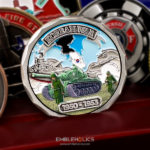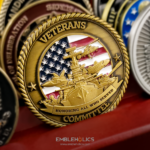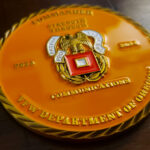
A VFW Department coin sits in the middle tier of the organization. It is not a national coin and it is not a post coin, and that puts it in an unusual position: it has to represent every post in a state without belonging to any one of them.
National, Department, Post
The Veterans of Foreign Wars is organized in three layers, and the word Department is the one that confuses people outside it.
National is the organization as a whole, with its own emblem and its own identity.
A Department is a state. The VFW Department of Oregon is the state-level organization, with its own officers, its own convention and its own programs, and it covers every post in Oregon.
A Post is local. A post is numbered, usually named after a local veteran, and is where most of the activity and most of the spending happens.
Posts order coins all the time, and that is well understood. A Department coin is a different brief. It goes to state officers, to delegates, to visiting national officers, and to posts as a mark of recognition. It has to look like it comes from the state organization rather than from whichever post happens to be hosting.
For the layer below, see a VFW post coin, and for the same three-tier structure in another organization, see American Legion coins.
What a Mid-Tier Coin Can Carry
The constraint is the interesting part. A Department cannot use a post’s artwork, a post number or a city, because that would make the coin local when the whole point is that it is not.
What is left is actually plenty:
The organization’s own emblem. The national emblem belongs to every level, so it reads correctly on a Department coin in a way a post’s device never would.
The state. This is what makes a Department coin a Department coin. The state name, the state outline, or a state symbol, and any of those says the tier without naming a post.
The branch insignia. This coin uses them, and it is a well-judged choice. A Department’s members come from every service, so the branches together say what the organization is made of without favoring anyone. It is the same logic that makes a set of service insignia the right answer for a veterans organization and the wrong answer for a unit coin.
The year or the office. A Department changes officers annually, so a coin can be dated to a term, which makes it a record rather than a standing issue. That is a decision to make deliberately, because a dated coin cannot be reordered after the year ends.
If the design uses service insignia, it is worth confirming your own permissions through the organization rather than assuming, since the branches hold those marks. We cover that in more detail on our military appreciation coin page.
Fine Etching and Why It Needs Room
The front of this coin carries the department logo and the service insignia etched in very fine detail, and that is where the production difficulty was.
Several insignia on one face is a set, not a single element. Branch seals are among the most detailed artwork in common use. Each one contains lettering, a device and usually a border, all inside a circle an inch across on the original. Put five of them on a coin face and each is a fraction of that.
Three things keep that legible:
Size them to equal optical weight. Different seals have different proportions, so matching them by diameter is not the same as making them look equal. Set them by how much space each one appears to occupy.
Accept a floor. Below a certain size, the lettering inside a seal closes up and the seal becomes a disc with texture on it. The only fixes are fewer seals or a larger coin, never smaller artwork.
Give them a clean field. Detailed artwork needs a plain background. A patterned or textured field behind a set of seals makes every one of them harder to read.
See plating options for how the base metal affects how fine etching reads.
About the VFW
The organization traces to 1899, when veterans returning from the Spanish-American War and the Philippines formed local groups, the first of them in Columbus, Ohio. Those groups merged in 1913 into the Veterans of Foreign Wars of the United States. Its work centers on service to veterans and their families, and on community and patriotic programs run largely at post and department level.
Eligibility is the detail that makes the organization what it is: the VFW is for veterans who served in an overseas conflict, which is why the name says foreign wars. It is also why a Department coin carries service insignia so comfortably. Every branch is represented in the membership.
See also more VFW challenge coins and a veterans committee coin.
Order a Department or Post Coin
Free professional artwork, unlimited revisions and a digital proof before anything is produced. Free shipping within the continental US, a 50-coin minimum, and most orders complete 45 to 50 days after artwork approval, with rush production available. Embleholics is veteran-owned, an SDVOSB, and registered in SAM.gov.
Two things worth settling before you ask for a quote. Whether the coin is dated to a term or meant to be reordered, and how many insignia you want on it, because that number decides the diameter rather than the other way round.
See more military challenge coins and commemorative coins.
Frequently Asked Questions
What is a VFW Department challenge coin?
A VFW Department challenge coin is made by the state-level organization rather than by a local post or by national. It represents every post in the state, which is why it carries the organization’s emblem and the state rather than a post number or a city.
What does Department mean in the VFW?
In the VFW, a Department is a state organization. It sits between National and the local posts, has its own officers and convention, and covers all the posts within that state.
How is a Department coin different from a post coin?
A post coin can be entirely local, with a post number, a town and a named veteran on it. A Department coin cannot, because it represents all the posts in a state, so it leans on the organization’s emblem, the state, and the service branches instead.
Can service branch insignia go on a veterans organization coin?
They are a common and well-suited choice, because a veterans organization’s members come from every branch and the insignia together say what the membership is made of. The branches do hold those marks, so an organization should confirm its own permissions rather than assume.
How many insignia fit on one side of a coin?
Three to five, depending on how much lettering each one contains. Service seals are detailed, and below a certain size the text inside them closes up, so the fix for too many is a larger coin rather than smaller artwork.
Should a Department coin carry the year?
Only if you want it to be a record of one term. A dated coin cannot be reordered once the year passes, so Departments that present regularly usually keep the design undated and let the occasion do the dating.
When was the VFW founded?
The organization traces to 1899, when veterans of the Spanish-American War and the Philippines formed local groups, the first in Columbus, Ohio. Those groups merged in 1913 to become the Veterans of Foreign Wars of the United States.
Who is eligible to join the VFW?
The VFW is for veterans who served in an overseas conflict, which is where the name comes from. That eligibility is also why a Department’s membership spans every branch of service.
What is the minimum order for a VFW coin?
The minimum is 50 coins, which suits a post or a Department presenting over a year. Departments that give coins at conventions and visits tend to reorder the same design rather than order a larger run at once.
More Veterans Projects