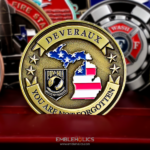
A coin for a university’s veterans office is made for people who are leaving one institution and arriving at another. That is a narrower and more specific audience than either a military unit or a student body, and it shows in the design: a university mark on one face and a compass on the other.
A Coin for People in Transition
Almost every coin on this site marks belonging. A unit coin says you are one of us. A rating coin says this is your trade. An anniversary coin says you were there.
A student veterans coin marks a crossing rather than a membership. The people receiving it have left the service or are leaving it, and are using education benefits to get somewhere else. They are not members of the university in the way an undergraduate is, and they are no longer serving in the way they were.
Three consequences for the design:
It should not look like a unit coin. No insignia, no rank, no branch device as the main subject. A coin that leans on service identity says the thing the holder is moving away from, and most veterans using these services have had enough coins of that kind.
It should not look like campus merchandise either. A university logo on a disc is a bookstore item. What makes this a coin rather than a souvenir is that it marks something, which is the compass face.
It is given individually. These go to people one at a time, across a year, at enrollment, at graduation, at a visit. That means a small run, no date, and a design that will still be right in three years.
Why a Compass Is the Right Device
The reverse carries an etched compass, and it is a better choice than it first appears.
It names the situation without naming anybody’s circumstances. A compass is about finding a direction, which is exactly what a transition service is for, and it says that without implying the holder is lost. A coin given to someone navigating a change of life should be about the navigating rather than about the difficulty.
It is also one of the best shapes in coin design. A compass rose is radially symmetrical, built from straight lines and hard points, and sits naturally inside a circle. It needs no color, holds up at any size, and reads correctly whichever way the coin is turned. Very few devices do all of that.
And it has no owner. Unlike an insignia or a seal, a compass belongs to nobody and needs no approval, which matters on a coin that already has one licensed mark on it.
One practical note: a compass rose is fine line work radiating from a centre, which means it works engraved and recessed rather than raised. Cut lines hold their edges at small sizes where raised points round over.
A Licensed University Mark
The other face carries the university’s logo, and that is the part of this coin that needs handling before artwork.
University names, seals, logos and marks are licensed. They are managed through an institution’s licensing office or an outside licensing agent, and collegiate licensing is among the more carefully policed areas there is. Approval comes from that office rather than from a vendor, and it should be settled before a design is drawn.
We cover the same ground, with the added complication of a service mark alongside it, on our ROTC challenge coin page.
What we need from you is the approved artwork and a note on what may not be altered. What we will do is reproduce it rather than restyle it.
Copper With a Dark Toned Finish
The base is a copper-toned metal, with the university logo in its own colors and a dark coating giving the whole piece a toned look.
Three things that combination is doing:
Copper is the quietest of the three common metal tones. Gold reads as ceremonial and silver as neutral. Copper reads as warm and slightly aged, which suits an institution rather than an occasion.
The dark coating is what makes the engraving read. A toned finish sits in the recesses and leaves the raised surfaces lighter, which is what gives an etched compass its depth. Without it the same engraving would be a faint pattern on a flat field.
Color only on the logo. Everything else is metal and relief, which means the one colored element is the brightest thing on the coin and reads as the official part of the design. That is the same logic as painting an insignia and leaving the rest bare.
See antique and polished finishes and plating options.
Who the Center Is Named For
The center is named for General John W. Vessey Jr., and the reason is worth stating properly rather than calling him legendary.
Vessey enlisted in the Minnesota National Guard in May 1939, at sixteen, as a motorcycle rider. His unit was activated in February 1941. In May 1944, at the Anzio beachhead in Italy, he received a battlefield commission as a second lieutenant with the 34th Infantry Division and served as a forward observer. He went on to become the tenth Chairman of the Joint Chiefs of Staff, serving from 18 June 1982 to 30 September 1985, and he was the last World War II combat veteran to hold that post.
Enlisted private to Chairman of the Joint Chiefs. For a center that exists to help military-connected students get an education and go further, that is about as apt a namesake as there is, and it needs no adjectives attached to it.
The Vessey Veterans Resource Center supports military-connected students at University of Maryland Global Campus, with a veterans lounge on campus and a virtual counterpart.
Order a Coin for a Veterans Office
Free professional artwork, unlimited revisions and a digital proof before anything is produced. Free shipping within the continental US, a 50-coin minimum, and most orders complete 45 to 50 days after artwork approval, with rush production available. Embleholics is veteran-owned, an SDVOSB, and registered in SAM.gov.
Two things to have ready. Approval from your institution’s licensing office for its marks, and the approved artwork files. With those settled the rest moves quickly.
See more other challenge coin projects and military challenge coins.
Finished Coin (Front)

Finished Coin (Back)

Frequently Asked Questions
What is a student veterans challenge coin?
A student veterans challenge coin is made by a university’s veterans office or a student veterans organization, for military-connected students using education benefits. It marks a transition rather than membership in a unit.
Should a student veterans coin use military insignia?
Generally not as the main subject. The people receiving it are moving away from service identity, and most of them already have unit coins. A device about the transition itself works better than a branch emblem.
Why is a compass a good coin device?
Because a compass rose is radially symmetrical, built from straight lines and hard points, and sits naturally inside a circle. It needs no color, holds at any size, reads correctly whichever way the coin is turned, and belongs to nobody so it needs no approval.
Should a compass be engraved or raised?
Engraved. A compass rose is fine line work radiating from a centre, and cut lines hold their edges at small sizes where raised points round over in the strike.
Can a university logo be used on a challenge coin?
University names, seals and logos are licensed marks managed through the institution’s licensing office or an outside agent. Approval comes from that office rather than from a vendor, and it should be settled before artwork begins.
What does a dark toned finish do?
It sits in the recesses and leaves the raised surfaces lighter, which gives etched detail its depth. Without it, engraving on a flat field reads as a faint pattern rather than as cut line work.
Why choose copper over gold or silver?
Copper reads as warm and slightly aged, where gold reads as ceremonial and silver as neutral. For an institution rather than an occasion, copper tends to suit better.
Who was General John W. Vessey Jr.?
He enlisted in the Minnesota National Guard in 1939, received a battlefield commission at Anzio in May 1944 with the 34th Infantry Division, and later served as the tenth Chairman of the Joint Chiefs of Staff from 1982 to 1985. He was the last World War II combat veteran to hold that post.
How many coins should a veterans office order?
Most start at the 50-coin minimum, because these are given individually across a year rather than issued at an event. An undated design can be reordered as needed.
More Veterans Projects