A warship’s crew exists well before the ship does, and the coins that crew orders are among the most sought-after a command will ever produce. This one was made for the chief petty officers of USS Patrick Gallagher (DDG 127), an Arleigh Burke-class destroyer built at Bath Iron Works and christened there on 27 July 2024. The coin is elliptical, designed in the style of a brewery label for the mess’s “Bob’s Goat Locker,” with Navy insignia sculpted in relief on the reverse and a glossy painted finish.
What a plank owner coin is
A plank owner is a member of a ship’s first crew, serving at the moment she is placed in commission. The term is old and the tradition around it is strong: a plank owner’s claim on the ship is one nobody who comes later can acquire. It is a one-time, closed membership that gets smaller every year thereafter and never gets larger.
That makes the coin unusual in a specific way. Most unit coins are reorderable indefinitely. A plank owner coin is finite by definition, which is why these are the coins that turn up in collections, get asked about at reunions and hold their meaning decades later.
Before commissioning, the crew is a pre-commissioning unit, usually written PCU. A PCU has a crew, a chain of command and a growing identity, but it is not yet a USS, because the USS prefix applies only from the moment of commissioning. Some crews order a PCU coin during the build and a separate plank owner coin at commissioning. Others make one coin do both jobs. Either is fine, but decide which, because it determines whether the artwork can carry the USS prefix.
Order before commissioning day, not after
This is the practical core of it. A plank owner coin has to exist on commissioning day, because that is when the crew is assembled in one place for the last time in that configuration. Within months people transfer, and distributing afterwards turns into a mailing exercise against a roster that is already going out of date.
Work backwards from the commissioning date with real margin. Pre-commissioning schedules move. Build timelines slip, delivery dates shift, and commissioning ceremonies get rescheduled. Design and approve early so that a date change costs you nothing, rather than compressing production into whatever window is left.
Count the roster, then add to it. The plank owner list is finite but it is also contested at the margins, and crews frequently want coins for the ship’s sponsor, the shipyard team, families and the namesake’s relatives. Those are not large numbers but they are easy to forget, and there is no second run that means the same thing.
Corporal Patrick Gallagher
DDG 127 is named for Corporal Patrick Gallagher, an Irish-born United States Marine who received the Navy Cross for his actions in Vietnam and was killed in action in 1967, aged twenty-three. He is one of a small number of foreign-born service members to have a warship named after him.
A ship named for an individual gives a crew something most do not have. Where a ship named for a place or a battle offers heraldry, a ship named for a person offers a story, and crews build their identity around it in ways that show up in their coins. A namesake’s family is usually closely involved with the ship, which is another reason to include them in the coin count.
Keep the namesake treatment dignified and factual. A portrait, dates, a decoration, or a line of the citation all work. Where a namesake died in action, the coin is a memorial as much as a unit piece, and the design should carry that even when the rest of it is light-hearted.
When a coin is a joke and a memorial at the same time
This coin is styled like a beer label, and that is not a contradiction. A chief petty officer mess has its own culture, and a goat locker coin is made by chiefs for chiefs rather than for presentation to visiting dignitaries. Humor is entirely appropriate in that context and these are often the best coins a ship produces, because they are made for an audience the designers actually belong to.
Two things keep it on the right side of the line. The first is that the humor belongs to the mess, not to the namesake: the beer-label styling is about the goat locker, and the ship’s formal identity sits on the reverse where it belongs. The second is to run a second, straight design for anything that leaves the mess. A command needs a coin it can hand to a congressman, a foreign officer, or the namesake’s family, and a brewery pastiche is not it.
One thing to check before striking. A design that closely imitates a real brand’s label, typography or trade dress can run into trademark problems, even on a non-commercial unit coin, and the risk sits with whoever commissioned it. The safe version takes the form of a label — the oval, the banner, the ornate border, the mock heritage lettering — and invents everything in it. That is how this one works, and it is funnier for being original.
Ordering a plank owner or PCU coin
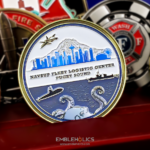
Tell us the commissioning date, the roster size and whether the coin is for the whole crew or for the mess. Those three answers settle the schedule, the quantity and the register. If the design is intended to be irreverent, say so plainly and we will tell you honestly whether anything in it is likely to cause a problem before it is struck rather than after. You can see more Navy challenge coins, including the USS Patrick Gallagher belt buckle we produced for the same ship and the NAVWAR goat locker coin, or send your details through the free quote form.
Frequently Asked Questions
What is a plank owner challenge coin?
A plank owner is a member of a ship’s first crew, serving when she is placed in commission, and a plank owner coin marks that membership. Because the group is fixed at commissioning and can never be joined afterwards, the coin is finite by definition, which is why these coins are among the most valued and most collected a ship ever produces.
What is the difference between a PCU coin and a plank owner coin?
Before commissioning a ship’s crew is a pre-commissioning unit, written PCU, and the USS prefix does not yet apply. A PCU coin is made during the build and should not carry USS; a plank owner coin marks the commissioning itself and can. Some crews order both, others make one coin serve both purposes, but the decision has to be made before artwork because it determines the wording.
When should a plank owner coin be ordered?
Early enough to be in hand on commissioning day, which is the last time the first crew is assembled in one place. Work backwards from the commissioning date with generous margin, because pre-commissioning schedules shift regularly and a compressed production window is the common failure. Distributing afterwards means mailing against a roster that is already changing.
How many plank owner coins should we order?
The roster, plus more than you think. Crews routinely want coins for the ship’s sponsor, the shipyard team, families and the namesake’s relatives, and those are easy to overlook when counting. Because a second run does not carry the same meaning, this is a case for ordering generously the first time.
Who was Patrick Gallagher?
Corporal Patrick Gallagher was an Irish-born United States Marine who received the Navy Cross for his actions during the Vietnam War and was killed in action in 1967 at the age of twenty-three. USS Patrick Gallagher (DDG 127), an Arleigh Burke-class destroyer christened at Bath Iron Works on 27 July 2024, is named for him. He is among a small number of foreign-born service members to have a warship named in their honor.
Can a unit coin be humorous?
Yes, and coins made within a chief petty officer mess are often the best a ship produces precisely because they are made for an audience the designers belong to. The thing to get right is scope: keep the humor to the piece that stays within the mess, and run a separate straight design for anything that will be handed to visiting officials, foreign officers or a namesake’s family.
Can a coin be designed to look like a brand or product label?
It can take the form of one safely, but it should not imitate a specific real brand. A design that closely copies an actual company’s label, typography or trade dress can create a trademark problem even on a non-commercial unit coin, and the exposure sits with whoever ordered it. Borrowing the format and inventing all the content gives you the same joke without the risk.
More Navy Projects