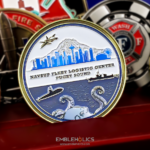
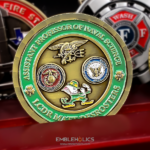
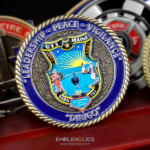
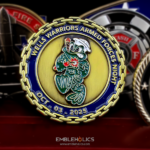
A custom piece carrying a large number of intricate elements, each one engraved and then colored, with gradient shading in the paint supplying depth and texture across the design. The page calls it one of the nicest coins the shop has produced. This NAVWAR Goat Locker coin was made for Naval Information Warfare Systems Command, an acquisition command of more than 10,000 active duty and civilian personnel.
The Goat Locker
The goat locker is the chief petty officers’ mess, and the name is one of the Navy’s older pieces of slang.
It refers to the chiefs’ berthing and dining space aboard ship, which is separate from the rest of the crew’s. The space is more than accommodation. It is where the senior enlisted leadership of a ship meets, where decisions about the crew get worked out before they are announced, and where new chiefs are inducted into the community. Entry is by invitation.
That exclusivity is precisely why a goat locker coin is a strong object. It represents membership in a defined body with its own space, its own traditions and its own standards, which is the clearest possible case for a coin. A command coin says where you work. A goat locker coin says what you are.
It also means the audience is small and senior. Chiefs are the people most associated with coin culture in the first place, and they are the least likely to be impressed by a mediocre piece, which raises the bar on anything made for them.
See also Navy chief traditions and the coins that mark them and a submarine chiefs mess coin.
Gradient Shading in Paint
Graded paint is a step beyond flat enamel fills and it is the technique that distinguishes this coin.
Flat color is the norm. Standard coin paint fills an area with one solid value, separated from the next color by a raised metal wall. It is clean, durable and entirely flat.
A gradient adds depth without relief. Varying the value across a single area makes a flat surface read as curved or lit from one side, which is a way of getting dimensionality out of color rather than out of the die.
It suits complex designs. On a coin with many elements, sculpting each one deeply is not possible in the space available. Shading lets elements separate and recede without each needing its own relief height.
And it is the harder technique. A flat fill either covers the area or it does not. A gradient has to transition smoothly and match across every coin in the run, which is a much narrower tolerance.
The consistency question is the one to ask. Graded paint that varies between pieces produces a batch where some coins look better than others, and that is worth confirming before a large order.
Naval Information Warfare Systems Command
NAVWAR develops and sustains the Navy’s communications and information warfare capabilities, with more than 10,000 active duty and civilian personnel. It is an acquisition command, which means its work is buying, building and sustaining systems rather than operating them.
Two things follow for a coin. The first is the civilian majority. A command where most of the workforce is civilian cannot lean entirely on military convention, and a chiefs’ mess inside such a command is a comparatively small uniformed community within a much larger organization. That makes the goat locker identity sharper rather than weaker.
The second is that the work is abstract. Information warfare systems have no physical form a coin can show, which pushes a design toward symbolism and toward complexity, since there is no single object to put in the middle. That is part of why a coin from this command ends up carrying many elements rather than one.
When a Busy Coin Is the Right Answer
Most advice on coin design argues for restraint, so it is worth saying when complexity is correct.
When the audience will study it. A coin given to a small, senior group who will look closely rewards detail that would be wasted on a piece handed out widely.
When the organization genuinely has many parts. A command with multiple directorates and no single mission image has real content to carry, and reducing it to one symbol would be a distortion rather than a simplification.
When the production can hold it. Detail is only an asset if it survives the strike. A busy design on a cheap die is a muddy coin, which is worse than a simple one.
And when there is a hierarchy. A complex coin still needs one thing the eye lands on first. Many elements with no lead is clutter; many elements arranged around a focal point is richness.
The failure mode is adding elements because they were requested rather than because they say something, which is how most crowded coins get crowded.
Order a Chiefs Mess or Command Coin
Professional artwork is free with unlimited revisions, and nothing goes into production until you approve a digital proof. The challenge coin minimum is 50 pieces, standard production runs about 45 to 50 days after final artwork approval, rush production is available on many projects, and shipping within the continental United States is included. Embleholics is veteran-owned, SDVOSB and registered in SAM.gov.
Two suggestions. If the design uses graded rather than flat paint, ask about consistency across the run, since a gradient has a much narrower tolerance than a solid fill and variation between pieces is visible when coins sit side by side. And if the coin carries many elements, establish which one the eye should land on first, because complexity with a focal point reads as rich and complexity without one reads as clutter. Request a free quote to begin.
Frequently Asked Questions
What is the goat locker?
The chief petty officers’ mess, the berthing and dining space aboard ship reserved for chiefs. It is where the senior enlisted leadership meets and where new chiefs are inducted, and entry is by invitation.
Why is a goat locker coin significant?
Because it represents membership in a defined body with its own space and standards. A command coin says where someone works, while a goat locker coin says what they are.
What is gradient shading on a coin?
Paint that varies in value across a single area rather than filling it with one solid color. It makes a flat surface read as curved or lit, adding depth without additional relief.
When is graded paint worth using?
On complex designs where sculpting every element deeply is not possible. Shading lets elements separate and recede without each needing its own relief height.
What is the risk with graded paint?
Consistency. A gradient has to transition smoothly and match across every piece in the run, which is a far narrower tolerance than a flat fill, and variation shows when coins sit together.
What does NAVWAR do?
It develops and sustains the Navy’s communications and information warfare capabilities, with more than 10,000 active duty and civilian personnel. It is an acquisition command rather than an operational one.
When is a busy coin design the right choice?
When the audience will study it, when the organization genuinely has many parts, and when the production can hold the detail. Detail that does not survive the strike makes a muddy coin.
How do you keep a complex coin from looking cluttered?
Give it a focal point. Many elements arranged around something the eye lands on first reads as rich, while the same number with no hierarchy reads as clutter.
More Navy Projects