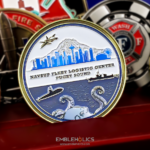
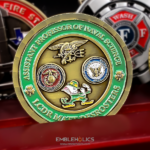
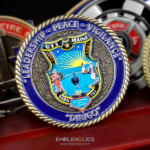
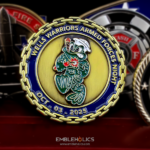
The dolphins are the submarine force’s warfare insignia, and they are the most requested element on any submarine coin. This one was made for USS Henry M. Jackson (SSBN 730), and it is an unusual piece: a silver coin with a gold octopus sculpted across it, holding the dolphins in its arms, and an engraved compass on the reverse carrying the boat’s initials and hull number.
Warfare insignia are earned, which changes how you use them
A unit crest identifies an organization. A warfare device identifies an individual’s qualification, and that distinction matters on a coin. Submarine dolphins, aviator wings, the surface warfare pin, the EOD badge and the parachutist badge are all awarded to a person for completing a qualification, not issued to a command.
The practical rule is simple: a coin carrying a warfare device should be going to people who hold it. A boat’s coin showing dolphins is entirely correct, because the crew are qualified submariners or working toward it. A coin given broadly to people outside the community, with a device on it, sits less comfortably.
Two cases worth thinking through:
- A command coin given to visitors. If the coin will be handed to civilians, foreign officers and people from other communities, the device is being used as decoration rather than as recognition. That is common and nobody objects, but the unit crest usually does the job better anyway.
- A qualification coin. Some boats present a coin when someone earns their dolphins, which is the strongest possible use of the device: the coin and the pin mark the same thing. If that is the intent, say so, because the design should centre on the device rather than treat it as an accessory.
Devices are prescribed artwork. Dolphins come in two forms, gold for officers and silver for enlisted, and the design is specified rather than interpretive. Reproduce them accurately or stylise them clearly; a half-accurate device looks like a mistake.
The octopus, and submarine imagery generally
The octopus has no official standing in the submarine force, and it is used constantly anyway. Kraken and octopus imagery appears across boat coins, patches and mess decorations as informal shorthand for the service: something large and unseen operating below the surface. It is a tradition of the community rather than a sanctioned symbol, which is precisely why it works on a coin made by and for that community.
Sculpting a creature across a flat coin is the technical interest here. The octopus is modelled in gold against a silver field, which is a two-tone plating job rather than enamel, and it is the right call: a sculpted animal reads through relief and shadow, and color would flatten it. The gold also separates the creature from the coin it is crawling on, so the two elements stay legible as two things.
A note on what this coin is not showing. There is a longstanding association between Castor and Pollux and sailors, from the lights seen on a ship’s rigging in a storm, but the twin figures flanking a submarine on the dolphins device are dolphins, not fish or mythological figures. It is worth naming the elements correctly on a coin page, because the audience knows.
A compass, initials and a hull number
The reverse is a model of restraint, and worth copying. An engraved compass with HMJ and 730 set around it is three pieces of information and no decoration: the boat’s identity in shorthand, in a form every crew member recognizes instantly.
Hull numbers do more work than ship names. Within the fleet a boat is as often 730 as Henry M. Jackson, and the number is shorter, bolder and legible at any size. On a coin where one face is given over to a sculpted element, putting the hull number on the other is the efficient choice.
Initials are a submarine habit worth knowing about. Boats with long names get shortened, and the crew’s own abbreviation is usually the right thing to put on a coin, rather than the full name squeezed small. Ask the crew what they call her.
About the boat
USS Henry M. Jackson (SSBN 730) is the fifth Ohio-class ballistic missile submarine and the only one not named for a state. She was to have been named USS Rhode Island, but was renamed after the death of Senator Henry M. Jackson of Washington in 1983; the Rhode Island name later went to SSBN 740. She was launched on 15 October 1983 and commissioned on 6 October 1984, and she serves with Submarine Squadron 17 at Bangor, Washington.
Bangor is a few miles from us. Embleholics is a veteran-owned shop in Port Orchard, Washington, so the Bangor boats and their crews are local work, and the Ohio-class boomers based there are a regular part of what we make coins for.
Ordering a submarine coin
Tell us whether the coin is for the crew, for presentation, or for a qualification. That decides whether the dolphins are the subject or an element, and it is the question that most often goes unasked. Send the boat’s emblem, tell us what the crew actually calls her, and remember that an SSBN has two crews, so the quantity is usually double what the manning figure suggests. You can see more Navy challenge coins, including the USS Alaska coin and the Submarine Development Squadron 5 coin, or send your details through the free quote form.
Frequently Asked Questions
What are submarine dolphins?
The dolphins are the submarine warfare insignia, awarded to a sailor on completing submarine qualification. They come in two forms, gold for officers and silver for enlisted personnel, and they are the most recognizable symbol in the submarine force. Because they are earned by individuals rather than issued to commands, they carry a different weight from a unit crest.
Can a challenge coin include a warfare device?
Yes, and boat and squadron coins do it routinely. The sensible rule is that a coin carrying an earned device should be going to people who hold it, or to the community it belongs to. A coin intended mainly for visitors and people outside that community is usually better served by the unit crest, where the device would just be decoration.
Should we reproduce the device exactly?
Either reproduce it accurately or stylise it clearly and deliberately. Warfare devices are prescribed artwork rather than open designs, so a version that is almost right reads as an error to everyone who holds one. If the design calls for a simplified treatment, make it obviously a treatment rather than a near-miss.
Why do submarine coins use octopus and kraken imagery?
It is a tradition of the community rather than an official symbol. Octopus and kraken imagery appears across boat coins, patches and mess decorations as informal shorthand for something large operating unseen below the surface. Having no official standing is part of why it works: it belongs to the crews rather than to the Navy.
How do you sculpt a creature across a coin?
Through relief and plating rather than color. A modelled animal reads by shadow, so enamel tends to flatten it, while a two-tone treatment such as gold over a silver field separates the creature from the coin beneath it and keeps both legible. The limbs need thickening slightly where they cross the edge so nothing thin is left unsupported.
Should a coin show the ship’s name or the hull number?
Often the number, and frequently both in shorthand. Within the fleet a boat is referred to by hull number as much as by name, and the number is shorter, bolder and readable at any size. Crews also have their own abbreviation for a long name, and that is usually the right thing to put on their coin.
What is USS Henry M. Jackson?
USS Henry M. Jackson (SSBN 730) is the fifth Ohio-class ballistic missile submarine and the only one not named after a state. She was originally to be named USS Rhode Island but was renamed following the death of Senator Henry M. Jackson of Washington in 1983. She was launched on 15 October 1983, commissioned on 6 October 1984, and serves with Submarine Squadron 17 at Bangor, Washington.
More Navy Projects