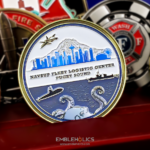
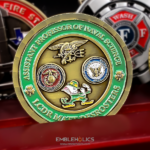
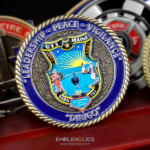
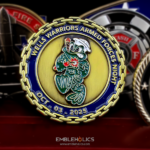
A ballistic missile submarine is crewed differently from any other ship in the Navy, and that single fact changes how its coins should be ordered. This one was made for the commanding officer of USS Alaska (SSBN 732), an Ohio-class ballistic missile submarine commissioned on 25 January 1986. It is an oval rather than a round coin, finished in matte gold with glossy paint on the engraved graphics, and its fonts and artwork are taken directly from the boat’s own emblem.
Blue and Gold: one boat, two crews, two coin problems
An SSBN is operated by two complete and separate crews, called Blue and Gold, who alternate the boat between patrols. One crew takes her to sea while the other trains and takes leave ashore, then they swap. USS Alaska has run this way since her first two patrols in 1986 and 1987, each conducted by a different crew.
For a coin order, that has two consequences nobody anticipates the first time.
The quantity is double what the manning document suggests. If you are coining the ship’s company, you are coining two ship’s companies. This is the single most common reason an SSBN coin order comes up short, and the fix costs nothing if you catch it before ordering and costs a second production run if you do not.
You have to decide whether the crews share a coin or split it. Three approaches are all in common use:
- One boat coin for both crews. Carries the hull and the ship’s emblem with no crew marking. Simplest, cheapest, reorderable forever, and it treats the boat as the thing that endures. Most command coins work this way, including this one.
- One design, two colorways. The same die struck in two finishes, or the same design with a blue or gold enamel element. Each crew gets its own coin at almost no extra design cost, since the die is shared.
- Two separate designs. Each crew gets its own artwork and identity. The most expensive route, since it is two dies, and worth it only where the crews genuinely want distinct identities.
The middle option is the one most crews end up happy with, because it recognizes the Blue and Gold distinction that matters enormously to the people living it, without paying twice for tooling.
Why an oval suits a boat
A submarine is long and low, and so is an oval. It is a quiet piece of design logic that works: the shape echoes the hull, it gives a long axis for a boat name and hull number to run along, and it reads as deliberate rather than defaulted. A round coin gives you a symmetrical field with no natural reading direction, which a long name has to fight.
An oval is also among the cheapest departures from a circle. It needs a die cut to its own profile, which is quoted separately, but with no points or narrow extremities it is at the simple end of custom shapes and carries none of the fragility risk that comes with an irregular outline.
Matte gold with glossy paint
The finish combination here is doing deliberate work. A matte or satin gold base absorbs light instead of throwing it back, which means the glossy painted elements become the only reflective surfaces on the coin. The eye goes straight to them. The same artwork on a bright polished base would compete with itself, because the field and the graphics would both be catching light.
It also wears better than a full polish. A matte base does not record fingerprints and fine scratches the way a mirror finish does, which matters for a coin that will be handled constantly during a patrol cycle. If you want a coin to look good in two years rather than on the day it arrives, this is the specification to copy.
USS Alaska
USS Alaska (SSBN 732) is an Ohio-class ballistic missile submarine, commissioned on 25 January 1986. She was based in the Pacific Northwest from late 1986, departing Kitsap for the last time in July 2006, and has been homeported at Naval Submarine Base Kings Bay, Georgia, since 2009. Ohio-class SSBNs carry out the sea-based leg of the United States nuclear deterrent, conducting long strategic deterrent patrols.
Her Pacific Northwest years are close to home for us. Embleholics is a veteran-owned shop in Port Orchard, a few miles from Naval Base Kitsap, and the boats that came and went from Bangor and Bremerton are part of the local landscape. We have made coins for a number of them, including the USS Henry M. Jackson coin.
Ordering a coin for a boat
Tell us the hull, the crew arrangement, and who the coin is for. If the boat runs Blue and Gold crews, say so in the first message and we will size the order correctly and show you what the two-colorway option looks like before you commit. Bring the boat’s emblem in the highest resolution you have, since taking the fonts and artwork from the official emblem, as this coin does, is what makes a boat coin look like it came from the boat. You can see more Navy challenge coins, including the Submarine Development Squadron 5 coin, or send your details through the free quote form.
Frequently Asked Questions
What are Blue and Gold crews?
Ballistic missile submarines are operated by two complete, separate crews, designated Blue and Gold, who alternate the boat between patrols. While one crew is at sea, the other trains and takes leave ashore, then they swap. The arrangement keeps the submarine deployed for a far greater share of the year than a single crew could sustain.
How many coins does an SSBN need?
Roughly double what the manning figure suggests, because you are coining two complete crews rather than one. This is the most common reason an SSBN coin order falls short, and it costs nothing to correct at the quote stage but requires a second production run if it is missed.
Should Blue and Gold crews have separate coins?
There are three workable answers. A single boat coin with no crew marking is simplest, cheapest and reorderable indefinitely. One design struck in two colorways, or with a blue or gold enamel element, gives each crew its own coin while sharing a die, and this is where most crews land. Two entirely separate designs means two dies and only makes sense where the crews want genuinely distinct identities.
Why choose an oval coin for a submarine?
The shape echoes the hull, and the long axis gives a boat name and hull number somewhere natural to run, which a round coin does not. An oval also sits at the inexpensive end of custom shapes: it needs its own die profile but has no points or narrow extremities to deform or catch.
Why use a matte base with glossy painted detail?
Because a matte field absorbs light while the painted elements reflect it, so the eye goes straight to the artwork. On a bright polished base the field and the graphics compete for attention. A matte base also hides fingerprints and fine scratches, so the coin still looks good after a patrol cycle of handling.
What is USS Alaska?
USS Alaska (SSBN 732) is an Ohio-class ballistic missile submarine commissioned on 25 January 1986. She operated from the Pacific Northwest from late 1986 until the mid-2000s and has been homeported at Naval Submarine Base Kings Bay, Georgia, since 2009. Ohio-class SSBNs carry out the sea-based leg of the United States nuclear deterrent.
Should a boat coin use the official ship’s emblem?
Wherever possible, yes, and that includes the fonts. Taking the artwork and lettering directly from the boat’s own emblem, rather than redrawing something similar, is most of what makes a coin look like it genuinely came from that command. Send the emblem at the highest resolution you can get and we will work from it rather than around it.
More Navy Projects