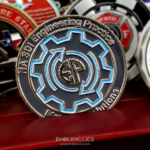
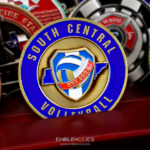
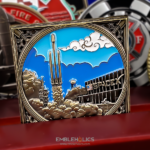
The front carries the parent club’s logo and the reverse carries the local chapter’s, both carved and embossed and painted in their own colors. Patterns are carved into the edge, which gives the piece a darker, more menacing feel than the faces alone would.
Costume and Fan Clubs Are Membership Organizations
Costume clubs sit alongside riding associations, lodges and car clubs in the coin world more comfortably than people expect, because structurally they are the same kind of thing.
They have chapters. A national or international club organized into named local groups is exactly the shape that produces coin orders, because the chapter is where the membership and the money sit.
They have a calendar. Conventions, appearances, charity events and troop-outs run through the year. That is a season rather than a single date, and it means a coin gets used rather than shelved.
Charity work is central. Many costume clubs exist substantially to raise money for causes through appearances. A coin is both an identity object and something that can be sold or given at those events.
Membership turns over and grows. New members join continuously, which makes coin orders recur.
And they meet other chapters. Conventions put chapters from different regions in the same room, which is where exchanging a coin becomes a natural courtesy, the same way it works in the military. For another fan community’s coin, see our Podcast Challenge Coin.
See more organization challenge coins and, for the same structure in another hobby, a car club challenge coin.
Parent Club and Chapter, One per Face
The two logos get a face each, which is the standard answer whenever an organization has two levels.
Putting both on one face ranks them by size and position, and in a club where the relationship between the national body and a local chapter matters, that is a conversation nobody wants to have over a proof. Two faces removes it, and each logo gets the whole space it was drawn for rather than half of one.
It also gives the coin a reading order. The parent club identifies what the coin belongs to, and turning it over tells you which chapter. That is a sensible use of a reverse and better than filling it with text.
The same approach works for any chapter-based organization, which is most of them: lodges under a Grand Lodge, posts under a national veterans body, locals under a union, chapters under a riding association.
Patterns Carved Into the Edge
The edge of this coin is carved rather than left plain, and it is the detail that gives the piece its character.
Most coin briefs cover two faces and forget the third surface. The edge is real estate, and leaving it smooth is a decision whether anybody makes it deliberately or not.
A carved edge is visible when the faces are not. Held between finger and thumb, or sitting in a stack, a coin shows its edge and nothing else. A pattern there means the piece is doing something from every angle.
It changes the feel in the hand. A smooth edge is slippery; a carved one grips. For a coin that will be handled, turned over and passed around at events, that is a real improvement rather than a cosmetic one.
And a custom pattern carries theme. A standard reeded or diamond edge is a finish. A pattern drawn specifically for the organization is part of the design, and it is one of the few places to put thematic detail that does not compete with the logos on the faces.
The cost is small, because the edge is machined as part of producing the coin either way. The thing to know is that it has to be specified at the quote stage, since it affects the die. See manufacturing and finish options.
Carved and Embossed Logos
Both logos are carved and embossed rather than printed flat, which suits club artwork well.
Club logos tend to be bold: strong outlines, high contrast, clear shapes, because they were designed to work on patches, shirts and banners and to be recognized across a convention hall. Those are exactly the qualities that survive being struck into metal, which means club artwork usually needs less adaptation than a corporate logo does.
What normally changes is the color count, since enamel costs scale with the number of distinct fills and patch artwork can carry more colors cheaply than metal can. The usual approach is to keep the colors that carry meaning and drop the ones that were only shading.
About the Club
The Twin Suns Spire is a chapter of The Dark Empire, an international costume club built around science fiction villain characters. The club attends conventions and carries out charity work in Arizona, and it welcomes new members across a range of character types.
Order a Coin for Your Club
Send us your club and chapter artwork, or clear photographs of your patches if the original files are gone. Professional artwork is free with unlimited revisions, and nothing goes into production until you approve a digital proof. The challenge coin minimum is 50 pieces, standard production runs about 45 to 50 days after final artwork approval, rush production is available on many projects, and shipping within the continental United States is included. Embleholics is veteran-owned, SDVOSB and registered in SAM.gov.
Two things to settle before ordering. Club logos and chapter devices are usually owned by the parent organization and licensed to chapters under its own rules, and the rules on selling items carrying the logo are often stricter than those on giving them away, so clear it through your chapter officers and your parent club first. Separately, if any element of your design draws on a film, game or franchise, confirm with the rights holder what your club is permitted to reproduce on merchandise; fan club permissions vary and do not automatically extend to manufactured goods. We produce from artwork the customer is authorized to supply and do not grant permission on anyone’s behalf. Request a free quote to begin.
Frequently Asked Questions
What is a fan club challenge coin?
It is a coin made for a hobby, costume or fan organization, usually carrying the parent club’s logo on one face and a local chapter’s on the other. Structurally these clubs work like any other chapter-based membership body.
Can a costume club order challenge coins?
Yes, and they are a natural fit. Chapters are local and self-funded, the convention and charity calendar runs through the year, membership turns over, and meeting other chapters at events creates exactly the exchange culture that coins come from.
How do you fit a parent club and a chapter on one coin?
One logo per face. Putting both on a single face ranks them by size and position, which members notice, and each mark ends up with half the space it was drawn for. Two faces also gives the coin a reading order.
Can patterns be carved into the edge of a coin?
Yes, and a custom pattern is one of the few places to put thematic detail without competing with the logos. The edge is machined as part of production either way, so the added cost is small, but it has to be specified at the quote stage because it affects the die.
Why bother with the edge of a coin?
Because it is visible when the faces are not. Held between finger and thumb or sitting in a stack, a coin shows only its edge. A pattern there also gives the fingers something to grip, which matters for a coin handled constantly at events.
Does club patch artwork work on a coin?
Usually very well. Patch and banner artwork is built from bold outlines, high contrast and clear shapes so it reads across a hall, and those are the qualities that survive being struck in metal. Corporate logos tend to need more adaptation.
What has to change when patch art goes on a coin?
Mainly the color count. Enamel cost scales with the number of distinct fills, and fabric can carry more colors cheaply than metal can. The usual approach is to keep the colors that carry meaning and drop the ones that were only shading.
Do we need permission to use our club’s logo?
Generally the parent organization owns the logo and licenses it to chapters under its own rules, and rules on selling branded items are often stricter than on giving them away, so clear it through your officers first. If any element draws on a film, game or franchise, confirm separately with the rights holder what your club may reproduce on merchandise.
More Corporate Projects