Car clubs sit alongside military units and fire departments in the coin world more comfortably than people expect. A club has members, a name, a logo, an annual calendar and a reason to hand something to a guest. That is the whole recipe.
Why Car Clubs Order Coins
A club is a membership organization with a visual identity already built. Most car clubs have a logo on jackets, banners and window decals before anyone mentions a coin, which means the artwork question is usually settled before the conversation starts.
The calendar is full. This is the part that makes a car club a better fit for coins than a one-off commemorative buyer:
- Cruises and club runs through the season
- Car shows, both ones the club attends and ones it hosts
- Charity drives, which many clubs organize as their main annual activity
- Picnics and club socials
- New member welcomes, which happen throughout the year
- Club anniversaries
- Visiting clubs, where exchanging a coin is the natural courtesy
And clubs are self-funded at the right scale. Dues and events pay for it, and a club’s membership typically sits comfortably above a 50-piece minimum without approaching the quantities a national organization would need.
Coins also travel well in this world. A club that meets other clubs at shows has an obvious use for something to hand over, which is the same exchange logic that drives coins in the military. See other association work, such as a golf challenge coin or a veterans riding association coin.
A Predominantly White Coin
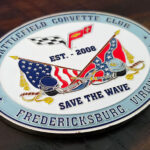
This coin is mostly white, with baby blue and red and blue accents. A white field is a specific production decision and worth understanding before you specify one.
White is a filled color, not an absence of color. On a soft enamel or printed coin, white is applied the same way red or blue is. It does not come for free because the metal underneath is light, and a large white area is a large filled area.
It is the least forgiving color on a coin. Any contamination, any thin spot, any slight unevenness in the fill shows against white where it would be invisible against a dark field. Black hides flaws. White displays them.
It also handles dirt differently in use. A coin that lives in a pocket or on a dashboard will show wear on a white field sooner than on a dark one. Epoxy coating is worth considering for a predominantly white design for exactly this reason.
And it changes how the accents read. Against white, baby blue and red sit forward and look brighter than they would against a dark background. That is why a pale palette works here instead of looking washed out: the white is doing the contrast work that a dark field would normally do.
The choice suits the subject. A pale, clean palette reads as automotive rather than institutional, which is correct for a car club and would be wrong for a unit coin. Our page on finish and enamel options covers the processes.
What the Two Faces Carry
The front carries the club’s logo, built around crossed flags, hats and sabers.
That imagery comes from the club’s location rather than from cars, and it is the sort of detail that makes a club coin specific rather than generic. A logo drawn from local history gives the coin something no other Corvette club’s coin has.
The reverse takes a different approach entirely. It carries a map of the United States with the flag, and lists the Corvette generations, C1 through C8.
That generation list is the smartest element on the coin. Every Corvette owner knows which generation they drive, and seeing the full run from C1 to C8 places their car in a sixty-year line. It is a piece of shared language among owners that means nothing to anyone else, which is exactly what you want on a coin for a specific community.
It is also a design that could date, and the club clearly accepted that. A generation list is accurate until the next generation arrives. That is a reasonable trade for an element that does this much work, but it is worth being deliberate about: if you want a coin that will still be current in ten years, avoid anything that is a snapshot of a sequence still running.
About the Club
The Battlefield Corvette Club is based in Fredericksburg, Virginia, and brings together Corvette owners across the generations for cruises, shows, picnics, racing and charity events.
Order a Coin for Your Club
Send us your club logo, or a clear photograph of it from a jacket, banner or decal if you do not have the original file. Most clubs have usable artwork already.
Professional artwork is free with unlimited revisions, and nothing goes into production until you approve a digital proof. The challenge coin minimum is 50 pieces, standard production runs about 45 to 50 days after final artwork approval, rush production is available on many projects, and shipping within the continental United States is included. Embleholics is veteran-owned, SDVOSB and registered in SAM.gov.
One thing to settle at the artwork stage. If your logo includes a manufacturer’s name, model name or badge, confirm what you are authorized to reproduce before ordering. Car manufacturers hold trademarks on model names and emblems, and permission comes from them rather than from us. More in Can a Sports Team or Movie Character Go on a Coin and Who Gets Permission to Use a Logo on a Coin. A club’s own logo and a car’s silhouette are a different matter. Request a free quote to begin.
Frequently Asked Questions
What is a car club challenge coin?
It is a coin made for an automotive club, carrying the club’s logo and usually something tied to the cars its members drive. Clubs use them at shows, cruises and charity events, and exchange them with visiting clubs the same way military units do.
Why do car clubs order challenge coins?
Because a club already has everything a coin needs: members, a name, a logo and a full calendar of cruises, shows, charity drives and socials. Clubs are also self-funded at a scale that suits a 50-piece order.
Can a coin be mostly white?
Yes. White is applied as a filled color the same way any other is, so a large white area is a large filled area rather than bare metal. It works well as a background because accent colors sit forward against it and look brighter than they would on a dark field.
Is white a difficult color on a challenge coin?
It is the least forgiving one. Contamination, thin spots and slight unevenness all show against white where a dark field would hide them. White also shows handling wear sooner, which is why an epoxy coating is worth considering on a predominantly white design.
Does a white coin get dirty in use?
More visibly than a dark one, yes. A coin carried in a pocket or kept on a dashboard picks up handling marks, and a white field displays them. An epoxy dome protects the surface and makes the coin easy to wipe clean.
Can a coin list car generations or model years?
Yes, and it is effective because it speaks directly to owners. The trade-off is that a list of a still-running sequence will date when the next entry arrives, so decide whether you want a coin that is current now or one that will still be accurate in ten years.
Can we use our club logo on a coin?
Yes. Send the artwork file, or a clear photograph of the logo from a jacket, banner or decal if the original file is gone. Most clubs have usable artwork already, and a photograph is often enough to work from.
Can a car manufacturer’s badge go on a club coin?
Manufacturer names, model names and emblems are trademarked, so confirm what you are authorized to reproduce before ordering. A club’s own logo and a car’s silhouette are a different matter. We produce from artwork the customer supplies and do not grant permission on a manufacturer’s behalf.
More Corporate Projects