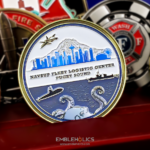
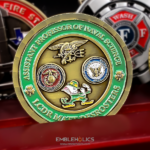
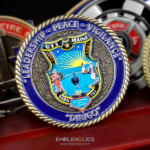
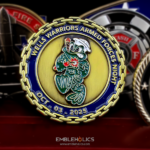
The coin is cut to the shape of an oak leaf. It began as a basic sketch from the customer, which the art team formalized and then worked through many rounds of revision and additional notes before the design was finalized. This commander challenge coin was made for a customer in the Navy supply community.
The Oak Leaf and Rank
The oak leaf is one of the most specific symbols in American military insignia, and using it as a coin shape is a precise statement rather than a decorative one.
It is a rank device. The oak leaf marks the field grade officer ranks, gold for one level and silver for the next, worn on the collar and the shoulder. Anyone in uniform reads it instantly as a rank rather than as foliage.
Which makes it personal. A unit coin represents an organization. A rank shaped coin represents a position and the person holding it, so a commander’s coin cut to an oak leaf says who is giving it rather than where it came from.
It is the commander’s own coin. Many commanders carry a personal coin distinct from the unit coin, presented at their discretion for performance. The shape here signals exactly that category.
And the outline behaves well. A leaf is a closed form with a broad center and gently tapered ends, so it has usable area and no fragile projections. It is one of the safer custom dies.
See also custom shaped challenge coins and Navy challenge coins.
The Navy Supply Corps
The Navy Supply Corps handles the logistics behind everything the fleet does: provisioning, fuel, parts, contracting, disbursing and food service, afloat and ashore. A supply officer aboard a ship is responsible for the material that keeps the ship operating, which is a command function rather than an administrative one.
It is a community with a strong internal identity, partly because supply officers are staff corps rather than line officers and partly because the work is specialized enough that the community trains and advances largely among itself. Supply officers start at Newport; see our Navy Supply Corps School Challenge Coin. Communities like that produce coins at a higher rate than more diffuse parts of a service, because the group is defined and the recognition is internal.
It is also work with the classic support organization problem. A ship that has what it needs is unremarkable, and a ship that does not is a crisis. The measure of success is the absence of a problem, which is the single most common reason an organization ends up wanting coins.
See also a Navy supply corps challenge coin and a ready for sea Navy supply coin.
From a Customer Sketch to a Finished Die
This design started as a basic sketch, which is worth saying because people often assume artwork has to arrive in a usable state.
A rough sketch is a good starting point. It communicates intent, layout and priority faster than a written brief, and those are the things hardest to extract any other way. It does not need to be well drawn.
The formalizing step is where the work is. Turning a sketch into machinable geometry means setting proportions, deciding relief heights, fixing line weights and resolving everything the sketch left implied. Most of those are decisions, not transcription.
Many revisions is normal and not a warning sign. Each round resolves something: text fitting, contrast, a detail that will not strike, an element that turns out to matter more than it first appeared. A design approved on the first draft usually means nobody looked hard.
And the additional notes matter as much as the sketch. What a thing means, who it goes to, which element is non-negotiable. Those shape the result more than the drawing does.
Revisions are free and unlimited, which removes the reason to settle. The irreversible step is approving a proof, because a struck coin cannot be edited afterward.
Personal Coins Versus Unit Coins
A commander’s personal coin is a different order from a unit coin, and the differences are practical.
The run is smaller. A personal coin is presented selectively over a tour rather than issued to everyone, so quantities are modest and the per piece cost of a custom shape is easier to justify.
It has a defined lifespan. The coin belongs to a person in a position, and when they move on it becomes historical. That is an argument for not dating it and for not tying it too tightly to one command.
The presentation is the point. These coins are handed over directly, usually with a handshake and a reason, which means the recipient remembers the moment and the object together.
And it should look distinct from the unit coin. If both exist, they need to be told apart at a glance, which is exactly what a non-round shape achieves.
Order a Commander’s or Supply Coin
Professional artwork is free with unlimited revisions, and nothing goes into production until you approve a digital proof. The challenge coin minimum is 50 pieces, standard production runs about 45 to 50 days after final artwork approval, rush production is available on many projects, and shipping within the continental United States is included. Embleholics is veteran-owned, SDVOSB and registered in SAM.gov.
Two suggestions. Send a rough sketch even if it is only a few lines, since it conveys layout and priority faster than a written description and the drawing quality does not matter. And if a commander’s personal coin will sit alongside a unit coin, make them visibly different, because two similar coins from the same command dilute both. Request a free quote to begin.
Frequently Asked Questions
What is a commander’s challenge coin?
A personal coin belonging to the officer in command rather than to the unit, presented at their discretion for performance. It represents a position and the person holding it.
Why use an oak leaf shape?
Because the oak leaf is a field grade officer’s rank device, read instantly by anyone in uniform. A coin cut to that shape says who is giving it rather than where it came from.
Is an oak leaf a difficult shape to strike?
No. It is a closed form with a broad center and gently tapered ends, so it has good usable area and no fragile projections. It is among the safer custom dies.
Can a design start from a rough sketch?
Yes, and it is a good starting point. A sketch communicates layout, intent and priority faster than a written brief, and the drawing quality does not matter.
Why do designs need many revisions?
Because each round resolves something real: text fitting, contrast, detail that will not strike, or an element that turns out to matter more than it first appeared. A first draft approval usually means nobody looked closely.
What does the Navy Supply Corps do?
It handles the logistics behind fleet operations, including provisioning, fuel, parts, contracting, disbursing and food service, both afloat and ashore.
How many personal coins should a commander order?
Fewer than a unit coin. A personal coin is presented selectively across a tour rather than issued to everyone, which also makes a custom shape easier to justify per piece.
Should a personal coin look different from the unit coin?
Yes. If both exist they need to be distinguishable at a glance, and a non-round shape is the simplest way to achieve that.
More Navy Projects