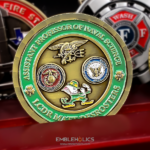
A supply officer challenge coin is a department coin: it belongs to the supply department of a ship or command rather than to the whole crew. This one was made for the Supply Officer of an aircraft carrier, built to a brief asking for a bold, classic design carrying the ship’s image on one face and the Supply Corps insignia on the other. The result is deliberately restrained, with sculpted relief doing the work instead of color.
SuppO, and the oak leaf behind the nickname
“SuppO” is a billet, not a rank. It refers to the department head who runs supply at a command, normally the senior Supply Corps officer aboard. Plenty of officers work in the supply department, but there is one SuppO, and a coin issued in that billet’s name carries a different weight than a general department coin. Worth knowing before the artwork is settled, because it changes whether the coin names the office or just the department.
The oak leaf is the device, and it is why Supply Corps officers get called pork chops. Supply Corps officers wear an oak leaf as their corps device on sleeve and collar, and the shape of it, seen at a glance, is what earned the nickname. That nickname is also the single most useful design asset on a supply coin: a sculpted oak leaf is instantly readable to anyone in the community and needs no caption, which is exactly what you want on a coin that will be handed over without explanation.
What a supply department actually covers
Supply is much broader than most people outside it assume, and that matters when choosing what goes on the coin. A Supply Corps officer’s work can run across supply management, inventory control, disbursing, financial management, contracting, fuels, food service, and physical distribution, among others.
The temptation is to represent all of it, and the right move is not to. A coin that tries to show fuel, food, contracting, and distribution ends up as a collection of small symbols that read as clutter. The designs that work pick one of two routes: the corps device alone, standing for the whole community, or a single element specific to that command. This coin takes the first route on the reverse and the second on the front, which is a clean division and the reason it still reads at arm’s length.
Restraint is a design decision, not a shortcut
A plain coin is harder to get right than a busy one. With no enamel to separate elements, everything depends on relief: how high the raised areas stand, how deep the field is cut behind them, and whether the rim gives the design somewhere to stop. Get those wrong and a plain coin looks unfinished rather than classic.
Three things carry a coin with little or no color:
- Relief height has to vary. If every raised element sits at the same height, the coin reads flat under any light. The ship’s profile should stand proud of the lettering, and the lettering proud of the field.
- The field needs a texture. A sandblasted or matte field behind polished relief creates the contrast that enamel would otherwise provide. A polished field behind polished relief loses the design in reflections.
- Negative space is part of the layout. Leaving the field genuinely empty around the device is what makes the device look deliberate. Filling it with a motto in small type is the most common way a restrained design stops being restrained.
Naming the office or naming the department
This is the one decision worth making before artwork starts. A coin marked for the supply department can be reordered for years and handed out by whoever is in the chair. A coin marked for the Supply Officer, or carrying a name, is tied to one officer’s tour and runs out when they do. Neither is wrong, but they are different products with different quantities.
Many commands end up running both, a standing department coin in volume for general recognition and a short run in the department head’s name for the recognitions they want to make personally. We go into the same trade-off on a commanding officer’s coin, where the arithmetic is identical.
Ordering a supply coin
Bring the ship or command crest, a decision on the billet question, and whether you want color at all. If the answer to the last one is no, we will come back with relief heights and field textures mapped out, because that is where a plain coin is won or lost. We have made a great many coins across the supply community, including the Supply Corps coin, the Navy Supply Corps School coin, and the NAVSUP Fleet Logistic Center coin. You can see more Navy challenge coins or send artwork through the free quote form.
Frequently Asked Questions
What is a supply officer challenge coin?
A supply officer challenge coin is a department coin belonging to the supply department of a ship or command, rather than a coin for the whole crew. It typically carries the Navy Supply Corps oak leaf device and the command or ship it was made for. Some are issued in the name of the Supply Officer billet specifically, which makes them personal to one officer’s tour.
What does SuppO mean?
SuppO refers to the supply department head at a command, normally the senior Supply Corps officer aboard. It describes a billet rather than a rank, so while many officers work in supply, there is one SuppO at a time. The distinction matters on a coin, because naming the office ties the coin to whoever currently holds it.
Why are Navy Supply Corps officers called pork chops?
Because of the oak leaf device they wear as their corps insignia on sleeve and collar. Seen at a glance, its outline resembles a pork chop, and the nickname stuck. It is also the most useful symbol available on a supply coin: a sculpted oak leaf is recognized instantly within the community without any accompanying text.
Should a supply coin show everything the department does?
No. Supply covers inventory, disbursing, contracting, fuels, food service, financial management, and distribution, among other areas, and a coin that tries to depict all of them becomes a cluttered collection of small symbols. The designs that work either use the corps device alone to stand for the whole community, or pick one element specific to that command.
Can a challenge coin work with no color on it?
Yes, and often better than a colored one, but it depends entirely on relief. Raised elements need to sit at different heights so light defines them, the field behind them needs a matte or sandblasted texture to contrast with polished relief, and the empty space has to be left genuinely empty. A plain coin with uniform relief height and a polished field will look unfinished rather than classic.
Is a plain coin cheaper than a colored one?
Somewhat, since there is no enamel work, but it is not an easier coin to produce well. The design time goes into relief mapping and field texture rather than color separation, and those decisions are less forgiving: a flaw in a plain coin has nothing to hide behind. Choose a restrained design because it suits the command, not to save money.
Should the coin carry the officer’s name?
Only if you accept that the batch ends with that officer’s tour. A coin marked for the department can be reordered from the same die for years and issued by whoever holds the billet next. Many commands run both: a standing department coin in volume, and a short named run for the recognitions the department head wants to make personally.
More Navy Projects