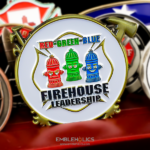
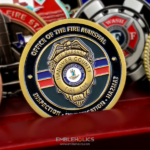
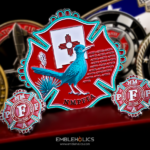
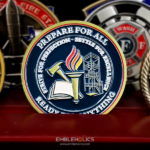
The piece carries a small base protruding from the main body with a hole through it, which is all it takes to turn a coin into a keychain. This Racine Fire Department coin was made for the City of Racine Fire Department, which handles fire protection, prevention and inspection, life support and public education.
Turning a Coin Into a Keychain
Adding a tab and a hole is the smallest possible modification to a coin, and it changes the object completely.
It moves from kept to carried. A coin lives in a drawer or on a desk. A keychain leaves the house every day, which is a different order of exposure for anything carrying an organization’s name.
The tab is the structural decision. A protruding base with a hole in it concentrates all the stress of a keyring into one small area of metal. It needs enough material around the hole and enough thickness in the tab, or it becomes the failure point.
Placement affects how it hangs. A tab centered at the top lets the piece hang straight. Off center and it sits at an angle on the ring, which looks accidental.
And the design should survive wear. Keys are abrasive and constant. Paint on raised surfaces wears first, which argues for engraving, plating or recessed color on anything that goes on a ring.
See also custom metal keychains and using the same design on coins and keychains.
One Design, Two Products
An organization that already has a coin can make the keychain version from essentially the same artwork, and the economics are worth understanding.
The faces are identical. The only change is the added tab, which means most of the design work and most of the decisions carry straight across. That is why a department with an existing coin can add a keychain far more cheaply than it could commission a second piece from scratch.
The strategic point is that the two products reach different people. A coin is presented to members and to counterparts at other agencies. A keychain goes to anyone, including family, community members and people at public events, because it carries no implication of belonging.
For a fire department doing public education, as Racine does, that distinction is useful. A coin given to a resident after a station visit is slightly odd; a keychain is not.
The City of Racine Fire Department
The department provides fire protection, fire prevention and inspection, life support and public education for the City of Racine, Wisconsin.
That list is worth reading closely, because prevention, inspection and public education are three of the four, and none of them involve a fire. Modern fire departments spend far more time on inspection, medical response and community programs than on structure fires, and the public education function in particular puts firefighters in front of residents, schools and community groups regularly.
Those are exactly the encounters where a small metal object gets handed over. A department with an active public education program has more natural giveaway moments than most organizations, which makes the keychain format a better fit than a presentation coin for a meaningful share of what the department does.
See also fire department challenge coins and a Racine Fire MIH and TEMS coin.
Designing for a Hole
The hole is small and it has consequences for the artwork that are easy to overlook.
It takes space from the composition. The tab occupies part of the overall outline, so the usable circular area is slightly smaller than the piece’s full dimensions suggest.
It sets an orientation. A plain coin can be viewed at any rotation. A keychain hangs from a fixed point, which means the design has a permanent top and the artwork has to be laid out for that.
It affects both faces equally. A keychain spins, so both sides are seen regularly. Neither face can be treated as the back in the way a coin’s reverse often is.
And the ring itself is part of the object. A split ring sits against the tab permanently, so the metal there should be clean and simple rather than carrying detail that a ring will obscure.
Order a Fire Department Coin or Keychain
Professional artwork is free with unlimited revisions, and nothing goes into production until you approve a digital proof. Standard production runs about 45 to 50 days after final artwork approval, rush production is available on many projects, and shipping within the continental United States is included. Embleholics is veteran-owned, SDVOSB and registered in SAM.gov.
Two suggestions. If you already have a coin, ask about a keychain from the same artwork, since the faces carry straight across and only the tab is new. And check the tab and hole on the proof for adequate material, because that small area carries all the stress a keyring puts on the piece. Request a free quote to begin.
Frequently Asked Questions
How is a coin turned into a keychain?
By adding a small base protruding from the main body with a hole through it. The faces stay the same, so most of the design work carries straight across from a coin.
Where do coin keychains fail?
At the tab. The hole concentrates all the stress of a keyring into one small area, so it needs enough material around it and enough thickness, or it becomes the breaking point.
Does the tab need to be centered?
Yes, for the piece to hang straight. An off center tab makes it sit at an angle on the ring, which reads as an error rather than a choice.
Can an existing coin design be reused for a keychain?
Usually, yes. The faces are identical and only the tab is added, which makes a keychain far cheaper to add than a second design commissioned from scratch.
Why give a keychain instead of a coin?
Because a keychain carries no implication of belonging. It can go to residents, families and community members, where handing a challenge coin to the public is slightly incongruous.
Should a keychain be painted?
Minimally. Keys are abrasive and constant, and paint on raised surfaces wears first, so engraving, plating or recessed color lasts far better.
Does a keychain need a front and a back?
Not in the way a coin does. It spins on the ring so both faces are seen regularly, and neither can be treated as a lesser side.
What does a fire department do with giveaway items?
Public education and community programs generate frequent contact with residents, schools and community groups, which produces far more natural giveaway moments than most organizations have.
More Firefighters Projects