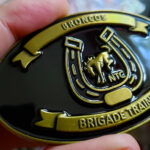
The brief was simple: the Brigade Trainers’ logo, black and gold, graphics and lettering engraved, and quality material strong enough to actually work as a belt buckle. It was made for the NTC Brigade Trainers, known as the Broncos.
A Buckle Has to Work as a Buckle
This is the point the client raised and it is the one most often overlooked, because a buckle looks like a large coin and is not one.
It carries load. A belt under tension pulls on the buckle every time the wearer sits, stands, bends or lifts. A coin sits in a pocket and is never stressed. That difference drives the material and thickness specification rather than the appearance.
It is worn every day, not kept. Which means wear is cumulative rather than incidental. A finish that looks good for a year on a shelf has to look good for years against a shirt, a desk edge and a seat belt.
The attachment has to be specified. How the buckle fastens affects the back of the piece, sometimes the thickness, and whether it suits the belts people already own. It belongs in the specification, not settled afterward.
And belt width is a dimension, not a preference. A buckle has to fit a specific size. Confirm it before artwork begins.
See custom belt buckles and minimum orders for belt buckles, since minimums differ from the challenge coin minimum.
Why Engraving Suits a Worn Piece
The graphics and lettering here are engraved rather than raised, and on a buckle that is a durability decision as much as a design one.
Recessed detail is protected. An engraved line sits below the surface, so the high points taking the wear are the plain areas around it. Raised detail is the first thing to rub, and on a piece worn daily it will show.
Paint in a recess lasts longer than paint on a ridge. Same principle. Color sitting in a channel is shielded; color on a raised edge is exposed. On a buckle that matters within months rather than years.
And engraving reads cleanly at buckle scale. A buckle is large enough that line work holds real detail, so engraving does not cost you legibility the way it might on a small coin.
The trade-off is that engraving gives a flatter object than sculpted relief does. For a piece meant to look substantial and catch light, relief is the stronger choice, and it is worth deciding deliberately which of the two you want. See a sculpted submarine belt buckle for the other approach.
Black and Gold on a Simple Layout
Two colors and one logo. For a buckle, that restraint is well judged.
A buckle is worn at the waist, which means it is seen at a distance and in motion far more often than it is examined up close. Detail that rewards close inspection is largely wasted; what matters is whether the piece reads from across a room. One strong device in two high contrast colors does that. A busy design does not.
Black and gold is also a practical pairing on a worn item. Gold on a buckle is usually plating on exposed metal rather than paint, so it cannot chip, and black is the most forgiving fill there is, hiding the small marks a daily-worn piece inevitably picks up.
An oval outline suits the format too, giving the logo a horizontal field without the hard corners of a rectangle, which are the parts of a buckle that catch and scuff first.
About the Unit
The National Training Center provides realistic pre-deployment training for United States military units. Each month an Army unit prepares there for deployment, with support from the Marines, Air Force and Navy.
NTC Brigade Trainers design curriculum, teach and assess student performance, with some specializing in areas such as military tactics. They are the people a rotating unit encounters rather than a unit that rotates, which is an unusual position and a good one for a coin or buckle: the trainers are the constant, and the units pass through.
That also explains the choice of a buckle over a coin. A coin is handed over; a buckle is worn. For a cadre who are the permanent presence at a training center, something worn identifies them to every unit that arrives.
See also a SECNAV belt buckle and putting a unit logo on a belt buckle.
Order a Buckle for Your Team
Professional artwork is free with unlimited revisions, and nothing goes into production until you approve a digital proof. Standard production runs about 45 to 50 days after final artwork approval, rush production is available on many projects, and shipping within the continental United States is included. Minimum quantities for belt buckles differ from challenge coins, so ask when you request a quote. Embleholics is veteran-owned, SDVOSB and registered in SAM.gov.
Two things to bring. The belt width the buckle has to fit, since that is a hard dimension. And a decision on engraved versus sculpted, because it changes both the look and how the piece wears: engraved detail is protected and lasts, sculpted relief looks more substantial and shows wear sooner. Request a free quote to begin.
Frequently Asked Questions
What is an engraved belt buckle?
It is a custom buckle whose graphics and lettering are cut into the surface rather than raised above it. On a piece worn daily that is a durability choice, since recessed detail is protected where raised detail rubs.
Is a buckle made the same way as a coin?
Similarly, but to a different specification. A buckle carries load from a belt under tension every time the wearer moves, where a coin is never stressed, so material and thickness are driven by function rather than appearance.
Should buckle detail be engraved or raised?
Engraved for durability, raised for presence. Recessed lines and the paint inside them are shielded by the plain surface around them, while raised detail and the color on it are the first things to wear on a daily-worn piece.
Does engraving limit the detail on a buckle?
Not much, because a buckle is large enough for line work to hold real detail. Engraving costs legibility on a small coin far more than it does at buckle scale.
How much detail should a buckle design have?
Less than you might think. A buckle is seen at a distance and in motion far more often than examined closely, so one strong device in high contrast colors beats a busy design that only rewards close inspection.
Why do black and gold work on a buckle?
Because gold on a buckle is usually plating on exposed metal rather than paint, so it cannot chip, and black is the most forgiving fill there is, hiding the small marks a daily-worn piece picks up.
What do you need to know before ordering?
The belt width it has to fit, which is a fixed dimension, and the attachment style, which affects the back of the piece and whether it suits the belts people already own. Both belong in the specification.
Is the minimum order the same as for coins?
No. Minimum quantities for belt buckles differ from the challenge coin minimum, so ask when you request a quote rather than assuming the coin figure carries over.
More Military Projects