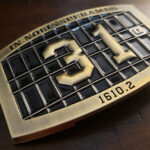
The brief was short: minimalist, with not many elements or decorations, elegant and classy, but sturdy enough to be worn every day. It was made for the office of the Secretary of the Navy.
Why Senior Offices Order the Plainest Pieces
There is a pattern worth naming here, because it runs against what most customers assume.
The more senior the office, the simpler the brief. Units deep in an organization often want everything on the piece: the crest, the motto, the mascot, the dates. The offices at the top tend to ask for one device and nothing else.
Because the device is already the whole message. When the emblem is instantly recognized, adding supporting elements dilutes it rather than reinforcing it. There is nothing to explain.
And decoration reads as compensating. A heavily ornamented piece looks like it is working to be impressive. A plain one with excellent execution looks like it does not need to. For a senior office, the second register is the correct one.
The practical consequence is that a minimalist brief shifts the budget from content to craft. There is nothing to look at except the surface quality, the edge finish and whether the single device is perfectly placed, so that is where the money goes.
See custom belt buckles.
Sturdy Enough to Be Worn Every Day
This half of the brief is the one that drives the specification, and it is what separates a buckle from a large coin.
A belt under tension pulls on the buckle constantly. Every time the wearer sits, stands, bends or lifts. A coin sits in a pocket and is never stressed. That difference sets the material and the thickness, and it is a functional requirement rather than a quality upgrade.
Daily wear makes damage cumulative. A piece worn against a shirt, a desk edge and a seat belt for years accumulates marks that a display item never sees. A finish chosen for how it photographs new is the wrong choice; one chosen for how it ages is right.
Which argues against raised detail and bright polish. Raised elements are the first to rub, and a mirror finish shows every scuff. A minimalist design with recessed detail and a softer finish is not only a styling choice here, it is the durable one.
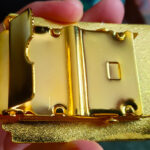
And the attachment matters as much as the face. How the buckle fastens determines whether it stays put and whether it suits the belts the wearer already owns. It belongs in the specification, not settled afterward.
Templates and Custom Forms
Worth knowing, because it changes the cost conversation: a buckle does not have to start from nothing.
There are established templates in a range of shapes and sizes, and starting from one is considerably cheaper and faster than commissioning a bespoke form. For most organizations, a standard outline with their own artwork on it is exactly what they wanted anyway.
Fully custom forms are available too, and almost any shape can be produced. The question to ask is whether the shape is carrying meaning. A buckle cut to a unit’s own insignia outline earns the cost; a buckle in an unusual shape for its own sake generally does not, and it brings the usual consequences of a custom outline, including fragility at thin points.
For a buckle where the shape does real work, see a sculpted submarine belt buckle, and for the engraved approach, an engraved belt buckle.
Belt Width and Other Fixed Dimensions
Three things on a buckle are measurements rather than preferences, and all three are better settled before artwork than after.
Belt width. A buckle has to fit a specific size. This is the single most common thing customers forget to state, and it cannot be adjusted once the piece is made.
Thickness. Driven by the load the piece carries and by whether the design includes relief. It affects both the feel and the price.
And minimum quantity. Minimums for belt buckles differ from the challenge coin minimum, so ask when you request a quote rather than assuming the coin figure carries over. See minimum orders for belt buckles and bottle openers.
About the Office
The Secretary of the Navy is a statutory officer and the head of the Department of the Navy, a military department within the Department of Defense. The Department of the Navy comprises both the Navy and the Marine Corps, and the office also oversees the construction, outfitting and repair of naval ships, equipment and facilities.
One note that applies to any piece carrying an official device. The authorization and the approved artwork both come from the organization. We produce from what the customer supplies and do not grant permission on any agency’s behalf. An official seal also cannot be simplified or restyled the way a logo can, which on a minimalist piece means the layout decisions are the only ones available.
See more Navy challenge coins and putting a unit logo on a belt buckle.
Order a Belt Buckle
Professional artwork is free with unlimited revisions, and nothing goes into production until you approve a digital proof. Standard production runs about 45 to 50 days after final artwork approval, rush production is available on many projects, and shipping within the continental United States is included. Minimum quantities for belt buckles differ from challenge coins, so ask when you request a quote. Embleholics is veteran-owned, SDVOSB and registered in SAM.gov.
Two things to bring. The belt width the buckle has to fit, since that is a fixed dimension and the most commonly omitted one. And a decision on whether you want a standard template or a custom form, because starting from a template is markedly cheaper and is usually what people actually wanted. Request a free quote to begin.
Finished Buckle (Front)
Finished Buckle (Back)
Frequently Asked Questions
What is a minimalist belt buckle?
It is a custom buckle carrying one device and little else, with no ornamentation. Senior offices tend to prefer this register, because a recognized emblem is already the whole message and decoration dilutes rather than reinforces it.
Why do senior organizations order plain pieces?
Because a heavily ornamented piece looks like it is working to be impressive, where a plain one with excellent execution looks like it does not need to. A minimalist brief also shifts the budget from content to surface quality and placement.
Is a buckle made the same way as a coin?
Similarly, but to a different specification. A belt under tension pulls on the buckle every time the wearer moves, where a coin is never stressed, so material and thickness are functional requirements rather than quality upgrades.
What finish lasts best on a buckle?
A softer finish with recessed detail. Raised elements are the first to rub on a piece worn daily, and a mirror polish shows every scuff. Choose a finish for how it ages rather than for how it photographs new.
Do buckles have to be custom shaped?
No. There are established templates in a range of shapes and sizes, and starting from one is considerably cheaper and faster. For most organizations a standard outline carrying their own artwork is exactly what they wanted.
When is a custom shape worth it?
When the shape carries meaning, such as a buckle cut to a unit’s own insignia outline. An unusual shape for its own sake brings the usual consequences of a custom outline, including fragility at thin points, without adding anything.
What dimensions do you need from us?
The belt width, which is the most commonly omitted detail and cannot be adjusted afterward, and the attachment style, which affects how securely the buckle sits and whether it suits the belts the wearer already owns.
Is the minimum order the same as for coins?
No. Minimum quantities for belt buckles differ from the challenge coin minimum, so ask when you request a quote rather than assuming the coin figure applies.
More Navy Projects