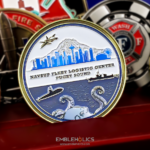
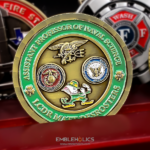
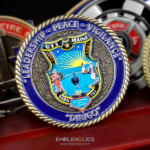
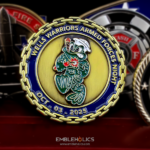
A custom cutout shape built around a parachute rendered in three dimensions, finished in silver plating. The reverse lists the SEAL teams and carries the motto, the only easy day was yesterday. This Navy SEAL challenge coin was made to a client’s request rather than from a stock design.
A Parachute in Three Dimensions
A canopy is a difficult object to sculpt and a rewarding one, because almost nothing else on a coin has that shape.
It is a curved surface, not a flat outline. Most coin subjects are emblems or silhouettes. A parachute is a dome, which means relief has to describe curvature rather than just lift a shape off the field.
The panels and lines give it structure. Seams running down the canopy and rigging lines below it provide a natural framework of fine lines, which reads well in cut metal and keeps the dome from looking like a blob.
The shape suits a cutout. A canopy has a broad rounded top narrowing toward the lines below, which makes an outline with strong recognition and decent usable area.
And the imagery is specific. A parachute points at insertion and jump qualification rather than at the service in general, which gives the coin a subject rather than a badge.
The technical caution is the rigging lines. Suspension lines are the thinnest elements in the whole image, and if they are part of the cutout they will be fragile. Rendering them as engraved detail within the body of the coin rather than as cut-out voids is the safer approach.
See also custom shaped challenge coins and whether cutouts make a challenge coin weaker.
Listing Teams on the Reverse
Putting a list of units on the back of a coin is a common request and it needs more thought than it usually gets.
A list is typography, not artwork. The whole face becomes a text layout problem, where the spacing, the alignment and the size relationships carry the design. That is a different discipline from an emblem.
Completeness matters more than anything else. If units are listed at all, every one has to appear. An omission is the error people spot immediately and remember afterward.
It dates the coin. Organizational structures change, units are activated and deactivated, and a list fixes the coin to the moment it was made. That suits a commemorative and causes trouble for a standing issue piece.
And arrangement is a decision. Numerical order is the only neutral option. Any other arrangement implies a ranking that somebody will read into it.
The practical note is size. A list of entries at legible size takes most of a face, which is why a listing reverse usually pairs with a single strong image on the front rather than with a second busy face.
Silver Plating
Silver is a quieter finish than gold and it suits a sculpted subject better.
It is neutral. Gold carries an award association and copper carries warmth and age. Silver reads as the default, which lets the sculpting be the subject rather than the finish.
It renders relief cleanly. A cool, bright surface shows shadow with high contrast, so the curvature of a sculpted object reads clearly. On a 3D element that is doing the main work, that matters.
And it matches the register. Silver on an unpainted coin reads as equipment rather than as a trophy, which suits a design built on a piece of operational hardware.
The trade-off is handling. A bright plating shows fingerprints and fine marks, so a coin meant to be carried rather than displayed may be better served by an antique silver, which keeps the same neutrality while darkening the recesses and hiding wear.
See antique vs polished finishes.
Special Operations Coins
Coins from special operations communities have a few characteristics worth naming, because they shape what a good design looks like.
Accuracy is not negotiable. These are communities with precise insignia, precise unit designations and a low tolerance for approximation. An emblem rendered loosely is noticed instantly.
Restraint reads as authentic. An understated coin in plain metal carries more credibility in these circles than a bright, heavily colored one. The convention runs toward less rather than more.
What goes on the coin is a judgment call. Anything on an object that circulates should be information the organization publishes about itself. A coin leaves the building and does not come back.
And the motto does real work. Communities with a well known phrase have something no designed element can replace, and a motto set cleanly often beats an extra graphic.
See also military challenge coins.
Order a Special Operations or Custom Cutout Coin
Professional artwork is free with unlimited revisions, and nothing goes into production until you approve a digital proof. The challenge coin minimum is 50 pieces, standard production runs about 45 to 50 days after final artwork approval, rush production is available on many projects, and shipping within the continental United States is included. Embleholics is veteran-owned, SDVOSB and registered in SAM.gov.
Two suggestions. If a cutout design includes thin elements such as lines or cables, render them as engraved detail inside the body of the coin rather than as cut voids, because thin metal spans are where cutout coins break. And if the reverse lists units, confirm the list is complete and in numerical order before the proof, since an omission is the one error everybody notices. Request a free quote to begin.
Frequently Asked Questions
What is a cutout challenge coin?
A coin with areas removed from the metal so the shape itself carries part of the design. It makes a striking outline but introduces thin spans that need care at artwork stage.
Are cutout coins weaker?
They can be, where the remaining metal is thin. Thin spans bend and break in handling, so fine elements are better rendered as engraved detail inside the coin body than as cut voids.
Why is a parachute difficult to sculpt?
Because it is a curved dome rather than a flat outline, so relief has to describe curvature rather than just lift a shape off the field. The panel seams and rigging lines give it structure.
Should a coin list units on the reverse?
Only if the list can be complete. An omission is the error people notice and remember, and numerical order is the only arrangement that avoids implying a ranking.
What is the drawback of a list on a coin?
It dates the piece and it fills the face. Structures change over time, and entries at legible size occupy most of a side, so a listing reverse needs a simple front.
Why choose silver plating?
It is neutral where gold reads as an award and copper reads as aged. A cool bright surface also shows shadow with high contrast, which suits a sculpted element doing the main work.
What suits a coin that will be carried rather than displayed?
An antique silver rather than a bright one. It keeps the neutrality while darkening the recesses, which improves relief contrast and hides handling marks.
What should go on a special operations coin?
Only information the organization publishes about itself, rendered accurately. These communities have precise insignia and low tolerance for approximation, and a coin leaves the building permanently.
More Navy Projects