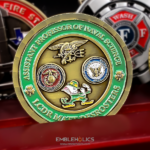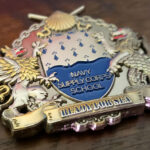
Highly detailed, and described on the page as an art piece rather than a coin. A griffin and a dragon carry the design, with feathers and scales rendered individually. A chain runs around the edge, the school’s emblem is embossed and a trident is engraved. This Navy school challenge coin was made for the Navy Supply Corps School, a 27 week course at Naval Station Newport, Rhode Island.
Mythological Figures on a Coin
A griffin and a dragon are unusual subjects for a military coin, and they work for reasons worth setting out.
They are heraldic, not decorative. Both are long standing heraldic beasts with established meanings, which puts them in the same tradition as the crests and devices military organizations already use. They are not fantasy illustration dropped onto a coin.
They carry attributes. A griffin traditionally guards treasure, which is close to the actual function of a supply organization. A dragon is the other great guardian figure. For a school teaching the stewardship of material, those associations are apt rather than arbitrary.
They give a sculptor something to do. Feathers and scales are exactly the kind of fine repeating texture that rewards detailed cutting, where a geometric crest gives relief very little to work with.
And they are legible to everyone. Neither figure needs explaining to any audience, which matters for a school coin that will travel widely as graduates disperse through the fleet.
See also Navy challenge coins.
Feathers and Scales
Rendering both textures on one coin is the technical ambition here, and they behave differently.
Feathers are directional. They lie in overlapping rows that flow along the body, and the flow is what makes plumage read as plumage. Feathers cut at uniform angle look like a pattern rather than a wing.
Scales are geometric. Regular overlapping shapes in a grid that curves with the form. The regularity is the point, so any irregularity in a scale field is visible immediately.
Both hit the same limit. Each is a dense repeating texture, and below a certain spacing the individual elements merge into a smooth surface. The practical answer is fewer, larger feathers and scales than a drawing would show, which reads as more detailed at coin size rather than less.
And they need separating. Two fine textures meeting on one face risk reading as one undifferentiated mass, so the boundary between the griffin and the dragon has to be defined by depth or by a clear gap.
A Chain Around the Edge
A chain border is a less common alternative to a rope rim, and it brings different associations.
Rope reads as nautical and traditional. Chain reads as heavier and more industrial, with connotations of anchoring, securing and links in a system. For a supply organization, which is literally a chain of custody for material, that is a more pointed choice than rope would be.
Technically a chain is harder than a rope. Rope is a continuous twisted form that can be cut as one repeating element, where a chain is a sequence of discrete links that have to interlock convincingly, each with a void at its center. At coin scale those voids are small, and if they close up the chain becomes a lumpy band.
The quality checks are therefore the link openings and the join where the pattern meets itself around the circumference. Both are proof stage items and both are immediately visible once noticed.
Navy Supply Corps School
The Navy Supply Corps School is a 27 week course at Naval Station Newport, Rhode Island, where newly commissioned supply officers learn the profession before joining the fleet.
Half a year in one place with one cohort is what makes this a strong coin audience. Students arrive as new officers, spend a long course together, and then disperse across ships, squadrons and shore commands worldwide. The school is the shared starting point for an entire community, and the coin is the object that marks it.
Newport also carries weight. It is where the Navy concentrates much of its officer education, so a Newport coin sits alongside others from the same base in the collections of people who passed through more than once in a career.
The class structure argues for one decision in particular. A course running several cohorts a year can either issue a dated class coin or a single undated school coin. The second gives one die that serves indefinitely and is usually what a school wants, while the first makes a collectible series.
See also a Navy supply corps challenge coin and academy graduation challenge coins.
Order a School or Training Coin
Professional artwork is free with unlimited revisions, and nothing goes into production until you approve a digital proof. The challenge coin minimum is 50 pieces, standard production runs about 45 to 50 days after final artwork approval, rush production is available on many projects, and shipping within the continental United States is included. Embleholics is veteran-owned, SDVOSB and registered in SAM.gov.
Two suggestions. If a design uses fine repeating texture such as feathers or scales, go with fewer and larger elements than the drawing shows, because detail below a certain spacing merges and reads as a smooth surface. And decide whether the coin is a school coin or a class coin before artwork, since one undated die can serve for years while a dated one commits you to reordering every cohort. Request a free quote to begin.
Frequently Asked Questions
Do mythological figures suit a military coin?
Yes, when they are heraldic rather than decorative. Griffins and dragons are established heraldic beasts with known attributes, which puts them in the same tradition as military crests.
Why a griffin for a supply organization?
A griffin traditionally guards treasure, which is close to the function of a supply corps. The association is apt rather than arbitrary, which is what separates a good symbol from a decorative one.
How are feathers rendered on a coin?
In overlapping rows that flow along the body, because the direction of flow is what makes plumage read as plumage. Feathers cut at a uniform angle look like a pattern instead.
What is different about scales?
They are geometric rather than organic, a regular grid of overlapping shapes curving with the form. The regularity is the point, so any irregularity shows immediately.
How fine can a repeating texture be?
There is a spacing below which elements merge into a smooth surface. Fewer and larger feathers or scales than a drawing shows will read as more detailed at coin size, not less.
How does a chain edge differ from a rope edge?
Rope reads nautical and traditional, chain reads heavier and more industrial, with associations of securing and linking. Chain is also harder to produce, since each link needs an open center.
What should be checked on a chain border?
The link openings and the join. Small voids that close up turn the chain into a lumpy band, and the point where the pattern meets itself has to be invisible.
Should a school issue a class coin or a school coin?
A school coin with no date gives one die that serves indefinitely, which suits a course running several cohorts a year. A dated class coin creates a series but commits you to a reorder every time.
More Navy Projects