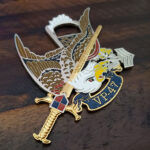
Maritime patrol is a community apart within naval aviation, and its coins reflect it. Patrol squadrons fly long sorties over open water, far from a carrier and often far from anyone, and the crews are large and mixed rather than one or two aviators in a cockpit. This coin was made for Patrol Squadron 47, the Golden Swordsmen, a P-8A Poseidon squadron under Patrol and Reconnaissance Wing 10 at Whidbey Island, Washington. It is cut to a shape drawn from the squadron’s own insignia, with a flying eagle and a golden sword, and it doubles as a bottle opener.
The VP community is a crew community
This is the thing that should shape a patrol squadron coin, and it usually gets missed. A fighter squadron’s identity sits with the aircrew. A patrol squadron flies a combat aircrew of around nine, mixing naval aviators, naval flight officers and enlisted aircrewmen, and the mission depends on the sensor operators and acoustic specialists as much as on whoever is flying.
In practice that argues for two things. The first is that the design should not be pilot-centric: wings and cockpit imagery read as aviator imagery, and on a squadron where most of the crew are not pilots, that lands narrowly. The squadron’s own insignia, which belongs to everyone, is the safer and better subject, and it is what this coin uses.
The second is quantity. A patrol squadron has a large enlisted complement alongside its officers, and the aircrew are only part of the total. Maintenance, ordnance and support personnel all belong to the squadron, and a coin order sized to aircrew rather than to the squadron will come up badly short.
Drawing the coin from the squadron insignia
Taking the coin’s outline from the patch is the strongest move available to a squadron, and it is underused. Most squadrons have a decades-old insignia that every member recognizes instantly. Cutting the coin to follow its dominant element, as this one does with the eagle and sword, means the coin is identifiable at silhouette before anyone reads VP-47.
Mirroring the eagle across both faces is a neat solution to a real problem. A shaped coin has a fixed outline, so both faces have to live within the same silhouette. Rather than fighting that, this design embraces it: the eagle appears on both sides, mirrored, with the detail differing between them. The coin reads as one object rather than as a front with an unrelated back.
The ribbon at the base does the labelling. On a shaped coin with no rim there is nowhere obvious for text, and a banner or ribbon worked into the bottom of the design solves it. Here the front ribbon carries the squadron designation and the reverse carries U.S.N., which is about as much text as a shape like this will take.
Adding a bottle opener to a shaped coin
A bottle opener is a function, and functions have requirements. The opener needs a notch with enough metal around it to take the leverage, which means thickness and a solid surround. On a shaped coin this has to be designed into the outline from the start rather than cut into it afterwards.
Three things to settle early:
- Where the opener sits. Built into the edge of the body, as on this coin, or cut into the centre. An edge opener preserves the middle of both faces for artwork; a centre opener is more obviously a tool and takes the best real estate on the coin.
- Thickness. A bottle opener has to be thicker than a standard coin to work without bending. This affects the quote and it is not optional.
- What you lose. The area around the notch cannot carry fine detail, so plan the layout knowing one region of the coin is given over to function.
Openers suit squadron coins particularly well, because a squadron coin spends its life in a ready room and a hangar rather than in a display case. If the coin is going to be used, it may as well be useful.
About the squadron
Patrol Squadron 47, the Golden Swordsmen, flies the P-8A Poseidon on maritime patrol and reconnaissance, attached to Patrol and Reconnaissance Wing 10 at Whidbey Island, Washington. Its insignia pairs an eagle with a golden sword, which is where the coin’s shape and the squadron’s nickname both come from.
Whidbey Island is in our part of the world. Embleholics is a veteran-owned shop in Port Orchard, Washington, so the Whidbey squadrons are regional neighbours and a good share of our Navy aviation work comes from them.
Ordering a squadron coin
Send the squadron patch at the highest resolution you can find, and tell us the full squadron headcount rather than the aircrew number. If you want a bottle opener, say so in the first message, because it changes the thickness and the layout rather than being something that can be added at the end. We will show you the outline and both faces at actual size before any die is cut. You can see more Navy challenge coins we have produced, including the VP-26 Tridents coin and the earlier VP-47 coin, or send your artwork through the free quote form.
Frequently Asked Questions
What is a patrol squadron challenge coin?
It is a coin for a Navy maritime patrol squadron, the VP community, which flies long-range patrol and reconnaissance aircraft such as the P-8A Poseidon. These coins differ from fighter squadron coins because a patrol squadron flies a large mixed combat aircrew of aviators, flight officers and enlisted aircrewmen, so the design and the quantity both need to account for the whole squadron.
Should a squadron coin use aviator imagery?
Be careful with it. Wings and cockpit imagery read as pilot imagery, and in a patrol squadron most of the crew are not pilots, with sensor and acoustic operators central to the mission and a large maintenance and support complement besides. The squadron’s own insignia belongs to everyone and is usually the better subject.
Can a coin be cut to the shape of our squadron patch?
Yes, and it is one of the strongest options available. Most squadrons have a long-established insignia that members recognize immediately, so cutting the coin to follow its dominant element makes the coin identifiable at silhouette before any text is read. Send the patch at the highest resolution you have and we will work from it.
How do you handle both faces on a shaped coin?
Both faces have to live within the same outline, so the usual solution is to work with that rather than against it. Mirroring the main element across both sides, with the detail differing between them, makes the coin read as a single object instead of a front with an unrelated back. A ribbon or banner worked into the base gives the text somewhere to go, since a shaped coin has no rim.
Can a shaped coin also be a bottle opener?
Yes, but it has to be designed in from the start. The opener needs a notch with enough metal around it to take the leverage, which means the coin must be thicker than standard and the area around the notch cannot carry fine detail. Decide early whether the opener sits in the edge, which keeps both faces clear, or in the centre, which takes the best space on the coin.
How many coins should a patrol squadron order?
Size it to the whole squadron, not the aircrew. A patrol squadron’s maintenance, ordnance and support personnel substantially outnumber the flying complement, and an order based on aircrew numbers will fall well short. Count the full manning and add a margin for turnover and for exchange with other squadrons.
What is VP-47?
Patrol Squadron 47, nicknamed the Golden Swordsmen, is a US Navy maritime patrol squadron flying the P-8A Poseidon under Patrol and Reconnaissance Wing 10 at Whidbey Island, Washington. Its insignia combines an eagle with a golden sword, which is the source of both the nickname and the shape of this coin.
More Navy Projects