Almost every coin in this gallery is given inside an organization, to people who already belong to it. A charity coin is the opposite. It goes outward, to donors, volunteers and supporters, and that single difference changes what the design has to do.
A Coin That Has to Explain Itself
A unit coin can be as internal as the unit likes. Four letters and a device mean everything to the people holding it and nothing to anyone else, and that is fine, because nobody else will hold one.
A charity coin is held by people with no context at all. A donor, a volunteer at one event, a family member, somebody who bought one at a fundraiser. None of them knows the organization’s internal shorthand, and most of them will never learn it.
Three things follow:
The cause has to be legible without the name. An image carries further than an acronym. A coin that shows what the organization is for is understood by someone who has never heard of it, which is most of the people who will receive one.
Spell out the organization’s name. In full, somewhere on the piece. Supporters pass these on, and the next person should be able to find the organization from the coin alone.
It is often sold rather than given. Coins are a reliable fundraising item, which means the design has to appeal to somebody deciding whether to spend money on it, not only to somebody being handed one.
Showing a Cause Without Showing a Child
This is the hardest judgment on any coin about children, and this design handles it well, so it is worth saying how.
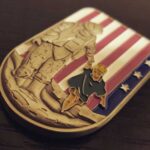
The front shows a service member walking hand in hand with a child across rocky ground. Both figures are rendered as forms in relief rather than as portraits.
Nobody on the coin is identifiable, and that is the point. A coin about children should not carry a likeness of a particular child, and at coin size a portrait would not be a likeness anyway, it would be an approximation, which is worse. Figures seen from behind or in relief read as the relationship rather than as two people.
The gesture carries the meaning. Two figures holding hands and walking is understood instantly, in any language, by anyone. It needs no caption and no explanation, which is exactly what a coin going to strangers requires.
The ground does the rest. Rocky, uneven terrain under the figures says difficulty without anyone having to write the word. That is the kind of detail worth spending relief depth on, because it is doing real work.
Keep the rule for anything in this category: show the relationship and the circumstance, not a person.
Antique Finish on a Cause Coin
The coin uses an antique plating finish, which darkens the recesses and leaves the raised surfaces lighter.
That choice does two things here. It gives the relief its depth, since the figures and the ground only read as three-dimensional if the shadows under them are dark. And it reads as weight and permanence rather than as novelty, which suits a serious subject better than a bright or glossy finish would.
The general rule: an antique finish suits sculpted, figurative, serious subjects. A polished or glossy finish suits flat graphic artwork and bright palettes. Putting a bright finish on a sculpted figurative design flattens exactly the depth the sculpting was for.
See antique and polished finishes.
When You Arrive With Your Own Artwork
This design came to us largely finished. That happens often, and it is worth describing honestly what the remaining work is, because plenty of organizations assume that finished artwork means nothing left to do.
Flat artwork has to be given depth. A drawing has no relief information in it at all. Deciding which elements come forward, which sit back and how far apart those planes are is a separate piece of work from drawing the picture, and it is what makes a struck coin read as an object rather than as a flattened print.
Line weights get checked against the process. Anything below the minimum width a die can hold disappears into the surface, so fine lines in supplied artwork are thickened or dropped deliberately rather than discovered missing.
The finish gets chosen for the artwork. As above. The same drawing on an antique base and a polished one is two different coins.
None of that changes what the artwork is. It is adaptation for the process, not redesign, and anything beyond that is the client’s call rather than ours. For how the process works, see our coin design process, and if you are starting from nothing, custom artwork.
Why Coins Work for Charities
Challenge coins started as military objects, and they have moved well outside that, which is why a coin for a children’s cause is less unusual than it first appears.
What makes them work for a cause: a coin is a keepsake rather than a disposable, so it stays with a supporter instead of going in a drawer. It is small and cheap to post. It carries a subject in relief rather than in words, which travels further. And it is an object people are willing to pay for at a fundraiser, which merchandise generally is not.
What they are not good for: a coin cannot carry much text, so anything that needs explaining in sentences belongs on a card alongside it rather than on the piece.
See more other challenge coin projects and commemorative coins.
Order a Coin for Your Cause
Free professional artwork, unlimited revisions and a digital proof before anything is produced. Free shipping within the continental US, a 50-coin minimum, and most orders complete 45 to 50 days after artwork approval, with rush production available. Embleholics is veteran-owned, an SDVOSB, and registered in SAM.gov.
Two things worth telling us when you ask for a quote. Whether the coins will be given or sold, because those are different designs. And your organization’s full name as you want it to appear, since on a coin going to supporters that name is how anyone finds you afterwards.
Frequently Asked Questions
What is a charity challenge coin?
A charity challenge coin is made by an organization for its donors, volunteers and supporters rather than for its own members. Because it goes to people with no internal context, it has to be understandable to someone who has never heard of the organization.
How is a charity coin different from a unit coin?
A unit coin can use internal shorthand, since only members will hold one. A charity coin is held by outsiders, so the cause has to be legible from the imagery and the organization’s name has to appear in full.
Can charity coins be sold rather than given?
Yes, and many are, because coins are a reliable fundraising item. That changes the design brief: it has to appeal to someone deciding whether to spend money rather than only to someone being handed one.
Should a coin about children show a child?
Show the relationship rather than a person. Figures in relief or seen from behind read as the circumstance without carrying anyone’s likeness, and at coin size a portrait would be an approximation rather than a likeness in any case.
How do you show a cause without words?
Use a gesture and a setting. Two figures holding hands and walking is understood instantly without a caption, and uneven ground beneath them says difficulty without anyone writing the word, which is where relief depth is worth spending.
Why use an antique finish?
An antique finish darkens the recesses so relief reads as depth, and it carries a sense of weight that suits a serious subject. Sculpted figurative artwork generally wants an antique finish, while flat graphic artwork suits a brighter one.
What happens if you already have finished artwork?
It still needs adapting for the process rather than redesigning. Flat artwork carries no relief information, so the planes have to be decided, and any line below the minimum width a die can hold is thickened or dropped deliberately.
How much text fits on a charity coin?
Not much, which is why the imagery has to carry the meaning. The organization’s full name belongs on the piece, and anything needing sentences belongs on a card alongside the coin rather than on it.
What is the minimum order for a charity coin?
The minimum is 50 coins, which suits a single event or a first fundraising run. Unlike a dated anniversary piece, a cause coin can be reordered, so starting at the minimum and repeating is a reasonable approach.
More Navy Projects