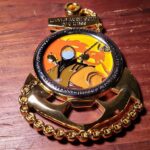
The crew chose the Navy’s anchor as the base shape of the coin. The anchor is gold, the chains are sculpted, the logos and images are engraved, and the piece works as a bottle opener. One face carries a diamond plate background. It was made for the Gold crew of USS Little Rock, a Freedom-class littoral combat ship.
The Anchor as a Coin Shape
An anchor is the most recognizable naval outline there is, and it is more demanding than it looks.
The silhouette does all the identifying. A shank, a crown, two flukes and a stock at the top. Nobody needs to be told what it is, which means the shape identifies the coin before any detail is read.
But it is mostly thin. This is the structural problem. An anchor is a narrow vertical shank with projections at each end, which is close to a list of everything that makes a shaped coin fragile. The shank has to be thickened well beyond true proportion to stay rigid, and the fluke tips need rounding.
The usable area is small and awkward. Artwork has to live where the shank meets the crown, or in the triangular spaces between the flukes. Neither is a generous field, which is why anchor coins usually carry a device and very little else.
And the negative space has to be decided. The gaps between the shank and the flukes either get cut through, which is dramatic and more fragile, or recessed deeply to read as shadow, which is sturdier. On a coin that will be carried, recessing is the safer answer.
See custom shaped challenge coins and another Navy anchor challenge coin.
Sculpted Chain on a Flat Outline
The chains on this piece are sculpted rather than engraved, and chain is one of the better subjects for relief.
A chain is a series of interlocking loops at alternating angles, which means it has natural overlap built in. Overlapping forms at different heights is precisely what sculpted relief does well, and a chain gives the sculptor that for free rather than having to invent depth.
Three practical points. Link size has to be larger relative to the coin than a real chain would be, because fine links turn into a rope-like texture at coin size. The alternating angle matters more than the detail, since that is what reads as chain rather than as a row of rings. And a chain works best following a curve or an edge, where it has a path to lie along, rather than crossing an open field.
Gold plating on the anchor with the chains sculpted alongside is a good pairing, because gold is plating on exposed metal rather than paint. It cannot chip, and it catches light across the sculpted links in a way no painted gold reproduces.
A Bottle Opener in a Shaped Coin
The piece also functions as an opener, which on a shaped coin is a design decision rather than an addition.
An opener needs a specific geometry: a lip to catch the cap edge and a fulcrum behind it. On a round coin that is usually cut into the rim or placed near the center. On a shaped coin the outline often supplies it naturally, and an anchor is one of the shapes that does, since the crown and flukes already provide a hooked form.
Two things to plan for. An opener has to be thicker than a standard coin to work as a tool, which affects both the feel and the price. And minimum quantities for bottle openers differ from the challenge coin minimum, so ask when you request a quote. See custom bottle openers and whether a challenge coin can be a bottle opener.
Diamond Plate as a Background
One face uses a diamond plate pattern as its background, which is a well chosen texture for a naval piece.
Diamond plate is what the deck is actually made of, so it is a material reference rather than decoration. It also solves the usual background problem: a large flat recessed area shows every imperfection in the fill, while a machined repeating pattern hides small variations and gives the surface something to do.
The rule with any background pattern is that it has to stay subordinate. Cut too deep or at too large a scale it stops being a background and starts competing with what sits on top. For a fuller treatment, see a diamond plate challenge coin.
Crew Coins on a Dual-Crewed Ship
USS Little Rock is named after the capital of Arkansas and operates with two crews: Gold, the Scorpions, and Blue, the Warhawgs. This coin belongs to the Gold crew.
Dual crewing makes an unusually good case for crew-level coins.
Each crew is its own unit. They train together, deploy together and rotate as a body, and they have their own name and their own identity separate from the hull.
There is a built-in counterpart. Two crews sharing one ship produces exactly the friendly rivalry that drives the most interesting coin designs, and each crew has an obvious audience to hand a coin to.
And the ship’s coin cannot cover it. A hull-level coin represents the vessel, which both crews share. Only a crew coin represents the people, which is why these ships typically have three designs rather than one.
See also a Navy command challenge coin.
Order an Anchor or Shaped Navy Coin
Professional artwork is free with unlimited revisions, and nothing goes into production until you approve a digital proof. Standard production runs about 45 to 50 days after final artwork approval, rush production is available on many projects, and shipping within the continental United States is included. Minimum quantities for bottle openers differ from challenge coins, so ask when you request a quote. Embleholics is veteran-owned, SDVOSB and registered in SAM.gov.
Two things worth raising. If you want an anchor outline, expect the shank to be thickened beyond true proportion and the fluke tips rounded, because the shape as drawn is too thin to survive a pocket. And if any element of your design draws on a film, game or other franchise, confirm with the rights holder what you are permitted to reproduce before ordering; a crew nickname is yours, but a character likeness belongs to whoever owns it. We produce from artwork the customer is authorized to supply and do not grant permission on anyone’s behalf. Request a free quote to begin.
Frequently Asked Questions
What is a Navy anchor command coin?
It is a coin cut to an anchor outline, usually made for a ship, command or crew. The anchor is the most recognizable naval shape, so it identifies the piece before any detail is read.
Is an anchor a difficult shape for a coin?
Yes, more than it looks. An anchor is a narrow vertical shank with projections at each end, which is close to a list of everything that makes a shaped coin fragile. The shank needs thickening beyond true proportion and the fluke tips need rounding.
How much artwork fits on an anchor shaped coin?
Less than the outline suggests. The usable areas are where the shank meets the crown and the triangular spaces between the flukes, neither of which is generous, which is why anchor coins usually carry one device and little else.
Should the gaps in an anchor be cut through?
Usually not. Cutting through is more dramatic but more fragile, where recessing the gaps deeply enough to read as shadow is sturdier and almost indistinguishable at arm’s length. For a coin that will be carried, recessing is safer.
Does chain work well in sculpted relief?
Very well, because a chain is interlocking loops at alternating angles, so the overlap that relief does best is already built in. Make the links larger relative to the coin than a real chain, since fine links turn into a rope-like texture.
Is gold on a coin plated or painted?
It can be either, and plating is better on sculpted elements. Plated gold is the coin’s own exposed metal, so it cannot chip and it catches light across the relief in a way painted gold does not reproduce.
Can a shaped coin also be a bottle opener?
Yes, and some outlines supply the geometry naturally. An opener needs a lip to catch the cap and a fulcrum behind it, and a hooked form such as an anchor’s crown already provides that. It has to be thicker than a standard coin to work.
Why do dual-crewed ships order separate coins?
Because each crew is its own unit with its own name and identity, training and deploying as a body. A hull-level coin represents the vessel that both crews share, so only a crew coin represents the people.
More Navy Projects