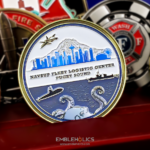
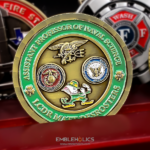
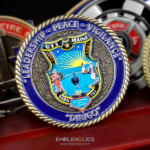
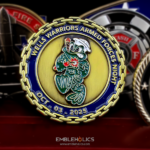
The diamond plate pattern runs as the background of the whole layout, on both faces. Over it sit engraved insignias and lettering, with a gold finish on some of the elements and the small painted ornaments rendered in their original colors. The result is a shiny, colorful and detailed coin.
Diamond Plate as a Background
Deck plate is one of the most effective background textures available, and it is particularly suited to naval and expeditionary work because it is a material reference rather than a decorative pattern.
It is what the deck is actually made of. Anybody who has worked on a boat or a flight deck recognizes it immediately. A pattern that refers to the working environment says something a generic texture cannot.
It solves the flat-field problem. A large recessed area in a single color shows every imperfection in the fill: thin spots, slight unevenness, small contamination. A machined repeating pattern breaks that area up and hides the variation, which is a practical reason to use texture rather than a purely visual one.
It is geometric, so it reproduces cleanly. Diamond plate is raised lozenges at regular intervals. There is no fine organic detail to lose, and the pattern survives reduction better than most textures do.
And it creates light variation across the whole coin. Each raised lozenge catches light on one side and casts shadow on the other, so the field shifts as the coin turns. A flat painted background is inert by comparison.
See finish and engraving options.
Getting the Scale Right
This is the decision that separates a good diamond plate coin from a muddy one, and it is the same problem camouflage has.
Real deck plate is sized for a human stride. The lozenges are a few inches across because they exist to provide grip underfoot. Reproduce that at true relative scale on a coin and each lozenge becomes a speck, and the field reads as a rough texture rather than as diamond plate.
So the pattern has to be enlarged. A coin needs lozenges several times larger, relative to the object, than the real material uses. Six or eight visible across a face reads as deck plate. Sixty reads as sandpaper.
And it has to be cut shallow. The pattern is a background, which means it has to stay subordinate to the insignias and lettering on top of it. Cut at the same depth as the main elements it stops being a background and starts competing. The rule is that the pattern should be visible when you look for it and invisible when you are reading the device.
Angle it rather than aligning it square. A lozenge pattern running at an angle across a round face reads as a continuous surface. Aligned square to the rim it reads as a grid, which draws attention to itself.
Engraved Detail Over Texture
Both faces carry engraved insignias and lettering sitting on the textured field, which is the arrangement that needs managing.
The risk is legibility. Any recessed line cut into an already-patterned surface has to compete with the shadows the pattern is throwing, and fine lettering is the first casualty.
Three things keep it readable. The engraving has to be deeper than the pattern, so the two sit at clearly different levels. The area immediately around any text should be left plainer than the rest, which gives the type a quiet zone to sit in. And the lettering needs more stroke weight than it would on a plain field, because striking softens edges and a textured surround eats the difference.
The gold finish on selected elements is the other half of the solution. Plated gold on exposed metal reads as the brightest thing on the coin, which lifts those elements clear of the textured background without any paint at all. On a busy face, a change of metal is a cleaner separator than a change of color. See also a Navy anchor command coin, which uses diamond plate on one face.
About the Force
The Coastal Riverine Force is a United States Navy organization under Navy Expeditionary Combat Command. In 2020, NECC announced that these forces would be renamed Maritime Expeditionary Security Forces.
The force was established in 2005, in part to address insurgents using waterways in Iraq. Its patrol boat lineage runs back to the Second World War, when Motor Torpedo Boat Squadron Three evacuated General Douglas MacArthur from the Philippines.
The renaming is worth noting for anyone ordering now. A coin carrying an organization’s former name becomes a historical object the moment the name changes, which is either a feature or a problem depending on intent. If you want a piece that marks the Coastal Riverine era specifically, the old name is correct. If you want a coin that stays current, use the present designation.
See also a Navy expeditionary coin and a CORIVFOR coin.
Order a Coin With a Textured Field
Professional artwork is free with unlimited revisions, and nothing goes into production until you approve a digital proof. The challenge coin minimum is 50 pieces, standard production runs about 45 to 50 days after final artwork approval, rush production is available on many projects, and shipping within the continental United States is included. Embleholics is veteran-owned, SDVOSB and registered in SAM.gov.
Two things to expect. If you want diamond plate, the pattern will be drawn larger than the real material and cut shallow, and both of those are deliberate rather than shortcuts; a faithfully scaled pattern reads as sandpaper at coin size. And if your organization has been renamed recently, decide which name goes on the coin before artwork begins, because that choice determines whether the piece marks a period or stays current. Request a free quote to begin.
Frequently Asked Questions
What is a diamond plate challenge coin?
It is a coin using a deck plate pattern as its background field, usually machined into the recessed areas behind the main devices. It is common in naval and expeditionary work because it refers to the actual working environment.
Why use a textured background instead of a flat one?
Because a large flat recessed area shows every imperfection in the fill, while a repeating machined pattern hides those variations. Texture also creates light variation across the coin, where a flat painted field is inert.
How large should the diamond plate pattern be?
Several times larger, relative to the coin, than the real material. Six or eight lozenges visible across a face reads as deck plate; sixty reads as sandpaper, because real plate is sized for a human stride.
How deep should a background pattern be cut?
Shallower than the main elements. The pattern has to stay subordinate, so it should be visible when you look for it and invisible when you are reading the device. Cut at the same depth it competes with the artwork.
Should the pattern align with the coin’s rim?
No, angle it. A lozenge pattern running at an angle across a round face reads as a continuous surface, where one aligned square to the rim reads as a grid and draws attention to itself.
How do you keep lettering readable over texture?
Cut the engraving deeper than the pattern so they sit at different levels, leave the area immediately around the text plainer than the rest, and increase the stroke weight, since a textured surround eats the contrast.
Why use gold plating on a textured coin?
Because plated gold on exposed metal is the brightest element on the coin, which lifts those parts clear of a busy background with no paint at all. On a detailed face a change of metal separates more cleanly than a change of color.
Our unit was renamed. Which name should we use?
It depends on intent. The former name makes the coin a record of that period, which is valid and often wanted. The current designation keeps the coin usable going forward. Decide before artwork rather than after.
More Navy Projects