
A Navy expeditionary challenge coin represents a unit that works in ports, harbors, and coastal waters. These units deploy as small, named detachments and squadrons that rotate often. Their coins are usually ordered at the detachment or squadron level. Each one reflects the identity of a small group of sailors.
What Is Navy Expeditionary Combat Command?
Navy Expeditionary Combat Command, known as NECC, organizes the Navy’s shore and shallow-water communities. Its forces include maritime security units, Seabees, explosive ordnance disposal technicians, expeditionary logistics units, and Navy divers and salvage crews. Each community trains on its own path and wears its own insignia.
These sailors rarely draw the attention that fleet commands receive. A Seabee battalion and an EOD company answer to the same parent command. Their daily routines look very different, and so do their traditions.
The command’s structure explains much of that variety. The maritime security groups sit on both coasts, in San Diego and Virginia Beach. Groups oversee squadrons, and squadrons include companies. Separate detachments operate from forward locations such as Guam.
That layered structure shapes how coins get ordered. An NECC challenge coin can belong to a battalion, a squadron, a company, or a small detachment. Coins from these communities tend to be small runs tied to one unit or one tour. Sailors hand them out at homecomings, promotions, and unit milestones, and often keep them long after the tour ends.
What Happened to the Coastal Riverine Force?
In September 2020, Navy Expeditionary Combat Command renamed all Coastal Riverine Forces as Maritime Expeditionary Security Forces, or MESF. Coastal Riverine Groups became Maritime Expeditionary Security Groups. The squadrons under them became Maritime Expeditionary Security Squadrons.
Coastal Riverine Group ONE is now Maritime Expeditionary Security Group ONE, or MESG 1, based in San Diego. It oversees the West Coast squadrons. The MESF as a whole has two groups, one in San Diego and one in Virginia Beach.
Navy spokespeople said riverine warfare was no longer an assigned Navy mission area. The new name matches the work the force does today. The Coastal Riverine name itself dates to 2012, when riverine and coastal warfare groups merged.
People still search for the old name. A coastal riverine challenge coin from before 2020 bears the former designation. A maritime expeditionary security coin ordered today uses the current one. Coins made under the old name remain part of that unit history.
Who Orders Navy Expeditionary Coins?
Groups, squadrons, companies, and detachments each order their own coins. Expeditionary units deploy in small, named pieces, so the group ordering a coin is often a single company or detachment. That makes the order smaller, more personal, and more frequent than what a large fleet command might place. More in Challenge Coins for Detachments and Small Units. For comparison, see how a fleet-level order looks in these submarine squadron coins.
A Navy expeditionary challenge coin usually marks a moment the unit shares. Common occasions include a deployment, a homecoming, a detachment standing up in a new location, or a change of command. Others include a qualification milestone and a sailor rotating out of a forward posting. A detachment in Guam or Bahrain might order its own coin the same year its parent squadron does. A company within that squadron can do the same. Deployment challenge coins from other units show how crews mark a rotation.
Should a Coin Be Cut to the Shape of a Unit Crest?
A crest-shaped coin makes the unit’s insignia the whole object. The shield, the animal, or the crossed weapons form the outline, and the design fills it. For a unit with strong heraldry, that makes the coin recognizable at a glance. Some units build custom shaped challenge coins around a badge or emblem.
It comes at a cost. Thin points and narrow sections have to survive years in a pocket. A crest shape also gives an engraver less flat surface to work with. Color has less room to sit cleanly inside the outline. The reverse has to be designed to fit that same shape.
A round coin is usually the better choice when the unit has no strong, simple crest. It also suits designs that need detailed artwork on both faces. A crest shape earns its cost when the insignia is bold enough to define the whole coin.
About This Coastal Riverine Group ONE Coin
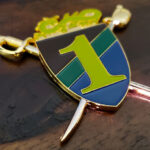
This coin was made for Coastal Riverine Group ONE, now Maritime Expeditionary Security Group ONE. The client wanted the coin cut to the outline of their own crest. Its features are:
- Outline. A dragon sits above a shield, with two crossed sabers behind it. The dragon and sabers form part of the edge.
- Front shield. Three colors split diagonally in black, green, and blue.
- Numeral and dragon. A large numeral 1 sits in the center in bright green, and the dragon matches it.
- Colors. They match the unit’s original insignia.
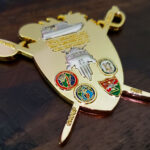
- Reverse. A silver boat sits at the top, with a silver emblem at the center.
- Unit emblems. Four small colored emblems sit below the center emblem.
- Engraving. GROUP and ONE run along the saber blades.
- Finish. The base is gloss gold on both faces.
Official Navy insignia and unit crests come with usage rules. Reproducing an official crest or badge without authorization can break federal rules, regardless of intent. Putting a unit crest on a coin usually requires approval from the unit or command first.
For a squadron, company, or detachment order, confirm with your chain of command before finalizing the design. Embleholics works from artwork the customer is authorized to supply. The artwork team can also design around your unit’s identity without an official crest.
Design a Coin for Your Unit or Detachment
Send your squadron crest, company patch, or detachment insignia, and the artwork team builds the coin from it. Artwork is free, revisions are unlimited, and a digital proof comes before production. Most orders finish 45 to 50 days after artwork approval. Rush production is available for tighter dates.
Deployed units are covered. Shipping is free within the continental U.S., and we also ship to APO and FPO addresses. The minimum order is 50 coins. Embleholics is veteran-owned and SDVOSB registered in SAM.
Request your free quote to start your design. Browse more custom Navy challenge coins, including Navy program office coins.
Finished Coin (Front)
Finished Coin (Back)
Frequently Asked Questions
What is Navy Expeditionary Combat Command?
Navy Expeditionary Combat Command, or NECC, organizes the Navy’s shore and shallow-water forces. These include maritime security, Seabees, explosive ordnance disposal, expeditionary logistics, and diving and salvage units.
What happened to the Coastal Riverine Force?
In September 2020, the Navy renamed the Coastal Riverine Force as the Maritime Expeditionary Security Force. Coastal Riverine Groups and Squadrons took new Maritime Expeditionary Security names. Navy spokespeople stated that riverine warfare was no longer an assigned Navy mission area.
What is the Maritime Expeditionary Security Force?
The Maritime Expeditionary Security Force is an NECC community created when the Coastal Riverine Force was renamed in 2020. It includes groups, squadrons, and companies. Group ONE is based in San Diego.
Who orders Navy expeditionary challenge coins?
Groups, squadrons, companies, and detachments each order their own coins. Orders usually mark a deployment, a change of command, a qualification, or a detachment standing up somewhere new.
Can a coin be cut to the shape of a unit crest?
Yes. A coin can be cut to the outline of a unit’s crest, so the insignia itself becomes the coin. The shape suits bold, simple crests. Detailed artwork on both faces often works better on a round coin.
Do crest-shaped coins cost more than round ones?
Often, yes. Irregular outlines with thin points need more engineering to survive handling, and pricing depends on the design. Send your artwork to get a free quote.
Can we use our unit insignia on a challenge coin?
Yes, once the unit has authorized the artwork. Official Navy and unit insignia have usage rules, so confirm approval with your chain of command first. The design is built from the artwork you are authorized to supply.
What is the minimum order?
The minimum order for custom challenge coins is 50 coins. Every order includes free professional artwork, unlimited revisions before production, and free shipping within the continental U.S.