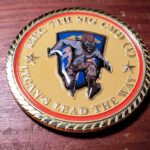
This coin was made for the headquarters company of 7th Signal Command, with the Signal Corps branch insignia on one face and the command’s own logo and mascot on the other. Those two faces are doing two different jobs, and the split is the reason the coin works.
What HHC Stands For
Worth spelling out, because a coin whose whole identity is three letters is no use to anyone who does not already know them.
HHC is Headquarters and Headquarters Company. It is the company that runs a battalion’s or a brigade’s headquarters: the soldiers in the staff sections, the communications shop, supply, maintenance, the medics, the drivers and the clerks who keep a headquarters functioning.
It is not a line company and it does not have a line company’s identity. That creates a specific problem for a coin.
An HHC has two identities and neither of them is entirely its own. It belongs to the parent unit, whose emblem and lineage it shares. And it has its own character as the staff, which the parent unit’s emblem says nothing about. A coin that carries only the parent unit could have been made by any company in it. A coin that carries only the company means nothing outside the headquarters.
The answer is the one this coin uses: one face for the wider identity, one for the specific one. See also another HHC coin and, for a company-level unit outside a headquarters, an engineer company coin.
The Signal Corps Insignia
The front carries the branch insignia, and it is one of the more distinctive devices in the Army.
The Signal Corps insignia is crossed signal flags with a flaming torch, a device that goes back to the branch’s origins in visual signalling. The branch was established in 1860, with Albert J. Myer as the Army’s first signal officer, and the flags and torch are a direct reference to how messages were actually passed before there was anything electrical to pass them with.
The branch colors are orange and white.
Two practical points for a coin. Crossed elements have to be resolved in relief, because struck metal cannot leave which flag passes in front ambiguous, so that is a decision made at artwork rather than left to the die. And a torch with a flame is fine, irregular line work, which means it needs enough diameter to hold its shape and belongs on the lower planes of the relief rather than at the top of it.
Branch Color or Unit Color
Here is a choice worth understanding, because this coin went one way and plenty of others go the other.
Army branch colors are prescribed rather than chosen. For the Signal Corps they are orange and white, and a coin built on the branch would use them. We have a page on an Army engineer coin that does exactly that: one color, scarlet, taken from the branch insignia and matched rather than picked. See the Army engineer crest coin.
This coin is not a branch coin. It is a unit coin that carries a branch insignia, and that is a different thing. It uses a gold base with glossy paint on the graphics, not the branch palette, and that is a legitimate choice rather than an oversight.
The rule worth taking from it: if the coin is about the branch, match the branch colors. If the coin is about a unit that happens to belong to a branch, the unit’s own palette is yours to choose and the insignia still goes on correctly. What does not work is a half measure, where the branch colors appear but inaccurately.
A Comic-Style Mascot on a Military Coin
The reverse carries the command’s logo with its werewolf mascot, drawn in the style of a golden-age comic. That is a real design decision and it deserves better than being described as fun.
A stylized mascot on a military coin can read as unit character, which is what it is for, or as unserious, which is fatal. Three things decide which:
Keep the official face official. The branch insignia on the front is reproduced exactly, with no stylization. A comic mascot alongside an accurately reproduced insignia reads as the unit’s own addition. A stylized insignia alongside a comic mascot reads as a novelty.
Separate them by face. One per side. Neither has to accommodate the other, and nobody is confused about which is which.
Draw it with weight. A comic figure rendered in solid relief with glossy paint carries very differently from the same figure as flat line work. Give it mass and it reads as a struck device rather than as a sticker.
One technical note on comic artwork specifically. A drawing made for print has outlines at whatever weight looked right on paper, and on a coin those outlines become raised ridges. Anything below the minimum width the die can hold disappears into the surface, so the artwork has to be redrawn at a weight metal can carry rather than simply scaled down.
Gold Base, Glossy Paint, Patterned Edge
The finish has three parts and they work together.
A gold base gives a single warm surface for both faces, which ties a formal heraldic device and a comic mascot together more effectively than any shared border could. Two very different designs on the same metal read as one object.
Glossy paint on the graphics makes the painted areas the brightest thing on the coin. On a gold field that contrast is strong, which suits comic artwork built out of flat color areas separated by outlines, because that is exactly what recessed color between raised lines produces.
A patterned edge works here because both faces are device-led rather than scene-led. The usual warning is one textured element per face, and a busy field plus a patterned rim will always fight. Two clean insignia with space around them can carry a decorative edge without competing with it.
See plating options for what each base metal does under glossy paint.
About 7th Signal Command
7th Signal Command (Theater) is the Army command responsible for network operations across the continental United States. Its headquarters company is the unit this coin was made for.
A network command is another organization whose work has nothing physical to show, which is part of why the insignia and the mascot carry so much of this design. There is no vehicle, aircraft or piece of equipment that would say what the command does, so the identity has to come from the branch device and from the command’s own character.
See more Army challenge coins.
Order a Headquarters Company Coin
Free professional artwork, unlimited revisions and a digital proof before anything is produced. Free shipping within the continental US, a 50-coin minimum, and most orders complete 45 to 50 days after artwork approval, with rush production available. Embleholics is veteran-owned, an SDVOSB, and registered in SAM.gov.
Two things worth sending with a quote request. The branch or unit insignia as source artwork rather than as a photograph of a patch, and your mascot artwork if you have one, because a drawing made for print usually needs redrawing at a line weight metal can hold.
Frequently Asked Questions
What does HHC stand for?
HHC stands for Headquarters and Headquarters Company. It is the company that runs a battalion’s or brigade’s headquarters, made up of the staff sections, communications, supply, maintenance, medical and transport soldiers who keep a headquarters functioning.
What goes on an HHC challenge coin?
Usually two identities, one per face: the parent unit’s emblem and lineage on one side, and the company’s own character on the other. A coin carrying only the parent unit could have come from any company in it, and one carrying only the company means little outside the headquarters.
What is the Signal Corps insignia?
The Signal Corps insignia is crossed signal flags with a flaming torch, a reference to the branch’s origins in visual signalling. The branch was established in 1860, with Albert J. Myer as the Army’s first signal officer.
What are the Signal Corps branch colors?
Orange and white. Army branch colors are prescribed rather than chosen, so a coin built around a branch matches those colors rather than selecting a palette.
Does a unit coin have to use the branch colors?
No. A coin about a branch should match the prescribed colors, but a unit coin that happens to carry a branch insignia can use its own palette, as this one does with a gold base. What does not work is using the branch colors inaccurately.
Can a cartoon mascot go on an Army challenge coin?
Yes, and units do it constantly. It works when the official insignia on the other face is reproduced exactly and the two are kept on separate sides, so the mascot reads as the unit’s own addition rather than as a restyling of something official.
Why does comic artwork need to be redrawn for a coin?
Because its outlines become raised metal ridges, and any line below the minimum width a die can hold disappears into the surface. The drawing has to be rebuilt at a line weight metal can carry rather than simply scaled down.
Can a challenge coin have a patterned edge?
Yes, when the faces are quiet enough to carry it. A good working rule is one textured element per face: two clean insignia with space around them can take a decorative rim, while a busy scene and a patterned edge will compete.
What is 7th Signal Command?
7th Signal Command (Theater) is the Army command responsible for network operations across the continental United States. This coin was made for its headquarters and headquarters company.
More Army Projects