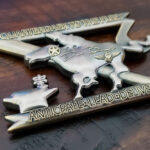
The squadron’s insignia is a cowboy riding a horse against a sunset, over a sea with a Navy ship sailing in it. Rather than putting that on a round coin, the coin was die cut to the shape of the cowboy and the ship themselves. It was made for Fleet Logistics Support Squadron 40, the Rawhides.
Cutting a Coin to a Figurative Shape
Most custom shapes are geometric or simple: a shield, a star, an arrowhead, a state. Cutting a coin to the outline of figures in action is a different order of difficulty and it is worth understanding what it requires.
The outline has to read as the subject with no internal detail. A viewer sees the silhouette against whatever is behind the coin, so the shape alone has to say cowboy on a horse. Posture does that; detail cannot, because detail is inside the outline where it does not affect the shape.
Everything thin has to be thickened. A horse’s legs, a rider’s arm, a mast, a rope. In an illustration those are lines; as the physical edge of a metal object they are the parts that bend. Each one has to be widened beyond true proportion, and the art is doing it without the figure looking swollen.
Gaps are decisions. The space between a horse’s legs, or between the rider and the saddle, either gets cut through, which is dramatic and fragile, or recessed deeply to read as shadow, which is sturdier. On a coin that will be carried, recessing is usually right.
And the two subjects have to connect. This is the structural point people miss. A cowboy and a ship as separate shapes would be two coins. They have to touch or overlap so the whole thing is one continuous piece of metal, which means the composition has to be rearranged from the original artwork rather than traced from it.
See custom shaped challenge coins and, for the difference from removing material inside a coin, custom shaped coin vs cutout coin.
When the Insignia Becomes the Shape
Taking a unit’s existing insignia and cutting the coin to it is the most direct form of custom shape there is, and the payoff is specificity.
A round coin with the Rawhides insignia printed on it is a coin that could belong to anyone, with their artwork on it. A coin cut to the shape of that insignia is a thing only that squadron can have, because no other unit has that silhouette. The page puts it well: it is a coin only the Rawhides can have.
The limit is which insignia can do it. A crest with a strong closed outline translates directly. One built from separate elements with gaps between them, or one whose outline is a plain circle or shield, has nothing distinctive to cut to. And a complex illustrative insignia like this one needs real rework rather than a trace.
The question to ask before committing is simple: would somebody recognize your insignia from its outline alone, with no color and no interior? If yes, it will work as a shape. If no, it belongs on a round coin. See an insignia shaped challenge coin for a simpler crest treated the same way.
A Sunset and a Sea as Background
The insignia includes a sunset behind the rider and a sea below, which on a die cut coin become the recessed field rather than the outline.
That split is the thing to plan. On a shaped coin the outline carries the subject and the interior carries the setting, which means the background elements have to be rendered as surface treatment rather than as part of the silhouette. Three approaches work: radiating lines for a sunset, horizontal bands for a sea, and a change of finish between the two so sky and water read as different materials.
What does not work is attempting a realistic scene in the interior. There is not enough room inside a figurative outline for a detailed background, and the eye is already occupied by the shape. A simplified field behind a strong silhouette is the right balance.
Coins for a Logistics Squadron
VRC-40 is a fleet logistics support squadron based at Naval Station Norfolk. Its mission is providing airborne logistics support to carriers underway, with secondary missions as directed by Commander, Naval Air Force Atlantic.
The squadron supports the fleet from northern Norway to the Eastern Seaboard, the Gulf Coast, the Caribbean, Central and South America, the Mediterranean and the Middle East. It maintains and flies 14 aircraft with nearly 400 enlisted personnel, 31 officers and 21 chief petty officers.
That geographic reach is part of why a distinctive coin matters here. A squadron that operates across that many theaters meets a great many other units, and a coin that is visibly unlike anything else is the one people remember receiving. See also a fleet logistics center coin and more Navy challenge coins.
Order a Die Cut Coin
Professional artwork is free with unlimited revisions, and nothing goes into production until you approve a digital proof. The challenge coin minimum is 50 pieces, standard production runs about 45 to 50 days after final artwork approval, rush production is available on many projects, and shipping within the continental United States is included. Embleholics is veteran-owned, SDVOSB and registered in SAM.gov.
Two things to raise early. Send your insignia and ask whether it will work as an outline before committing to the idea, because the answer depends entirely on the silhouette and it is better settled at the quote stage than after artwork. And expect a figurative shape to need packaging specified separately, since no standard capsule or display rack fits an irregular outline. Request a free quote to begin.
Frequently Asked Questions
What is a die cut challenge coin?
It is a coin cut to an irregular outline rather than struck as a disc, often following the shape of the subject itself. A figurative die cut, such as a figure or vehicle, is the most demanding version.
Can a coin be cut to the shape of a figure?
Yes, but the outline has to read as the subject with no internal detail at all, since a viewer sees the silhouette against whatever is behind the coin. Posture does that work; interior detail cannot affect the shape.
What happens to thin parts like legs or a mast?
They have to be thickened beyond true proportion, because as the physical edge of a metal object they are the parts that bend. The skill is widening them without the figure looking swollen.
Should gaps inside the shape be cut through?
Usually not. Cutting through is dramatic but fragile, where recessing a gap deeply enough to read as shadow is sturdier and almost indistinguishable at arm’s length. For a carried coin, recessing is safer.
Can two separate subjects be die cut on one coin?
Only if they touch or overlap, so the whole piece is one continuous run of metal. That usually means the original artwork has to be rearranged rather than traced, which is the step most people do not anticipate.
Will my unit’s insignia work as a coin shape?
Ask whether somebody would recognize it from its outline alone, with no color and no interior. If yes it will work. A crest built from separate elements, or one whose outline is a plain circle or shield, belongs on a round coin.
What happens to the background in the insignia?
It becomes the recessed interior rather than part of the outline, rendered as surface treatment: radiating lines for a sunset, horizontal bands for a sea, and a change of finish between them. A detailed realistic scene will not fit.
Does a die cut coin need special packaging?
Yes. No standard capsule, sleeve or display rack fits an irregular outline, so packaging has to be specified separately. It is worth raising at the quote stage rather than after the coins are struck.
More Navy Projects