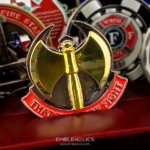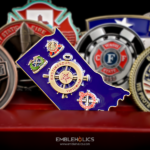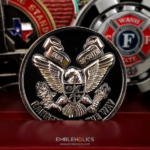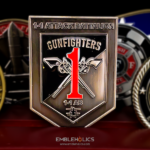
Rather than putting the unit crest on a round coin, this coin is cut to the shape of the crest itself. The front carries the unit insignia engraved, and the reverse carries the insignias of the commander and the first sergeant as the presenters of the coin. The colors are yellow and brown. It’s featured here as our HHC 359th Theater Signal Brigade Challenge Coin.
When a Crest Works as an Outline
Cutting a coin to the shape of the unit’s own insignia is the most direct custom shape there is, and it works beautifully for some crests and badly for others. The difference is worth knowing before you ask for it.
It works when the crest has a strong, closed silhouette. A shield, a scroll, a disc with a defined border, a heraldic device with a clean outer edge. These translate directly, because the shape they already have is a shape metal can be cut to.
It fails when the crest has fine projections. Thin scrollwork, narrow points, delicate wings, trailing ribbons. On paper these are fine. As the physical outline of a metal object they become the parts that bend in a pocket, and the usual fix is to thicken them until the crest no longer looks like itself.
It also fails when the crest is open. Some insignias are a collection of elements with gaps between them rather than one enclosed form. Those have no outline to cut to, so they have to sit on a background shape anyway.
And it changes the reverse. Whatever shape you cut for the front, the back is the same shape. A crest outline that suits the front device may be an awkward field for whatever goes on the reverse, so both faces have to be planned together.
The payoff when it does work is that the coin is recognizable as that unit’s before anybody looks at the detail, which no round coin achieves. See custom shaped challenge coins.
Yellow and Brown
An unusual pairing, and a deliberate one. Signal Corps colors have traditionally been orange and white, but the warmer earth tones here produce something closer to a field or heraldic register than a bright enamel coin would.
Two things make this palette work in metal. Yellow and brown sit next to each other on the color wheel, so they harmonize rather than fight, and the brown is dark enough to act as the forgiving background color that every coin benefits from, hiding small variations in fill the way black does. The yellow then has the whole face to itself as the bright element.
The caution with yellow specifically is that it is one of the weaker enamel colors for contrast. Yellow against white or a light metal nearly disappears; yellow against a dark brown is strong. If you want a yellow coin, it needs a dark partner, which is exactly what this one has.
The Presenters on the Reverse
The back of this coin carries the insignias of the unit commander and the first sergeant, identifying who the coin comes from. That is a less common choice than it should be.
Most unit coins put the unit on both faces, or the unit on one and a motto on the other. Naming the presenters instead does something specific: it turns the coin from an object that represents an organization into an object that came from two particular people.
For a coin given by command, that is the whole point. The recipient remembers being handed it by somebody, and the reverse records who. It also marks the coin in time without using a date, since a command team is a period.
One practical consequence. A coin identifying the current command team will become historical when they rotate out, which is either a feature or a problem depending on how you see it. If you want a coin that stays current indefinitely, leave the presenters off. If you want a coin that marks a particular command, this is how.
About the Unit
HHC 359th TTSB is the Headquarters and Headquarters Company of the 359th Tactical Theater Signal Brigade, a United States Army unit providing command and control to its assigned and attached units. The brigade oversees the installation, operation and maintenance of the theater communications system, excluding division and corps systems, and hosts a Joint Command, Control, Computer and Communications Center.
The unit is stationed at Fort Gordon, southwest of Augusta, Georgia, which was established in October 1941 as Camp Gordon. The post is home to the United States Army Signal Corps, Army Cyber Command and the Cyber Center of Excellence.
A headquarters company is a good illustration of why coins exist at all. The people in it support a brigade rather than appearing in its operational story, and a coin is one of the few ways that contribution gets acknowledged in an object. See also a brigade support battalion coin.
Order an Insignia Shaped Coin
Professional artwork is free with unlimited revisions, and nothing goes into production until you approve a digital proof. The challenge coin minimum is 50 pieces, standard production runs about 45 to 50 days after final artwork approval, rush production is available on many projects, and shipping within the continental United States is included. Embleholics is veteran-owned, SDVOSB and registered in SAM.gov.
Two things to raise early. Send your crest and ask whether it will work as an outline before you commit to the idea, because the answer depends entirely on the silhouette and it is better settled at the quote stage than after artwork. And plan both faces together, since the shape you cut for the front is the shape the back has to live in. Request a free quote to begin.
Frequently Asked Questions
What is an insignia shaped challenge coin?
It is a coin cut to the outline of the unit’s own crest rather than struck as a disc. The coin is recognizable as that unit’s before any detail is read, which a round coin carrying the same crest cannot achieve.
Can our unit crest be used as the coin’s shape?
It depends on the silhouette. A crest with a strong closed outline, such as a shield, scroll or bordered disc, translates directly. One with thin scrollwork, narrow points or trailing ribbons does not, because those become the parts that bend.
What makes a crest unsuitable as an outline?
Fine projections and open forms. Delicate elements have to be thickened until the crest stops looking like itself, and an insignia made of separate elements with gaps between them has no single outline to cut to, so it needs a background shape anyway.
Does the shape affect the back of the coin?
Yes, and it is often overlooked. Both faces share the same outline, so a shape that suits the front device may be an awkward field for whatever goes on the reverse. Plan both faces together rather than designing the front and then filling the back.
Does yellow work as a coin color?
Yes, with a dark partner. Yellow is one of the weaker enamel colors for contrast and nearly disappears against white or light metal, but against a dark brown or black it is strong and becomes the brightest element on the face.
Can the commander’s and first sergeant’s insignias go on a coin?
Yes, and it is a good use of a reverse. It identifies who the coin came from, which turns it from an object representing an organization into one that came from two particular people.
Should a coin name the current command team?
Only if you want it to mark that period. A coin identifying the current commander and first sergeant becomes historical when they rotate out. Leave the presenters off if you want a design that stays current indefinitely.
Why do headquarters companies order coins?
Because their work supports a larger unit without appearing in its operational story. A coin is one of the few ways that contribution gets acknowledged in a physical object, which is much of the reason coins exist.
More Army Projects