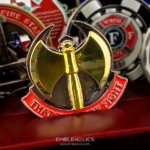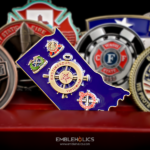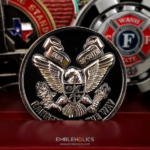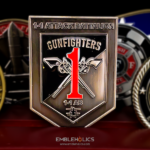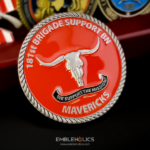
A brigade support battalion provides the logistics and medical support that lets a fighting brigade operate. This coin was made for the 181st, a Washington Army National Guard battalion supporting a Stryker brigade combat team, and it carries a buffalo skull on glossy red with a brushed silver reverse.
Recognition for the People Who Supply the Fight
Combat service support units have a specific recognition problem, and it is the opposite of the one most people assume.
A maneuver battalion’s work is visible. There are vehicles, there is terrain, there is a mission with a name. A support battalion’s work is visible only when it fails. Fuel arrives, ammunition arrives, casualties are treated and moved, equipment is repaired and returned, and if all of that happens correctly nobody outside the battalion notices any of it.
That makes the coin do more work than it would for a line unit. It is often the only object that says what these soldiers did, because the achievement is an absence of problems rather than a list of actions.
Three things follow for the design:
Lead with the identity, not the function. A coin covered in trucks, fuel cans and medical crosses describes a job. The buffalo skull and the Mavericks name say who these people are, which is what a member actually wants on it.
Put the mission statement in the lettering. This coin does exactly that: “WE SUPPORT THE MISSION” flanks the skull on the front, and “SUSTAINING VICTORY” sits on the reverse. The words carry the function so the artwork does not have to.
And keep the parent formation on it. A support battalion exists in relation to the brigade it supports, and acknowledging that is part of the identity rather than a dilution of it. For a comparable formation-level piece, see a sustainment brigade coin.
Glossy Red and Brushed Silver
The two faces use entirely different finishes. The front is a bright glossy red field with the skull centered on it. The reverse is brushed silver with embossed insignia and no color at all.
That split does something a single finish cannot.
Gloss advances and brushed recedes. A glossy surface reflects and draws the eye forward; a brushed one scatters light and sits back. Using one on each face means the coin has a clear front without needing the front to be busier.
Color on one side only makes that side the statement. The red face is the one that gets photographed and shown. The silver face is the one that rewards being looked at closely, because brushed metal shows relief better than a colored field does.
And brushed metal is the better home for embossed detail. On a glossy surface, raised detail competes with the reflections around it. On a brushed one it reads cleanly, which is why the insignia and the rank elements sit on that face rather than the other.
The trade worth knowing: a glossy colored field shows fingerprints and scuffs more readily than a brushed one, so the two faces will age at different rates. Most people find that acceptable on a coin with this much contrast built in. Our page on finishes and plating covers the options.
A Skull That Is Not the Usual Skull
The buffalo skull on the front is worth a note, because it is doing something different from the skull devices that appear on so many unit coins.
A human skull reads as a warning. An animal skull reads as a place. A buffalo belongs to a landscape, and for a unit drawn from one state that connection is specific in a way a generic death’s head is not.
It also sculpts well. The broad frontal bone and the curve of the horns give a sculptor large forms to work with, where a human skull at coin size is mostly eye sockets and teeth. Large forms survive reduction; fine ones do not. For a very different approach to skull imagery, see a coin cut to the shape of a winged skull.
The Battalion
The 181st Brigade Support Battalion is a Washington Army National Guard unit based at Camp Murray. It provides logistics and medical support to a Stryker brigade combat team.
Like most Guard formations it carries a dual history. The battalion has supported state emergency response at home, including during the pandemic, and it has deployed overseas, with its Alpha Company serving in Iraq. That combination of state and federal service is specific to the Guard and is part of why Guard coins tend to be handed over in civilian settings as often as in uniform.
See more National Guard challenge coins.
Order a Coin for Your Battalion
Professional artwork is free with unlimited revisions, and nothing goes into production until you approve a digital proof. The challenge coin minimum is 50 pieces, standard production runs about 45 to 50 days after final artwork approval, rush production is available on many projects, and shipping within the continental United States is included. Embleholics is veteran-owned, SDVOSB and registered in SAM.gov.
Two things worth sending. Your unit nickname and motto, because between them they usually carry more of the identity than the formal designation does. And if you want different finishes on the two faces, say so early, since it affects the plating sequence rather than just the artwork. See more Army challenge coins.
Frequently Asked Questions
What is a brigade support battalion coin?
It is a coin made for the battalion that provides logistics, maintenance and medical support to a brigade combat team. Support battalions order coins for the same reasons line units do, with the difference that their work is largely invisible when it goes well.
What should a support or logistics unit put on its coin?
Lead with the unit’s identity rather than its function. A coin covered in trucks, fuel cans and medical symbols describes a job description; a nickname, a mascot and a motto say who the people are. Put the function into the lettering and let the artwork carry the identity.
Can two faces of a coin have different finishes?
Yes, and it is an effective way to give a coin a clear front. A glossy colored face advances and draws the eye, while a brushed metal face recedes and shows embossed relief more cleanly. Specify it early, because it affects the plating sequence rather than only the artwork.
Why put embossed detail on the brushed side?
Because brushed metal scatters light instead of reflecting it, so raised detail reads cleanly against it. On a glossy surface, relief competes with the reflections around it and the detail gets lost in the shine.
Does a glossy colored face show fingerprints?
More than a brushed one, yes. A coin with a glossy face and a brushed face will age at slightly different rates on each side. Most people accept that as a consequence of the contrast, but it is worth knowing before choosing gloss for the face that will be handled most.
Why use an animal skull rather than a human one?
An animal skull reads as a place and a landscape, where a human skull reads as a warning. A buffalo also sculpts better at coin size, because the broad frontal bone and curved horns give large forms to work with, while a human skull reduces to eye sockets and teeth.
Do National Guard units order challenge coins?
Regularly. Guard units have both a state and a federal history, which gives them more occasions to mark than most, and a Guard coin tends to be shown in civilian settings as often as in uniform, since members return to civilian careers between duty periods.
Should a support battalion show the brigade it supports?
Usually yes. A support battalion exists in relation to the formation it sustains, and acknowledging that is part of its identity rather than a dilution of it. The common arrangement is the battalion’s own nickname and device leading, with the brigade referenced in the lettering or on the reverse.
More Army Projects