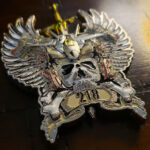
A skull challenge coin is one where the skull is the object rather than a picture on it. This piece is cut to the outline of a winged skull, with dragon heads and an aircraft engraved around the face and a shield and sword sculpted on the reverse, made for a Marine fighter squadron that flew Corsairs in the Pacific.
Why Skulls Work on Coins
The skull is the most requested device in this business and one of the most misunderstood. It comes up from military units, fire and police crews, security teams and riding chapters, and the results range from excellent to interchangeable.
A skull reads at any size. This is the mechanical reason it survives where other devices fail. The eye recognizes the shape of a skull before it resolves any of the detail, so the design still works when it is reduced to an inch and a half. A crest with fine heraldic elements does not have that advantage, because a crest has to be read rather than recognized.
It has real heraldic history. Worth saying because it separates a unit’s skull from a novelty one. Skull devices have carried meaning in military insignia for centuries, and in aviation specifically they go back to the earliest squadron markings. A unit using one is drawing on its own tradition rather than borrowing from merchandise.
It is also the most overused device in the category. That is the honest part. A skull printed flat on a round coin is the default, and the default looks like everyone else’s. If a skull is the whole idea, the coin will be forgettable however well it is made.
So a skull coin needs a second idea. There are two reliable ways to get one. Cut the coin to the skull’s outline so the shape itself is the design, which is what this piece does. Or pair the skull with something only your unit has, such as an airframe, a tool or a place. This coin does both, which is why it holds up.
One practical caution rather than a moral one: a skull is the device most likely to meet an objection inside an organization that answers to a public. If your coin needs sign-off from a city, a board or a public affairs office, show them the artwork early rather than at the proof stage.
Cutting an Irregular Outline
A winged skull is harder to produce than most custom shapes, because it has projections and concave curves in the same outline. Most shaped coins have one or the other.
Outward points are fragile. Wingtips and the line of the jaw stick out past the body of the coin, which makes them the first things to bend and the first things to catch on a pocket lining.
Inward curves are where the stress sits. The notch between a wing and the skull is a concave corner, and concave corners concentrate force during the strike. Left as a sharp angle, that is where a die cracks and where a finished piece fails. Radiusing the corner slightly solves it and costs nothing visually.
The usable face area is smaller than the outline suggests. A winged shape looks generous and most of its width is wing. The area that can carry artwork is the skull itself, which is why the engraving on this coin works around the skull rather than across it.
And nothing standard will fit it. A non-round coin does not sit in a capsule, a sleeve or a display rack, so protective packaging has to be specified rather than assumed.
The usual consequence of all four is that an irregular shape wants to be thicker than a round coin of the same width. That affects both the cost and the way the coin feels in the hand, and it is a decision to make at the artwork stage rather than after. Our page on custom shaped challenge coins covers the options.
Three Techniques on One Coin
This piece uses three different methods, which is unusual and is what gives it its depth.
The outline is die cut, so the shape is the coin. The dragon heads and the aircraft on the front are engraved, cut into the surface rather than raised from it. The shield and sword on the reverse are sculpted in relief, standing off the face.
Each one is doing a different job. The cut shape gives the object its identity before anyone looks at it closely. The engraving carries detail without adding height, which matters on a face that is already a strong silhouette. And the relief on the reverse gives that side a focal point the front does not need, because the front has the outline.
The result is two faces that read differently. That is the point of mixing techniques rather than a side effect of it: a coin built around one dominant shape can easily feel repetitive from side to side, and giving each face its own texture solves that.
The cost of a coin like this sits in the production steps rather than in the metal. Three techniques means three operations, and that is where the money goes. You can see the same combination of cutting, engraving and relief applied to other pieces in the gallery, including a coin with an aircraft on it.
The Squadron
Marine Fighting Squadron 218 was organized at Marine Corps Air Station Mojave, California, in July 1943 and commissioned that September.
It flew the F4U Corsair in the South Pacific, and its first combat action was covering the Allied landing on Green Island. The squadron was later reactivated in the Marine Corps Reserve in the 1950s and based at Naval Air Station Willow Grove, near Philadelphia.
A squadron with that history is the kind of client where the artwork tends to come from a patch, a cruise book or a photograph rather than from a file, because nothing was digital when the insignia was drawn. For other Marine squadron pieces, see a Marine squadron challenge coin.
Order a Shaped or Skull Coin
Professional artwork is free with unlimited revisions, and nothing goes into production until you approve a digital proof. The challenge coin minimum is 50 pieces, standard production runs about 45 to 50 days after final artwork approval, rush production is available on many projects, and shipping within the continental United States is included. Embleholics is veteran-owned, SDVOSB and registered in SAM.gov.
Two things worth saying at the start. If you want a skull, tell us what else the coin has to say, because the skull alone will look like everyone else’s. And if the outline has thin points or deep notches, we will tell you at the artwork stage what needs thickening rather than finding out at the strike. See more Marine Corps challenge coins or request a free quote.
Frequently Asked Questions
What is a skull challenge coin?
A skull challenge coin is one built around a skull device, and the strongest versions are cut to the skull’s outline rather than carrying a skull printed on a round face. This piece is a winged skull in profile, with engraved detail on the front and a sculpted shield and sword on the reverse.
Can a coin be cut into the shape of a skull?
Yes, and it is one of the better uses of a custom outline, because a skull is recognized by its shape alone. The outline needs enough thickness at the jaw and the wings to resist bending, and the inward notches should be slightly radiused rather than left as sharp corners.
Why are skulls so common on challenge coins?
Partly because they carry real heraldic history, particularly in aviation, and partly because the shape reads instantly at coin size where fine heraldic detail does not. The consequence is that skull designs are everywhere, so a coin needs a second idea alongside the skull to stand out.
How do you make a skull coin that does not look generic?
Two approaches work. Cut the coin to the skull’s outline so the shape is the design rather than a picture on a disc, or pair the skull with a device only your unit has, such as an aircraft, a tool or a location. Using both is what separates a distinctive skull coin from a stock one.
Do thin points on a shaped coin break?
They can bend if the metal is too thin, and they are the parts most likely to catch on a pocket. Wingtips, jaws, blades and tails all need either extra thickness or a slightly softened profile, which is a judgment we make at the artwork stage rather than after the die is cut.
Does an irregular shape need a thicker coin?
Usually yes. A shape with projections and concave notches carries stress that a circle does not, so the piece is normally specified thicker than a round coin of the same width. That affects both the cost and the weight in the hand, which most people consider an improvement.
Can one coin use cutting, engraving and relief together?
Yes, and this coin does. The outline is die cut, the front detail is engraved into the surface and the reverse is sculpted in relief. Each technique gives its face a different texture, which keeps a coin built around one strong shape from feeling repetitive. The cost sits in the extra production steps rather than in the metal.
Will a skull design cause problems with a public agency?
It sometimes does, in organizations that answer to a city council, a board or a public affairs office. The design itself is not a problem, but the approval can be, so show the artwork to whoever signs off early rather than at the proof stage.
More Navy Projects