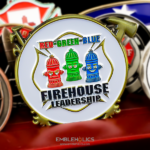
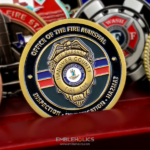
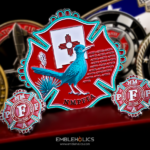
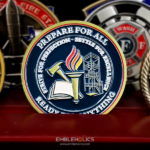
A department coin and a station coin are different things, and firefighters know it even when the people buying the coins do not. This one was made for Station 4 of the Boise Fire Department, the house on Ustick Road known as the Ustick Express. It carries a steam locomotive rendered in sports-team styling on one face and the station insignia on the other, on a polished silver base with only three colors a side.
The house, not the department
A fire department is an organization. A station is a place where a specific group of people live together on shift, and the identity attached to it is much more personal. Crews name their houses, adopt mascots, invent nicknames out of the street they sit on, and defend all of it against the other stations.
A department with eighteen stations is really eighteen identities under one badge, which is why a single department coin, however well made, never quite covers it. The department coin represents the organization to the outside world. The station coin represents the house to the people in it and to the other houses.
Practically, that means a department has two sensible options:
- One department coin, ordered in volume, for official presentation and recruitment. It carries the department badge and nothing station-specific, and it is reordered forever.
- Station coins, ordered small, one design per house. Each carries the station number, the house nickname and whatever the crew has adopted. These are the coins that actually get traded.
The second is cheaper than departments expect. If several stations order at once, the artwork is the only per-station cost that really varies, and the production economics improve across the combined run. A department that coordinates its houses into one order gets better pricing than eighteen separate small orders would.
Where house nicknames come from
Almost every house nickname comes from one of four places, and knowing which one yours is tells you what the coin should show.
- The street or neighborhood. The Ustick Express takes its name from Ustick Road. Geography-based nicknames usually suggest a local landmark or a piece of the street’s history.
- Call volume or reputation. Busy houses name themselves after the pace. These tend to produce the best mascots.
- Something that happened. A fire, an incident, a long-running joke. These are the hardest for an outsider to design for, which is why the crew needs to be in the conversation.
- The apparatus. A house known for its ladder or its heavy rescue often builds its identity around the rig.
A locomotive for an “Express” is the obvious and correct answer, and that directness is what makes station coins work. The crew does not need the joke explained, and neither does the next house over.
Sports-team styling in the fire service
Fire service art has borrowed from sports branding for decades, and it is one of the few places where the borrowing looks right rather than lazy. Bold outlined lettering, a mascot in three-quarter profile, hard-edged color blocks and a logo that would work on a jersey: all of it suits a house that thinks of itself as a team.
Three colors a side is the discipline that makes it work. Sports logos are built on tight palettes, because they have to read on a helmet, a shirt and a banner at different sizes. The same restriction on a coin keeps the design bold at an inch and a half across, where a detailed illustration would turn to mush.
A polished base suits this style specifically. Most of the time we would steer a working coin toward an antique or satin finish, but a sports-styled design wants brightness and hard contrast, and a polished silver field delivers it. The trade-off is that it shows handling, which is the right trade for a coin that is mostly a display and trading piece.
Keep the department badge on it somewhere
A station coin should still say which department it belongs to. House identity is the point of the coin, but a coin traded outside the department needs to be traceable to it, and the badge or department name in the rim or on the reverse does that without crowding the house design.
This also matters for permission. A crew-designed coin carrying the department badge is reproducing the department’s mark, which is a decision for the department rather than the house. Most departments are comfortable with it; the point is to ask once and get it settled for all the stations rather than station by station.
Ordering a station coin
Tell us the station number, the house nickname and where it came from. That last part is what gives us something to draw. If several houses in the department want coins, say so, because ordering together is cheaper than ordering separately and the set will look like a set. You can see more firefighter challenge coins we have produced, including the Boise Firefighters coin and the Chicago Fire Department coin, or send your details through the free quote form.
Frequently Asked Questions
What is a fire station challenge coin?
It is a coin for an individual fire station rather than for the department as a whole. Each house has its own crew, nickname, mascot and reputation, and a station coin carries that identity. A department coin represents the organization officially; a station coin is the one that gets traded between houses.
Should a department order one coin or one per station?
Often both. A department coin ordered in volume covers official presentation and recruitment and carries only the department badge. Station coins are small runs, one design per house, carrying the station number and whatever the crew has adopted. If several houses order at once the economics improve, so coordinating into a single order beats separate small ones.
Where do house nicknames come from?
Usually from the street or neighborhood, from call volume and reputation, from something that happened at the house, or from a particular piece of apparatus. Knowing which applies tells you what the coin should show, which is why the crew needs to be in the design conversation rather than just the chief’s office.
Why does sports-team styling work on fire coins?
Because a house thinks of itself as a team, and the visual language matches: bold outlined lettering, a mascot in three-quarter profile, hard-edged color and a logo that would work on a jersey. Sports logos are also built on tight palettes so they read at any size, which is exactly the discipline a coin needs.
How many colors should a station coin use?
Three a side is a good limit for this style. A restricted palette keeps the design bold at coin size, where a detailed illustration turns muddy, and it costs less because enamel is charged by area on every coin rather than once in the die. The constraint improves the design as well as the price.
Should a station coin carry the department badge?
Yes, somewhere. House identity is the point, but a coin traded outside the department needs to be traceable back to it, and the badge or department name in the rim or on the reverse does that without crowding the station design. It also means asking the department’s permission once, for all the houses, rather than station by station.
Is a polished finish a good idea for a fire coin?
For this style, yes, which is unusual. Most working coins do better with an antique or satin finish that hides handling, but a sports-styled design depends on brightness and hard contrast, and polished silver delivers it. The trade-off is visible handling, which is acceptable for a coin that mostly gets displayed and traded rather than carried daily.
More Firefighters Projects