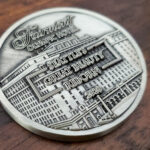
This coin marks the start of a hotel’s 2020 renovation. The building is etched on one face and the contractor’s logo on the other, which is the whole idea: a project has two parties, and the coin gives each of them a side.
Marking the Start Rather Than the Finish
Most commemorative coins are made when something is over. This one was made when something began, and that is the more interesting choice.
A coin made at the start gets carried through the work. Handed out at a kickoff, it sits in pockets and on desks for the duration of the project rather than arriving after everyone has moved on. People who worked on the job have the coin the whole time they are working on it.
It is also easier to design. A coin made at the end has to summarize what happened, which usually means dates, figures and a long inscription. A coin made at the start only has to say what is beginning, so it can be a clean image and a date.
And the timing is practical. Production runs about 45 to 50 days after artwork approval, which fits comfortably into the lead up to a groundbreaking or a kickoff. The end of a project is almost always more rushed than the start.
The same logic applies well beyond hotels. Any project with a defined beginning, a client and a contractor has the same shape: a new building, a ship’s keel laying, a system going live, a facility opening. See corporate challenge coins and, for a coin covering a partnership between organizations, a public-private partnership coin.
Two Parties, Two Faces
Splitting a project coin between the client and the contractor solves a problem that comes up on every joint commemorative.
The problem is hierarchy. Put two logos on one face and you have implicitly ranked them, because one is larger, higher or to the left. Everybody involved notices, and it is the sort of thing that generates a proof round nobody wanted.
Giving each party its own face removes the question entirely. There is no larger and no first; there are two sides. For a coin that both organizations will hand out, that is worth more than any clever layout.
It also means each face can use the right treatment for what it carries. Here the hotel side is an etched architectural image, which suits a building, and the contractor side is a logo, which suits a graphic mark. Forced onto one face, one of them would have had to compromise.
Etching a Building Into Metal
An architectural facade is one of the harder subjects to put on a coin, and it is worth knowing why before you ask for one.
Buildings are made of repeated small elements. Windows, cornices, columns, brickwork. Those are exactly the features that disappear first when an image is reduced to coin size, and a facade that has lost its windows stops looking like that building.
The answer is to simplify deliberately rather than reduce faithfully. A good architectural etch keeps the silhouette, the roofline and the two or three features that identify the building, and lets the rest go. Trying to keep every window produces a gray texture where a facade should be.
Etching suits it better than relief. Recessed line work reads as a drawing, which is how people are used to seeing buildings rendered. Sculpting a facade in relief is possible but tends to look like a model rather than a drawing, and it costs more.
And a photograph is the wrong starting point. A photo has to be converted to line work before it can be etched, and that conversion is a drawing decision rather than a mechanical one. Sending elevations or a clean photograph taken square on gives a much better result than a casual angled shot.
About the Hotel
The Fairmont Olympic Hotel is a historic hotel in downtown Seattle. This coin commemorates the start of its 2020 renovation, carried out in collaboration with Abbot Construction, and the client wanted the piece to reflect both the building’s history and the partnership behind the work.
Order a Project Coin
Professional artwork is free with unlimited revisions, and nothing goes into production until you approve a digital proof. The challenge coin minimum is 50 pieces, standard production runs about 45 to 50 days after final artwork approval, rush production is available on many projects, and shipping within the continental United States is included. Embleholics is veteran-owned, SDVOSB and registered in SAM.gov.
Two things that help. If the coin carries a building, send elevations or a square-on photograph rather than an angled snapshot, because the image has to be converted to line work and a good source makes that conversion far better. And if two organizations’ marks appear, confirm that both have approved the use before artwork begins; we produce from what the customer supplies and do not grant permission on either party’s behalf. Request a free quote to begin.
Frequently Asked Questions
What is a hotel challenge coin?
It is a commemorative coin made for a hotel, usually marking a milestone such as an opening, an anniversary or a renovation. Hospitality coins work the same way corporate ones do: they are handed to the people involved in the project and to guests of note.
Can a coin mark the start of a project rather than the end?
Yes, and it is often the better choice. A coin handed out at a kickoff gets carried through the whole job rather than arriving after people have moved on, and it is easier to design because it only has to say what is beginning.
How long before a kickoff should we order?
Allow about 45 to 50 days for production after final artwork approval, plus time for the artwork and proof rounds. Rush production is available on many projects if the date is tighter than that. More in How long does it take to get custom challenge coins made? and Can you rush custom challenge coins?
How do you put two companies’ logos on one coin?
Give each one its own face. Placing both on a single face implicitly ranks them by size and position, which everyone involved notices. Two faces removes the question and lets each mark be treated the way it needs.
Can a building be etched onto a challenge coin?
Yes, and etching suits architecture better than sculpted relief because recessed line work reads as a drawing, which is how people expect to see buildings rendered. Relief is possible but tends to look like a scale model and costs more.
Why do buildings lose detail on a coin?
Because a facade is made of repeated small elements such as windows, cornices and brickwork, and those are the first things to disappear at coin size. The fix is to simplify deliberately, keeping the silhouette, roofline and two or three identifying features.
What artwork should we send for a building?
Architectural elevations if you have them, or a clean photograph taken square on to the facade. A photo has to be converted into line work before etching, and a square, well lit source makes that conversion far more accurate than a casual angled shot.
Do we need permission for a hotel or contractor logo?
Each organization approves the use of its own mark, so confirm both before artwork begins. We produce from the artwork a customer supplies and do not grant permission on any company’s behalf.
More Corporate Projects