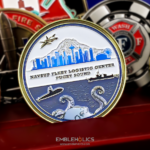
An overseas base coin has one requirement no domestic order has: it has to physically reach a place with no street address. This one was made for Camp Lemonnier in Djibouti, the largest United States military installation in Africa and home to Combined Joint Task Force–Horn of Africa. The coin is an oval rather than a circle, with insignia and inscriptions on both faces and a raised diamond plate pattern worked across the front.
Getting coins to a deployed address
Plan the shipping before the artwork, not after. This is the single most common thing that goes wrong with an overseas unit order, and it is entirely avoidable. Coins going to a base like Camp Lemonnier travel through the military postal system to an APO or FPO address, and that leg is slower and less predictable than domestic delivery. A rotation that ends in ten weeks and a production schedule that takes six does not leave enough margin.
What actually matters in practice:
- Use the APO or FPO address, formatted correctly. Military postal addresses are not foreign addresses, and entering Djibouti as the country will send the parcel into the international system instead of the military one. We cover the formatting and the common mistakes in our guide on APO and FPO challenge coin shipping.
- Build in more time than you think you need. Transit into the military postal system varies considerably by destination and season. Order with weeks of margin against your rotation date rather than days.
- Consider splitting the shipment. For a large order, sending in two consignments means a delay or a loss affects half the coins rather than all of them.
- Have a stateside fallback. If the timeline is genuinely tight, shipping to a rear detachment or a family member in the United States and having coins carried forward is sometimes faster than the postal route. Worth asking us about before you commit either way.
If the rotation is nearly over, say so when you ask for a quote. We can tell you honestly whether the date is achievable, and our rush production option exists for exactly this situation.
Camp Lemonnier, and what a base coin represents
Camp Lemonnier is a Navy-run installation next to Djibouti–Ambouli International Airport in Djibouti City. It began as a French Foreign Legion garrison, named after General Émile-René Lemonnier, and Djibouti leased it to the United States in 2002 along with rights to the neighboring airport and port facilities. It is now the largest US military installation in Africa and hosts Combined Joint Task Force–Horn of Africa, under US Africa Command.
A base coin is a different thing from a unit coin, and the design should reflect that. A unit coin belongs to one organization. A base coin belongs to a place that many different organizations pass through, often on short rotations, from several services and sometimes several nations. That makes the base itself the subject, and it means the design should avoid being specific to any one tenant command. The same base supports a range of units, including the CJTF-HOA information operations element, each of which may want its own coin alongside the installation’s.
Why an oval, and what the shape costs
An oval is the most underused shape in challenge coins, and it suits a base coin particularly well. A circle gives you a symmetrical field with no natural reading direction. An oval has a long axis, which means text wants to run along it and imagery wants to sit in the middle, so the layout organizes itself. For a name as long as Camp Lemonnier plus an inscription, that extra horizontal room is useful.
The trade-off is minor but real. Any non-round shape needs a die cut to that profile, so shape work is quoted separately from a standard round coin. An oval is at the simple end of that scale, with no fragile points or narrow extremities, so it is among the cheapest departures from a circle you can make.
Diamond plate as a texture, not a pattern
The raised diamond plate across the front is doing structural work, not decorative work. A coin with insignia and lettering on an otherwise empty field can look thin. Filling that field with a fine repeating texture gives the raised elements something to stand against, so they read as sitting on a surface rather than floating.
Industrial textures suit expeditionary and engineering subjects. Diamond plate, knurling, and rivet patterns carry an association with equipment and hard use that a plain or sunburst field does not. The rule is the same as with any texture: it has to be fine enough to read as a surface rather than competing as a pattern, and whatever sits on top of it needs enough relief height to clear it.
Ordering a coin for an overseas base
Give us the insignia, the inscription, and your rotation date and destination address in the same message. That last pair is what lets us work the schedule backwards and tell you straight away whether the date is realistic. We will confirm the shipping route before production rather than at the end of it. You can browse the military challenge coins we have produced, or send your details through the free quote form.
Frequently Asked Questions
Can you ship challenge coins to an APO or FPO address?
Yes. Coins for deployed units travel through the military postal system to an APO or FPO address. The important detail is formatting: a military postal address is not a foreign address, so entering the host country as the destination country pushes the parcel into the international system instead of the military one. Transit times are also longer and less predictable than domestic delivery, so order with weeks of margin rather than days.
How far ahead should a deployed unit order coins?
Further ahead than a domestic order, and measured against your rotation date rather than today. Production plus military postal transit needs real margin, and a rotation ending soon is the most common reason a deployed order fails to arrive in time. Tell us your rotation date when you request a quote and we will tell you honestly whether it is achievable.
What if our rotation ends before the coins could arrive?
There are two workable options. Rush production shortens the manufacturing leg, which is sometimes enough on its own. Alternatively, shipping to a rear detachment or a stateside address and having the coins carried forward can beat the postal route. Ask before ordering and we will tell you which is more likely to work for your dates.
What is Camp Lemonnier?
Camp Lemonnier is a US Navy-run installation in Djibouti City, next to Djibouti–Ambouli International Airport, and the largest United States military installation in Africa. It was originally a French Foreign Legion garrison named after General Émile-René Lemonnier, and Djibouti leased it to the United States in 2002. It is home to Combined Joint Task Force–Horn of Africa.
How is a base coin different from a unit coin?
A unit coin belongs to one organization and carries its crest and identity. A base coin belongs to a place that many units pass through, often on short rotations and from different services. That makes the installation itself the subject, and it means the design should stay clear of any single tenant command’s insignia so the coin works for everyone stationed there.
Why choose an oval instead of a round coin?
An oval has a long axis, so text runs naturally along it and imagery settles in the middle, which organizes the layout for you. It also gives more horizontal room for a long base or unit name. Because it is a non-round shape it needs its own die profile and is quoted separately, but with no points or narrow extremities it is one of the least expensive alternatives to a circle.
What does a diamond plate texture do on a coin?
It gives the raised insignia and lettering a surface to sit against, so they look placed rather than floating on an empty field. Industrial textures like diamond plate, knurling, and rivet patterns also carry an association with equipment and hard use that suits expeditionary and engineering subjects. The texture has to be fine enough to read as a surface, and anything sitting on it needs enough relief to clear it.
More Navy Projects