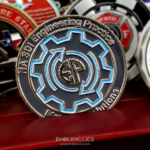
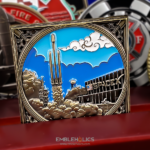
An awareness coin has a job most coins do not: it has to be worth buying. This one was made for a breast cancer awareness campaign, carrying a precisely engraved police shield and a landscape image, and it is colorful rather than restrained because the people picking it up need to want it.
A Coin That Has to Be Sold
This is the key difference, and it changes several design decisions at once.
It competes for a purchase, not just attention. A unit coin is given to people who already belong. An awareness coin is offered to someone deciding whether to part with money. That means it has to look like good value in the hand within a couple of seconds.
Which argues for color, not restraint. On most of the coins in this gallery we would argue for a limited palette, because restraint reads as considered. On a coin being sold, color reads as value. A buyer comparing a full color coin and a two tone one at the same price picks the colorful one almost every time.
It is bought by people outside the organization. So it cannot rely on internal references, nicknames or acronyms. Someone who has never heard of the department should understand what the coin is for.
And the quantity math is different. The cost per piece falls as quantity rises, and on a fundraising item that gap between cost and sale price is the entire point. Ordering more is not a risk here the way it is on a dated event coin, provided the design is not tied to a single year.
One decision to make early: date it or not. An undated awareness coin can be sold across multiple campaign years and reordered from the same die. A dated one becomes a collectible series, which some supporters prefer, but commits you to a fresh die annually. Both work; pick deliberately.
See more organization challenge coins.
Precise Engraving in a Colorful Coin
The shield and the landscape on this coin are engraved with precision, which is the part that stops a colorful coin from looking cheap.
Color and detail are often treated as alternatives. They are not. A coin that is only color is a flat object with bright areas; a coin that is only detail is subtle but quiet. The combination is what produces something that reads well from across a table and rewards a closer look.
Two things make it work. The engraved line work needs to sit at a different depth from the color fills, so the two do not compete on the same plane. And the detailed areas need somewhere plain next to them, because fine engraving surrounded by bright enamel on all sides disappears into the noise.
A landscape in particular depends on this. Scenery at coin size has to be simplified to a few strong horizontal bands with one or two identifying features, not rendered faithfully. Attempting detail produces texture rather than a view. See engraving and enamel options.
Awareness Coins in Law Enforcement
Police and fire departments have become some of the most active participants in awareness fundraising, and the model is worth understanding if you are considering it.
The Pink Patch Project is the most visible example. Agencies produce pink versions of their own patches and sell them, with the proceeds going to breast cancer research and support. The Bellingham Police Department in Washington, a participant, has raised over $100,000 since joining, and dedicated one year’s fundraising to a local resident fighting the disease.
A coin fits that model well for three reasons:
It is a better keepsake than a patch for non-collectors. A patch needs sewing onto something. A coin sits on a desk.
It can carry the department’s identity and the cause at once. A shield on one face and campaign imagery on the other does both without compromise.
And it extends the campaign beyond the uniform community. Patches sell mainly to collectors and other officers. A coin sells to the general public at community events, which is a much larger audience.
See also a police union challenge coin and more police challenge coins.
Running a Coin Fundraiser
A few practical points that come up repeatedly.
Settle where the money goes before you order, and be able to state it plainly on the page or the card that goes with the coin. Buyers ask, and “a local charity” is a weaker answer than a named one.
Plan the lead time around the campaign. Awareness months are fixed dates. Production runs about 45 to 50 days after final artwork approval, with artwork and proof rounds before that, so working backward from October means starting in summer.
Check the rules on your own insignia. Selling an item carrying a department shield is often governed differently from giving one away, and the approval usually comes from the agency rather than the unit running the campaign.
And consider a matching item. Once the artwork exists it can go onto a pin or a keychain at little additional design cost, which gives buyers a lower price point. Minimum quantities differ by product, so ask about all of them in the same conversation.
Order an Awareness Coin
Professional artwork is free with unlimited revisions, and nothing goes into production until you approve a digital proof. The challenge coin minimum is 50 pieces, standard production runs about 45 to 50 days after final artwork approval, rush production is available on many projects, and shipping within the continental United States is included. Embleholics is veteran-owned, SDVOSB and registered in SAM.gov.
Tell us at the quote stage that the coin is for fundraising. It changes the advice we give: larger quantities to widen the margin, a design that is not locked to one year unless you want a series, and a palette chosen for shelf appeal rather than restraint. Request a free quote to begin.
Frequently Asked Questions
What is an awareness challenge coin?
It is a coin made for a cause campaign, usually sold rather than given, with the proceeds going to research or support. Police and fire departments use them widely, pairing their own insignia with imagery for the cause.
Should a fundraising coin be colorful or restrained?
Colorful. On most coins a limited palette reads as considered, but a coin being sold has to look like value in the hand, and a buyer comparing a full color coin with a two tone one at the same price picks the colorful one.
How many should we order for a fundraiser?
More than you would for an internal coin. Cost per piece falls as quantity rises, and on a fundraising item the gap between cost and sale price is the whole point. Over-ordering is only a risk if the design is locked to one year.
Should an awareness coin carry the year?
It depends what you want. An undated coin sells across multiple campaign years and reorders from the same die. A dated one becomes a collectible series that some supporters prefer, but commits you to a new die annually.
Can a coin have both fine engraving and bright color?
Yes, and the combination is what stops a colorful coin looking cheap. The engraved line work has to sit at a different depth from the color fills, and the detailed areas need a plain area beside them so they are not swallowed by surrounding enamel.
How do you put a landscape on a coin?
Simplified into a few strong horizontal bands with one or two identifying features. Scenery rendered faithfully at coin size becomes texture rather than a view, so the detail has to be chosen rather than reproduced.
Do we need permission to sell coins with our department shield?
Usually yes, and the rules on selling are often stricter than on giving away. Approval generally comes from the agency rather than the unit running the campaign, so clear it before ordering.
Can we offer a cheaper item alongside the coin?
Yes. Once the artwork exists, putting it on a pin or keychain costs little additional design work and gives buyers a lower price point. Minimum quantities differ by product, so ask about everything in the same conversation.
More Corporate Projects