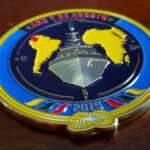
This coin was made for a deployment that involved several navies working together, and it does the obvious thing: it carries the flag of every nation that took part. That is one of the most colorful coins we have produced, and it is also one of the most technically demanding, for reasons that are worth setting out.
Putting Several National Flags on One Coin
Flags look simple. On a coin they are not, and the difficulties compound with every flag you add.
Flags have exact colors. A national flag is specified, and people from that country notice when the shade is wrong in a way they would never notice on an invented design. Enamel colors are matched from a standard range, so the right approach is to specify the reference for each flag rather than describe the color in words.
Every flag adds to the color count. Each distinct color on a soft enamel coin is a separate fill, and the cost and complexity rise with the number. Six flags can easily mean a dozen colors once you account for the fact that reds, blues and greens differ between countries and cannot be shared.
Flags have internal detail that does not survive reduction. Stars, crests, central emblems and stripe counts are the first casualties. Some flags reduce beautifully because they are bands of color. Others carry an emblem that becomes a blob at coin size.
And they are rectangles, which a circle resists. A row of flags sits awkwardly on a round face. Arranging them around the circumference works better, and a common solution is to render them as pennants or ribbons rather than strict rectangles so they can follow the curve.
What makes it worth the trouble is that nothing else communicates a coalition as directly. A list of country names requires reading; a ring of flags is understood at a glance, in any language, by everyone who was there. For flags around a cutout ring, see our Afghanistan NATO Army Challenge Coin. For the processes involved, see enamel and finish options.
A Sculpted Ship on the Front
The front carries a sculpted front view of the vessel, and the viewing angle is the interesting decision.
Ships are almost always shown in profile, because that is the recognizable view and the one that fits a horizontal space. A head-on view is unusual and harder, since a ship seen from the front is mostly superstructure and has far less to identify it.
What a front view gives you in exchange is depth. A bow-on vessel has real foreshortening, with the hull receding and the superstructure stacking upward, and that suits sculpted relief in a way a flat profile does not. A profile tends to read as a silhouette even when it is sculpted. A head-on view reads as an object.
The trade-off is recognizability, which is why this works for a crew who know their own ship and would work less well for a general audience. For a coin going to the people who sailed on it, that is the right trade. See also a ship anniversary challenge coin and a ship decommissioning coin.
Coins for Joint and Coalition Operations
Deployments that put several nations’ units under one task force are a natural fit for a coin, and the reasons are specific.
The group is temporary. A coalition exists for one operation and then dissolves. There is no standing organization to carry the memory, which is exactly the gap a coin fills.
Exchanging coins is already the custom. Across most navies and armies, handing a coin to a counterpart from another service or another country is established practice. A coalition deployment produces dozens of those moments.
And the quantity is right. A ship’s company or a task force element sits comfortably above a 50 piece minimum without approaching a service-wide order.
One planning note. If a coin is going to be handed to personnel from other nations, settle early which language the inscription will be in, or whether it will carry two. A coin that reads only in the issuing nation’s language is perfectly normal, but it is a decision worth making rather than defaulting into.
About the Ship and the Operation
The ARC 7 de Agosto is a Colombian-built offshore patrol vessel of the Colombian Navy. Construction began in August 2013 at Cotecmar in Cartagena, and the design is based on the Fassmer OPV-80 class, modified to meet Colombian Navy requirements.
In 2015 the ship joined the Colombia Against Piracy campaign, reaching the Gulf of Aden on 8 August 2015 and operating in close collaboration with Operation Atalanta and the EU Naval Force. It escorted and protected World Food Programme vessels and other vulnerable shipping along the Somali coast, and worked to deter and disrupt piracy in the region.
The coin was ordered to commemorate that deployment, which is why the partner nations’ flags are on it.
Order a Coalition or Deployment Coin
Professional artwork is free with unlimited revisions, and nothing goes into production until you approve a digital proof. The challenge coin minimum is 50 pieces, standard production runs about 45 to 50 days after final artwork approval, rush production is available on many projects, and shipping within the continental United States is included. Embleholics is veteran-owned, SDVOSB and registered in SAM.gov.
Two things to settle at the artwork stage. If flags are involved, send the color references for each one rather than describing the shades, and expect the color count to drive the quote. And decide which flags go on the coin before artwork begins, because adding a nation later means reworking the whole arrangement rather than slotting one more in. Request a free quote to begin.
Frequently Asked Questions
What is a multinational challenge coin?
It is a coin made for an operation involving units from more than one country, usually carrying the flags or insignia of every participating nation. Coalition task forces are temporary, so a coin is often the only lasting record of who served together.
Can several national flags go on one coin?
Yes, and a ring around the circumference works better than a row, since rectangles sit awkwardly on a round face. Rendering the flags as pennants or ribbons lets them follow the curve while staying recognizable.
Do multiple flags make a coin more expensive?
Yes. Each distinct color is a separate enamel fill, and flags rarely share shades because national reds, blues and greens differ. Six flags can easily mean a dozen colors, and the color count is a main driver of the quote.
How do you get flag colors right on a coin?
Specify the color reference for each flag rather than describing the shade in words. Enamel colors are matched from a standard range, and people from a given country notice an incorrect shade in a way they never would on an invented design.
Do all flags reduce well to coin size?
No. Flags made of bands of color reduce beautifully. Flags carrying a central emblem, a crest or fine stars lose that detail first, so those elements usually need simplifying or the flag needs to be rendered slightly larger than its neighbors.
Can a ship be shown head-on rather than in profile?
Yes, and it suits sculpted relief better. A bow-on view has real foreshortening and reads as a three dimensional object, where a profile tends to read as a silhouette. The trade-off is that a head-on ship is harder to identify.
Why do coalition deployments order coins?
Because the group is temporary and there is no standing organization to carry the memory. Exchanging coins with counterparts from other services and nations is already established practice, and a joint deployment produces many such moments.
What language should a coalition coin use?
Either the issuing nation’s language or two languages, but decide deliberately rather than by default. A coin handed to personnel from several countries is worth thinking about in that respect before artwork begins.
More Navy Projects