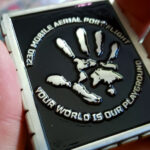
This coin carries a handprint. Not an emblem, not an aircraft, not a badge. For a unit whose work is moving cargo onto and off aircraft, that turns out to be a better subject than any of the obvious ones, and it is worth explaining why.
A Mark Left by a Person
Aerial port work has a particular problem when it comes to a coin. The work is physical, demanding and entirely temporary: pallets are built, loaded, flown, unloaded and gone. Nothing stays. There is no structure at the end of it and no equipment that belongs to the unit, because the aircraft belong to somebody else.
A handprint solves that in one image. It is the mark of a person who was there, pressed into the thing they handled, which is as close as this kind of work comes to leaving a trace. It says the job is done by hand without naming anybody, and it needs no caption in any language.
Three reasons it works as a coin subject:
It is a strong, simple shape. A hand outline with five separated digits is instantly readable at any size, which is exactly what struck metal handles well. No anatomy to misjudge, no proportions to get wrong.
It suits relief. A print is a shallow impression by nature, so modelling it as a raised or recessed form in metal is doing the same thing the object itself does. The subject and the medium agree.
It is universal. Anyone who has lifted anything recognizes it, including people with no connection to the Air Force at all.
The general rule for any unit whose work leaves nothing behind: look for the trace rather than the product. A handprint, a boot print, a worn tool, a set of marks. We make the same argument about using the trace instead of the animal on our training squadron paw print page.
One Bold Face, One Detailed Face
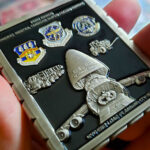
The reverse goes the other way entirely: engraved aircraft and vehicles with painted insignia, and a good deal of text.
That contrast is the structure of the coin, and it is a sound one. One face carries an idea, the other carries the inventory. The handprint is read in a second. The reverse is looked at properly, afterwards, in the hand.
Two rules make that division work:
Do not balance them by weight. Normally a sparse face and a dense face look like a finished side and an unfinished one. The exception is when the sparse face is deliberately a single bold statement, because then its emptiness reads as confidence. A handprint with nothing around it is a decision. A handprint with a motto, a border and three insignia squeezed in beside it is a crowded face.
Keep the detail recessed. Engraved aircraft and vehicles hold their edges at small sizes where raised versions round over, which is why the detailed face here is cut rather than built up.
Drawing Aircraft and Vehicles Small
The reverse puts several vehicles on one face, which is among the harder things to ask of a coin.
Each one has to be identifiable by silhouette alone. At that size nobody is reading panel lines or markings. A cargo aircraft is recognized by its high wing, its tail and its proportions; a loader by its boxy mass and its lift. Those are the forms to keep, and everything else comes off.
Give them a baseline. Vehicles with nothing under them float. A ground line, a shadow or a strip of lettering gives them somewhere to stand.
Limit the count. Three vehicles can be told apart on a coin face. Six cannot, and the result reads as texture rather than as equipment.
And put the paint only on the insignia. Which this coin does. Painted insignia against engraved line work means the color identifies the units and the engraving carries the machinery, rather than color being spread across everything and distinguishing nothing.
About Air Mobility Command
Air Mobility Command is a major command of the US Air Force, established on 1 June 1992 from the inactivated Military Airlift Command and elements of Strategic Air Command, with its headquarters at Scott Air Force Base, Illinois. Its work is airlift, air refueling and aeromedical evacuation, with a global support network behind it.
This coin was made for the 1230 Mobile Aerial Port Flight, a unit within that mission. An aerial port flight handles the cargo and passenger side of air mobility: building and breaking down pallets, loading and unloading aircraft, and running the terminal end of an airlift.
That distinction is worth keeping in mind for a coin. A command’s coin is built on its emblem and its reach, which we cover on our headquarters coin page. A flight’s coin is built on the work, which is what this one does.
See more Air Force challenge coins, our Air Force coin designs page, and an aeromedical squadron coin.
Order a Flight or Squadron Coin
Free professional artwork, unlimited revisions and a digital proof before anything is produced. Free shipping within the continental US, a 50-coin minimum, and most orders complete 45 to 50 days after artwork approval, with rush production available. Embleholics is veteran-owned, an SDVOSB, and registered in SAM.gov.
If your unit’s work has nothing obvious to show, tell us what the job actually involves rather than what it is called. The subject is usually in there somewhere, and it is rarely the emblem.
Finished Coin (Front)
Finished Coin (Back)
Frequently Asked Questions
What is an Air Mobility Command challenge coin?
An Air Mobility Command challenge coin is made for a unit within the Air Force’s air mobility mission, covering airlift, air refueling and aeromedical evacuation. Most are ordered at squadron or flight level rather than by the command itself.
What do you put on a coin when the work leaves nothing behind?
Use the trace rather than the product. A handprint, a boot print, a worn tool or a set of marks says the work was done by people without needing a structure, a product or a piece of equipment to show.
Why does a handprint work as a coin subject?
Because it is a strong simple shape with five separated digits, readable at any size, and because a print is a shallow impression by nature, so rendering it in relief does the same thing the object itself does.
Can one coin have a plain face and a busy face?
Yes, when the plain face is deliberately a single bold statement. Emptiness then reads as confidence rather than as an unfinished side, which is why the bold face should not have a motto and extra insignia added beside it.
How many vehicles can go on one coin face?
About three. Each has to be identifiable by silhouette alone at that size, so the recognizable forms are kept and everything else comes off, and beyond three the face reads as texture rather than equipment.
Should aircraft be engraved or raised?
Engraved, at small sizes. A cut line holds its edge where a raised edge rounds over in the strike, which is why detailed machinery survives better recessed than built up in relief.
Where should paint go on a detailed face?
On the insignia only. Painted insignia against engraved line work means the color identifies the units while the engraving carries the machinery, where color spread across everything distinguishes nothing.
When was Air Mobility Command established?
On 1 June 1992, from the inactivated Military Airlift Command and elements of Strategic Air Command. Its headquarters is at Scott Air Force Base, Illinois.
What does an aerial port flight do?
An aerial port flight handles the cargo and passenger side of air mobility: building and breaking down pallets, loading and unloading aircraft, and running the terminal end of an airlift operation.
More Air Force Projects