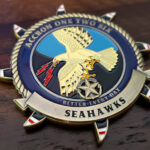
This coin is round, with propellers projecting from the rim. That sounds like a decoration added to a standard coin, and it is something cleverer than that: on a squadron that flies an aircraft defined by a huge rotating disc, the round body of the coin is doing double duty.
The Coin Body Is the Rotodome
The E-2 Hawkeye is one of the most recognizable aircraft in naval aviation for one reason: the radar dome mounted above the fuselage. It is a disc, and it is the first thing anyone notices.
A challenge coin is also a disc. Put propellers on the edge of one and the coin stops being a coin with an aircraft on it and becomes a reference to the aircraft itself. The identification happens in the silhouette, before any artwork, lettering or color is read.
That is an unusually good fit between a format and a subject, and it is worth saying why it is rare. Most aircraft are long, thin and asymmetric, which is the worst possible shape for a round coin. A squadron flying almost anything else would have had to either fight the circle or abandon it. This squadron’s aircraft happens to have a circle at the heart of it.
The general lesson for any unit: look at what your equipment or your emblem is actually shaped like before deciding on a format. Occasionally the obvious shape and the right shape are the same thing, and when they are, the coin almost designs itself.
Adding to a Round Coin Instead of Cutting a Shape
The propellers project past the body, which makes this a round coin with additions rather than a fully custom shape. That is a distinction worth understanding, and we cover it in more detail on our ship’s helm coin page, where the same approach is used with handles.
The short version: adding to a round coin keeps the rim, keeps the artwork contained and protected, and still changes the silhouette. Cutting a fully custom outline gives you a stronger shape and loses the rim entirely.
For this coin the additions bring three constraints:
Blades are the outermost metal. Anything projecting takes every knock, so the blades are kept thick enough and short enough to survive it. Scale-accurate propeller blades would be too thin.
Spacing has to be even. Irregular gaps between elements around a circle are immediately visible, in a way that irregular spacing on a straight edge is not. Blades around a rim have to be set rather than placed.
They add size without adding design area. The whole piece is larger but the usable face is still the diameter of the disc, so the artwork has to work inside the original circle.
Designing Between the Blades
Projections around a rim create a secondary problem nobody anticipates: they interrupt the edge, which is where lettering normally goes.
On an ordinary round coin a squadron name runs around the rim in a continuous band. Here the band is broken wherever a blade meets the body. Two ways to handle it:
Break the text deliberately. Set short pieces of lettering in the arcs between blades, so the interruptions become part of the layout rather than accidents. This works when the text is short and the blades are evenly spaced.
Or move the text inboard. Bring the lettering off the rim and set it inside the field, leaving the outer ring to the blades alone. This works better for longer text and keeps the rim reading as a mechanical element rather than a typographic one.
Either is correct. What does not work is running continuous text around a rim that is interrupted, because the eye follows the line and then loses it.
A Name Written the Way It Is Spoken
The squadron appears here as ACCRON ONE TWO SIX rather than as VAW-126, and that is not a stylistic flourish. It is how the designation is said aloud.
ACCRON is Airborne Command and Control Squadron. ONE TWO SIX is the number, spoken as individual digits the way any unit designation is over a radio or on a flight line.
Whether to use the spoken form or the written one on a coin is a real choice:
The spoken form is how the squadron refers to itself, which means it reads as authentic to anyone in that community and as slightly puzzling to everyone else.
The written designation is universally legible, and it is shorter, which matters when rim space is already broken up by propeller blades.
Plenty of unit coins carry both, with the spoken form as the headline and the designation small. If a coin will only ever be held by members of the squadron, the spoken form alone is fine. If it will be given to visitors, families or other units, something on it should be readable by someone who has never heard it said.
About VAW-126
Airborne Command and Control Squadron 126, the Seahawks, is a US Navy squadron established in 1969 and based at Norfolk, Virginia. It flies the E-2D Hawkeye.
This coin was made for the squadron’s commanding officer, which puts it in the small, presented-by-hand category rather than the issued-to-everyone one. A commanding officer’s coin belongs to the post rather than to the individual, so a design built on the squadron and its aircraft rather than on one officer’s tour is the one that survives a change of command.
See more Navy challenge coins and other Navy projects.
Order a Squadron Coin
Free professional artwork, unlimited revisions and a digital proof before anything is produced. Free shipping within the continental US, a 50-coin minimum, and most orders complete 45 to 50 days after artwork approval, with rush production available. Embleholics is veteran-owned, an SDVOSB, and registered in SAM.gov.
If you want elements projecting from the rim, tell us at the quote stage. It changes the overall size of the piece without changing the usable face, so it affects both the tooling and the layout from the start.
Frequently Asked Questions
What is a Hawkeye squadron challenge coin?
A Hawkeye squadron challenge coin is made for a Navy airborne command and control squadron flying the E-2 Hawkeye. Designs in that community often use the aircraft’s radar disc, since a round coin and a rotodome are the same shape.
What does ACCRON stand for?
ACCRON stands for Airborne Command and Control Squadron. ACCRON ONE TWO SIX is the spoken form of VAW-126, written the way the designation is said aloud rather than in its abbreviated form.
Can propellers or other elements be added to the edge of a coin?
Yes. Elements projecting from the rim change the silhouette while keeping the round body and its protective rim, which is different from cutting the coin to a fully custom outline. The projections have to be thick and short enough to survive handling.
Do projecting elements make a coin less durable?
They are the first parts to take wear, because they are the outermost metal on the piece. The answer is thickness and length rather than avoidance: scale-accurate thin blades would fail, while broader shortened ones last.
Does adding elements to the rim give you more design space?
No. The piece gets physically larger but the usable face is still the diameter of the disc, so the artwork has to work inside the original circle. That is worth knowing before the layout is drawn.
Where does lettering go if the rim is interrupted?
Either in short pieces set into the arcs between the projections, or moved inboard into the field so the outer ring belongs to the projections alone. What does not work is continuous text around a broken rim, because the eye follows the line and then loses it.
Should a coin use a unit’s spoken name or its written designation?
The spoken form reads as authentic within the community and puzzling outside it, while the written designation is universally legible and shorter. Many coins carry the spoken form as the headline with the designation set small, which covers both.
What aircraft does VAW-126 fly?
VAW-126 flies the E-2D Hawkeye. The squadron, nicknamed the Seahawks, was established in 1969 and is based at Norfolk, Virginia.
What is a commanding officer’s coin?
A commanding officer’s coin is presented by hand to people the commander selects rather than issued to the whole unit, so the run is small. It belongs to the post rather than the person, which is why the design should survive a change of command.
More Navy Projects