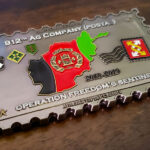
This coin is a rectangle cut to look like a postage stamp, with perforation holes along each side. The front carries an etched map of Afghanistan and the reverse carries engraved insignias and lettering. It was made for the 912th Adjutant General Company to commemorate Operation Freedom’s Sentinel, 2018 to 2019.
Cutting a Perforated Edge
The scalloped edge of a postage stamp is the detail that makes this coin work, and it is worth understanding what it involves.
The perforations are cut into the outline, not punched through. A real stamp is perforated so it can be torn. A coin cannot be, so what is produced is a scalloped edge: a series of semicircular bites taken out of the border, which reads as perforation at a glance without compromising the piece.
Scale is the whole decision. Make the scallops too small and they soften into a wavy line that looks like a manufacturing defect. Too large and they look like decorative scalloping rather than perforation. The right size is the one that reads as holes from arm’s length, which usually means fewer and larger than a real stamp has.
Each notch is a stress point. A concave cut concentrates force during the strike, and a border made entirely of concave cuts has a great many of them. The standard precaution is to keep the border metal between notches wide enough to stay rigid, which is another argument against making the scallops too fine.
And a rectangle is already a custom shape. Before the perforations, this coin is not round, which means the usual points apply: no standard packaging fits, and the corners want slight rounding so they do not catch.
See custom shaped challenge coins for more on outlines.
Why a Stamp
The shape is not decoration. An Adjutant General company handles personnel and human resources work, and mail has been part of that tradition for as long as armies have deployed.
That is what makes this a good example of a shape doing real work. A unit coin can be round with an insignia on it, and most are. But a shape that refers to what the unit actually does gives the coin a second layer: you understand something about the unit from the outline before you read a word.
The lesson generalizes. If your unit has an object that is genuinely associated with its work, a tool, a piece of equipment, a document, that object is usually a better outline than a generic shape. The test is whether somebody in the unit would smile at it. If the shape needs explaining, it is not working.
A Map on the Front
The front carries an etched map of Afghanistan, which is the standard way deployment coins mark where a unit went, and there are a few things that make the difference between a good one and a vague one.
Outlines beat terrain. A country’s border is a distinctive shape and reproduces cleanly. Attempting mountains, rivers or relief at coin size produces texture rather than geography.
Etching suits a map better than relief. A map is a drawing, and recessed line work reads as a drawing. A sculpted landmass tends to look like a blob with an edge.
Orientation should be conventional. A country rotated to fit the available space stops being recognizable. If the shape does not sit well on the face, it is better to scale it than to turn it.
And one marked location is enough. A single point for the base or the area of operations reads clearly. Several points with labels becomes a diagram, and a coin is not a diagram.
See also a deployment challenge coin and an end of deployment coin.
About the Unit
The 912th Adjutant General Company is a United States Army Reserve unit based in Miami. The Adjutant General branch provides personnel support across the Army: manning the force, human resources services, band operations, and recruiting and retention.
The 912th builds, generates and sustains forces for combatant commanders and supports leaders and soldiers at every level. Like much of the AG community, it has absorbed reductions in personnel authorizations over several rounds, while demand on the function has continued.
That context is part of why a coin matters to a unit like this. Personnel work is rarely the subject of a commemoration, and a deployment coin is a way of marking that the work was done and where it was done. See more Army Reserve challenge coins.
Order a Shaped Deployment Coin
Professional artwork is free with unlimited revisions, and nothing goes into production until you approve a digital proof. The challenge coin minimum is 50 pieces, standard production runs about 45 to 50 days after final artwork approval, rush production is available on many projects, and shipping within the continental United States is included. Embleholics is veteran-owned, SDVOSB and registered in SAM.gov.
Two things to plan for. Start the artwork before you redeploy rather than after, because a unit scatters quickly once it is home and getting approvals becomes much harder. And if you want an unusual edge treatment like perforation, raise it at the quote stage, since it affects the die rather than being something that can be added later. Request a free quote to begin.
Frequently Asked Questions
What is a stamp shaped challenge coin?
It is a rectangular coin cut with a scalloped border so it reads as a perforated postage stamp. Units whose work involves mail, personnel records or correspondence use the shape because it says something about the unit before any detail is read.
Can a coin have perforated edges like a stamp?
Yes, as a scalloped outline rather than actual holes. A series of semicircular bites taken out of the border reads as perforation at a glance without weakening the piece the way real perforations would.
How big should the perforations be?
Larger and fewer than a real stamp has. Scallops that are too fine soften into a wavy line that looks like a defect, while the right size reads as holes from arm’s length. Larger notches also leave more rigid metal between them.
Is a scalloped edge fragile?
Not if it is designed properly. Each notch is a concave cut that concentrates stress during the strike, so the border metal between notches has to stay wide enough to remain rigid. That is another reason not to make the scallops too small.
Can a challenge coin be rectangular?
Yes. A rectangle is a straightforward custom shape, and the corners are usually given a slight radius so they do not catch in a pocket. As with any non-round outline, standard capsules and display racks will not fit it.
Can a map go on a challenge coin?
Yes, and country outlines work well because a border is a distinctive shape that reproduces cleanly. Etching suits a map better than sculpted relief, since a map is a drawing and recessed line work reads as one.
Should a map show terrain or cities?
Neither, generally. Mountains and rivers become texture at coin size, and multiple labeled points turn the face into a diagram. An outline with one marked location for the base or area of operations reads clearly.
When should a unit order a deployment coin?
Before redeployment rather than after. A unit scatters quickly once it is home, which makes approvals and headcounts much harder to get. Allow about 45 to 50 days of production after final artwork approval, plus the artwork and proof rounds.
More Army Projects