A closeout coin marks the end of a named operation rather than the middle of one. There will be no second order, because the organization that would place it is standing down, and the people who served under the name are already moving on to other assignments.
What Is an End of Deployment Coin?
Most deployment coins are made while a unit is still forward. They are working objects: handed out during the rotation, given to attached personnel, traded with neighboring units, used by a first sergeant to recognize somebody at two in the morning.
A closeout coin is the other kind. It is made at the end, looking backward, and it is final. The deployment is over, the task force is dissolving, or the named operation itself has concluded and will not be used again.
That retrospective position changes what belongs on it and who it goes to, and it introduces one constraint that governs everything else.
Why a Closing Operation Is Harder to Order For
There is no reorder. This is the whole of it. A unit coin that runs short can be reordered next quarter. When a named operation closes, within months there is no headquarters to place an order, no budget line to place it against, and no staff section that owns it. Whatever was produced is all that will ever exist.
The audience is larger than the unit that orders it. A deployment coin goes to the people currently on the ground. A closeout coin is wanted by everyone who served under that name, across every rotation, going back years. Most of them are no longer anywhere near the organization placing the order, and a lot of them will hear about the coin after it is gone.
The design has to cover a span rather than a moment. A single rotation’s coin can carry that rotation’s dates and that unit’s patch. A closeout coin covers the whole operation, which means the name, the years, and the identity that stayed constant while the units rotated through it.
And the timing works against you. People start leaving before the paperwork closes. The person who would organize the coin is often already on orders somewhere else, and the budget is being closed out at the same time. This is the practical trap: the right moment to order is earlier than it feels, and the window shuts faster than anyone expects.
So start it before the closure is complete, order generously, and put the order in the hands of someone who will still be reachable when it ships. It is the same constraint that makes a ship’s final coin difficult, set out on our page about ordering when there will be no second run.
What Goes on an Operation Coin?
The operation’s name, in full, with the abbreviation if it is the form people actually use.
The span of years rather than a single date, because a named operation is a period and not an event.
The unit, task force or headquarters that the coin belongs to.
The theater or region in general terms, where it is appropriate to name one at all.
A motto, if the organization has one.
What should stay off matters just as much here, and it is worth being direct about it. Specific locations, installations, routes, dates beyond the operation’s span, unit strengths and equipment do not belong on a coin. A coin is a public object with a very long life. It gets photographed, traded, resold, inherited and posted online, and anything struck into it is published permanently with no way to recall it. If a detail would not be read aloud to somebody outside the organization, it does not go on the metal.
Beveled Edges and Hybrid Shapes
This coin is neither round nor square. It is a hybrid of the two, with the corners of a square softened into curves, and the edges beveled.
The bevel is doing two jobs. Corners are where a square coin fails first. A sharp right-angled corner is the highest point on the piece, it takes every knock, and the plating wears through there before anywhere else. Rounding and beveling the corner removes the vulnerable point without losing the square-ish character that made the shape appealing.
The second job is how the piece sits in the hand. A beveled edge catches light along its whole length and reads as a thicker, more substantial object than a flat-edged coin of the same depth. On a piece that also has to work as a bottle opener, where mass and rigidity are functional requirements rather than aesthetic ones, that impression happens to be accurate.
The result has the proportions and the feel of a dog tag, which for a deployment piece is a deliberate association rather than a coincidence. How an opener is built into an outline is covered on our page about how bottle opener coins are built, and the tag format specifically on our page about dog tag shaped openers.
About This Operation Freedom’s Sentinel Coin
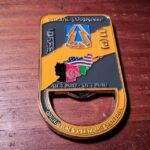
Operation Freedom’s Sentinel was a United States military operation in Afghanistan that concluded in August 2021. This piece was produced for a signal element serving under the operation.
The design is a beveled square-and-circle hybrid, close to a dog tag in the hand, with embossed insignia and lettering on both faces, and it works as a bottle opener.
What is worth noticing is how little the piece relies on color or decoration. The shape and the relief carry it, which is the right instinct for an object that was going to be handed over as an operation wound down. A closeout piece is going into a drawer or a shadow box rather than into daily circulation, and designs that lean on bright enamel tend to look dated faster than designs that lean on form.
For another named operation, see our Operation Inherent Resolve coin.
Can We Use Operation and Unit Insignia on a Coin?
Most units can, but the authorization has to come from the organization, not from us. Unit insignia, task force devices, command emblems and service marks are controlled by the organizations that own them, and the rules differ between branches and between commands.
There is one point specific to a closing operation, and it is a practical one rather than a legal one. Do this early. The person who knows where the approved artwork lives, and the office that would authorize its use, are both disappearing on the same timeline as the operation. A permission that takes a week while the headquarters is staffed can take months once it is not.
Clear the artwork through your own chain of command before you order, and send us artwork your organization is authorized to supply. We produce from what the customer provides and we do not grant permission on anyone’s behalf.
Design a Coin for Your Deployment
Tell us the date the organization stands down, not the date you would like the coins. Standard production runs about 45 to 50 days after final artwork approval, and artwork development happens before that window opens, so a closeout piece needs starting while there is still somebody to approve a proof.
Professional artwork is free with unlimited revisions, and nothing goes into production until you approve a digital proof. Minimum quantities for bottle openers differ from those for challenge coins, so ask when you request a quote. Rush production is available on many projects, and shipping within the continental United States is included. Embleholics is veteran-owned, SDVOSB and registered in SAM.gov. See more custom Army challenge coins or request a free quote.
Frequently Asked Questions
What is an end of deployment challenge coin?
An end of deployment coin is made as a deployment or named operation concludes rather than while it is ongoing. It looks backward across the whole period rather than one rotation, and it is final, because the organization that would place a second order is standing down.
Can a coin be made after an operation has ended?
Yes, and many are, but it is harder than ordering during the operation. The headquarters, the budget and the people who hold the artwork all disappear on the same timeline, so the practical advice is to start before the closure completes rather than after.
Who orders a coin for a closing operation?
Usually a staff section, a task force headquarters or a senior enlisted leader within the organization, often personally. Because the organization is dissolving, the order should sit with someone who will still be reachable when the coins ship rather than with a position that is about to be deleted.
How many should be ordered?
More than the current headcount suggests. Everyone who served under the operation’s name across every rotation is a potential recipient, and many will only hear about the coin after it is produced. Since there is no second run, the usual caution about over-ordering does not apply.
What goes on an operation challenge coin?
The operation’s name, the span of years, the unit or task force, and a motto. Specific locations, installations, routes, unit strengths and equipment should be left off, because a coin is a permanent public object that circulates well beyond the organization that made it.
Why are coin corners beveled?
Beveling removes the sharp corner on a square or angular coin, which is the highest point on the piece and the first place plating wears through. It also catches light along the edge, which makes the piece read as thicker and more substantial than a flat-edged coin of the same depth.
Can an operation coin also be a bottle opener?
Yes. The opener has to be designed into the outline from the start rather than cut into a finished coin, because it needs a lip, a fulcrum and enough solid metal around both. Angular and tag-shaped outlines accommodate one particularly well.
What is the minimum order for bottle openers?
Minimum quantities for bottle openers differ from the 50-coin minimum that applies to challenge coins, so ask when you request a quote. Larger quantities lower the cost per piece, which matters on a closeout order where there will be no second run.
More Army Projects