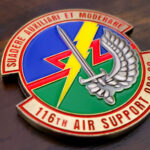
One face carries the squadron insignia and the other the unit’s mascot, the Husky. The concept is simple and the execution is where the work went, with the base material, embossed lines, lettering and painted colors all working together. This 116th ASOS challenge coin was made for the 116th Air Support Operations Squadron of the Washington National Guard.
Insignia on One Face, Mascot on the Other
Splitting the official emblem and the unofficial one across the two faces is a reliable structure, and it says something a single face cannot.
They come from different places. A squadron insignia is approved, specified and permanent. A mascot is chosen by the people in the unit and exists nowhere official. One is the organization and the other is the group.
Both are real identity. A coin carrying only the official emblem describes the unit as the Air Force sees it. Adding the mascot describes it as its members see it, which is usually closer to how they will remember the assignment.
They want different treatments. Insignia are precisely defined and have to be reproduced faithfully. A mascot is the unit’s own, which means there is latitude to render it with more character.
And it gives the reverse a reason to exist. The commonest weak reverse is a motto in a circle. A mascot face is content rather than filler.
See also an Air Force challenge coin.
The 116th Air Support Operations Squadron
The 116th ASOS is a Washington National Guard unit assigned to the 194th Wing. It trains and equips Joint Terminal Attack Controllers and other air support elements that work with United States Army units.
A JTAC is the person on the ground who directs aircraft onto targets, which is a qualification with a demanding certification pipeline and continuing currency requirements. It is also a job performed away from any airfield, embedded with Army formations, which means an Air Force unit whose people spend their working lives in an Army environment.
That situation is the strongest argument for a unit coin here. Someone wearing an Air Force uniform attached to an Army unit has an unusually sharp need for an object that says which organization they belong to, and a coin is the portable form of that.
The Husky mascot places it in Washington state unmistakably, which is the other half of the identity for a Guard unit whose members are drawn from one state.
See also a USAF Special Warfare coin, which carries this squadron’s insignia on its front.
Using a Local Mascot
A mascot drawn from a regional association is a strong choice for a Guard unit and it comes with one thing to check.
The advantage is specificity. A Husky says Washington to anyone from the state and to most people outside it, which gives a unit coin a geographic anchor that a generic predator would not. For a National Guard formation recruited from one state, that local connection is a genuine part of the identity rather than decoration.
The thing to check is whether the version being drawn is an original rendering or resembles an existing institutional mark. A husky as an animal is free to use; a particular stylized husky that belongs to an organization is that organization’s property. The safe route is an original drawing of the animal rather than anything adapted from an existing logo, and that is a conversation worth having at artwork stage rather than after a proof exists.
The design point is that an animal head renders better than a full body at coin scale. Detail concentrates in the face, and a head fills the available area with the part people actually recognize.
Simple Concept, Careful Execution
The page says the concept is simple and every element was executed perfectly, and that distinction is the useful one.
Embossed lines do the structural work. Raised line work separates areas without needing a color boundary for every division, which keeps the palette manageable on a design that has two detailed subjects.
Lettering has to be sized for the strike. Unit designations are long, and squeezing a full squadron name onto a face produces text below the legible threshold. Abbreviating deliberately beats shrinking.
The base material shows through. On a coin where paint covers some areas and not others, the exposed metal is part of the palette rather than an absence of one, so the plating choice matters as much as the paint colors.
And perfect execution is the deliverable. A simple design has no complexity to distract from a soft edge or a misaligned fill, which is why simple concepts put more pressure on manufacture rather than less.
See plating and enamel options.
Order a Squadron or Air Guard Coin
Professional artwork is free with unlimited revisions, and nothing goes into production until you approve a digital proof. The challenge coin minimum is 50 pieces, standard production runs about 45 to 50 days after final artwork approval, rush production is available on many projects, and shipping within the continental United States is included. Embleholics is veteran-owned, SDVOSB and registered in SAM.gov.
Two suggestions. If a mascot resembles an existing institutional symbol, commission an original rendering of the animal rather than adapting an existing mark, and raise it at artwork stage rather than at the proof. And abbreviate long unit designations deliberately instead of shrinking the type, because text below the legible threshold fills in during the strike. Request a free quote to begin.
Frequently Asked Questions
Should a coin carry the official insignia or the mascot?
Both, one per face. The insignia describes the unit as the service sees it and the mascot describes it as its members do, which is usually closer to how they remember the assignment.
How do the two differ in treatment?
An insignia is specified and has to be reproduced faithfully. A mascot belongs to the unit itself, so there is latitude to render it with more character.
What does an Air Support Operations Squadron do?
It trains and equips Joint Terminal Attack Controllers and other air support elements that deploy with Army units, directing aircraft onto targets from the ground.
Why does an embedded unit need a coin?
Because its people work in another service’s environment. Someone in an Air Force uniform attached to an Army formation has a sharp need for a portable marker of which organization they belong to.
Can a unit use a local animal as a mascot on a coin?
Yes, and it anchors a Guard unit to its state. Check that the rendering is original rather than resembling an existing institutional mark, since the animal is free but a particular stylized version may not be.
Head or full body for an animal on a coin?
The head. Detail concentrates in the face, so a head fills the available area with the part people recognize, where a full body shrinks everything that matters.
What do embossed lines do on a coin?
They separate areas without needing a color boundary at every division, which keeps the palette manageable on a design carrying two detailed subjects.
Does a simple design make production easier?
No, harder in one sense. There is no complexity to distract from a soft edge or a misaligned fill, so a simple concept puts more pressure on the execution rather than less.
More Military Projects