Marine squadron designations are not names, they are descriptions, and they change when the aircraft changes. That matters on a coin more than anywhere else, because the coin outlasts the airframe and a mismatched designation is the kind of error the squadron notices immediately.
The Designation Changes With the Aircraft
A Marine squadron’s designation encodes what it does and what it flies. VMF is a fighter squadron. VMF(N) is a night fighter squadron. VMA is attack. VMA(AW) is all-weather attack. VMFA is fighter attack, and VMFA(AW) is all-weather fighter attack.
So a squadron that has changed aircraft has changed its name, sometimes several times, and the designation on a coin belongs to one of those periods rather than to the squadron as a whole.
This squadron is a good example. It was commissioned on 1 October 1943 at Marine Corps Air Station Cherry Point as a night fighter squadron, and it has been known by several designations since, including the attack designation it carried while flying the A-6 Intruder and the fighter attack designation it carried afterwards.
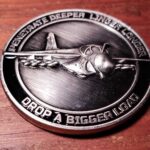
This coin shows the A-6, which ties it to the attack era rather than to the current one. That is entirely legitimate, and it is worth being clear about on the page: a coin showing a retired airframe is a heritage piece, and the designation that goes with it is the one the squadron held at the time.
The decision for any squadron commissioning a coin is the same. Pick the era and be consistent: current aircraft with current designation, or legacy aircraft with the designation that went with it. What does not work is the current designation beside an aircraft the squadron no longer flies, because the two contradict each other and anybody in the community can see it.
The nickname is the exception, and it is why nicknames are valuable on coins. The Hawks have been the Hawks through every designation and every airframe. A coin built on the nickname is correct in all of them.
An Aircraft That Lifts Off the Face
The reverse sculpts the A-6 so that it appears to be flying out of the coin, which is the most ambitious thing on this piece and worth explaining.
Most relief sits inside the plane of the coin: artwork raised above the field but still contained by the rim. Here the aircraft is modelled to break that plane, so the nose or wing reads as standing clear of the surface rather than lying on it.
What it gives you:
Real depth rather than suggested depth. An aircraft rendered flat reads as a picture of an aircraft. One that lifts off the field reads as an object, and the difference is immediate in the hand.
A shadow that moves. A high point catches light from a different angle than the field does, so the piece changes as it is turned, which flat relief does not.
What it costs:
Metal and thickness. High relief needs stock behind it, so a coin like this is struck heavier than a flat-relief piece of the same diameter.
Exposure. The highest point on the coin is also the first thing to touch any surface, so an element standing proud of the field takes the wear. On an aircraft that usually means the nose and the wingtips, and they are the parts to keep solid rather than fine.
Detail at the peak. The top of a high relief takes the most deformation in the strike, so the finest detail belongs on the lower planes. On an aircraft that means the panel lines and markings come off and the airframe is carried by its shape.
We cover the general cost of depth on our high relief page.
Drawing the A-6
The Intruder is a more forgiving aircraft to put on a coin than most, and the reason is its shape.
It is a relatively short, deep-bodied aircraft with a blunt nose and a side-by-side cockpit, which gives it a recognizable bulk rather than a long thin profile. Long slim aircraft are the hard ones, because they either shrink to a line or run off the edges of a round face.
Two notes. A three-quarter view works better than a side profile, because it uses the width of the coin and shows the wing planform at the same time. And the refueling probe, the antennas and the stores pylons are all below the width struck metal can hold, so they come off deliberately rather than being attempted and lost.
Insignia on One Face, Aircraft on the Other
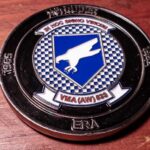
The front carries the squadron insignia embossed and painted. The reverse carries the sculpted aircraft.
That division is the right one and it is the standard that works: one face reproduced, one face modelled.
An insignia is fixed artwork. It gets a full clean face, painted in its own colors, reproduced rather than reinterpreted. Setting the aircraft alongside it would mean shrinking the insignia to make room.
An aircraft is an object. It wants depth, bare metal and nothing competing with it, which is exactly what an otherwise empty face provides.
Putting both on one face is the single most common way a squadron coin ends up crowded.
See more Marine Corps challenge coins and a Marine battalion coin.
Order a Squadron Coin
Free professional artwork, unlimited revisions and a digital proof before anything is produced. Free shipping within the continental US, a 50-coin minimum, and most orders complete 45 to 50 days after artwork approval, with rush production available. Embleholics is veteran-owned, an SDVOSB, and registered in SAM.gov.
Tell us which era the coin is for. If it shows a legacy airframe we will use the designation that went with it, and if it shows the current one we will use the current designation. Mixing them is the error that cannot be fixed after the strike.
Finished Coin (Front)
Finished Coin (Back)
Frequently Asked Questions
What is a Marine squadron challenge coin?
A Marine squadron challenge coin carries the squadron’s insignia, nickname or aircraft. Because Marine designations change with the mission and the airframe, the coin’s designation and its aircraft have to belong to the same period.
What do Marine squadron designations mean?
They describe the mission and the aircraft. VMF is fighter, VMF(N) night fighter, VMA attack, VMA(AW) all-weather attack, VMFA fighter attack and VMFA(AW) all-weather fighter attack. A squadron’s designation changes when its aircraft and role do.
Can a coin show an aircraft the squadron no longer flies?
Yes, as a heritage piece, and plenty do. The rule is to pair it with the designation the squadron held at the time rather than the current one, because the current designation beside a retired airframe contradicts itself.
Why are squadron nicknames useful on coins?
Because a nickname survives every designation and every aircraft change, where a designation does not. A coin built on the nickname is correct in every era of the squadron’s history.
Can an aircraft be sculpted so it stands off the coin?
Yes. Modelling an element to break the plane of the field gives real depth rather than suggested depth, and the piece changes as it is turned. It needs more metal behind it and the high points take the wear.
Does high relief make a coin thicker?
Usually. Depth needs stock behind it, so a high relief coin is struck heavier than a flat-relief piece of the same diameter, and that weight is part of what the effect costs.
Where does detail go on a high relief design?
On the lower planes. The top of a high relief takes the most deformation in the strike, so the finest detail belongs away from the peak and the raised element is carried by its shape instead.
Should the insignia and the aircraft share a face?
No. An insignia is fixed artwork that needs a clean face and its own colors, while an aircraft wants depth and an empty field. Putting both on one side is the usual cause of a crowded squadron coin.
How should an aircraft be angled on a coin?
A three-quarter view generally beats a side profile, because it uses the width of the face and shows the wing planform at once. Probes, antennas and pylons fall below the width metal can hold and come off deliberately.
More Marine Corps Projects